Aluminium extrusion & press capacity
Three numbers decide whether your section can be extruded at all
Before price, before lead time, before finish — a section either fits inside a press envelope or it does not. Most of the profiles that fail downstream were never checked against these three limits at the quotation stage. Here is the envelope we run, the geometry that will not fill, and the tolerance question your drawing probably leaves unanswered.
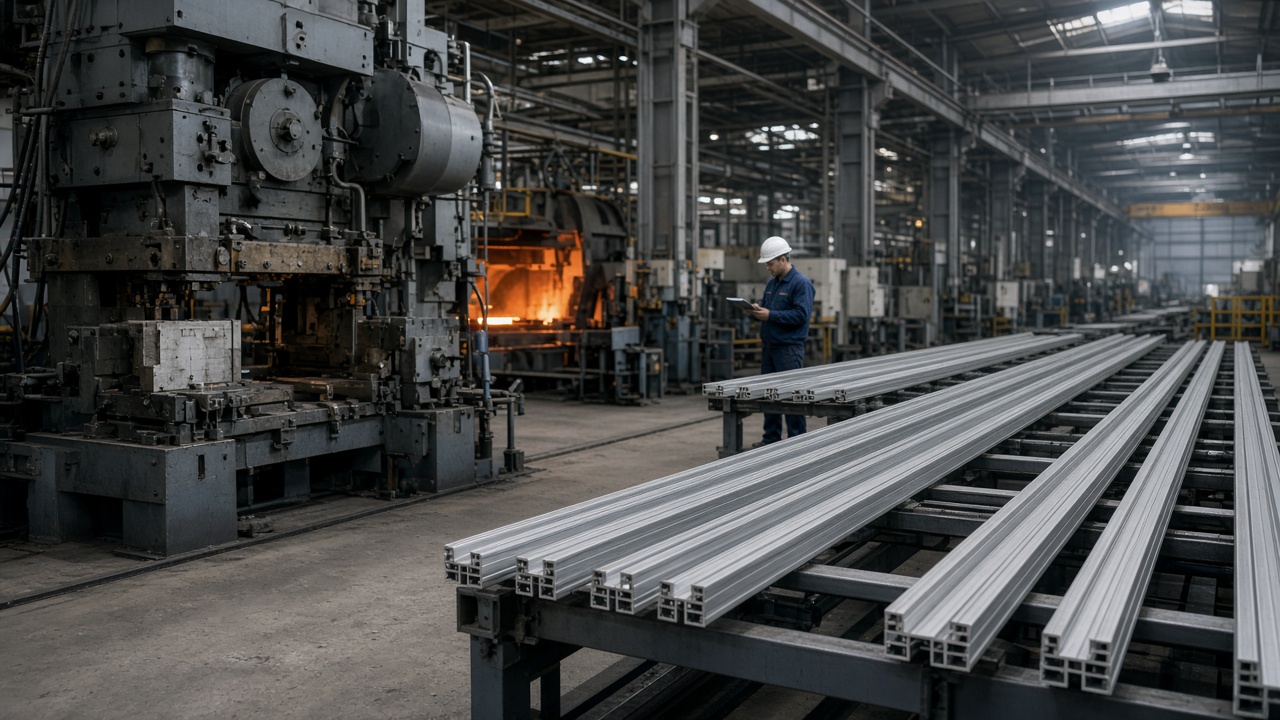
Envelope
Which press your section lands on, and what that does to your price
The press is chosen by the circumscribing circle, not by weight. A light section with a large circle still occupies a large press, and the press sets the hourly rate the profile has to carry — which is why two sections of identical weight can price very differently.
| Press | Max circle | Billet Ø | Typical weight | What it is normally used for |
|---|---|---|---|---|
| 800 t | 120 mm | 102 / 127 mm | 0.1–3 kg/m | Capping profiles, trims, small T-slot sections, heat-sink fins |
| 1,000 t | 160 mm | 127 / 152 mm | 0.3–5 kg/m | Window and door sections, 20–40 series structural profiles |
| 1,250 t | 220 mm | 152 mm | 0.5–8 kg/m | 45–60 series profiles, machine frames, heavier hollows |
| 1,500 t | 320 mm | 152 / 178 mm | 1.0–12 kg/m | Curtain wall mullions, large architectural sections, structural beams |
A section can be moved up a press class to gain run speed or straightness, but not down. If your circle sits near a boundary, expect the quote to reflect the larger press — that is a real cost, not padding.
Geometry
The three limits that stop a section filling
These are the checks we run before quoting. You can run the same three against your own drawing in about ten minutes, and it will tell you whether a supplier who quoted happily actually looked at the section.
Circumscribing circle
circle = smallest Ø enclosing the sectionThe circle has to fit the press table above. A section at 330 mm is not a negotiation — it needs a larger press than we run, and no amount of die work changes that. This is the first thing we check, and the reason we decline some façade sections.
Wall thickness, and how uneven it is
min wall: 0.8 mm (6063) / 1.2 mm (6061)Below the minimum the metal simply will not fill at production speed — it can be made slowly, which means it cannot be made at the quoted price. Uneven walls matter as much: a 1.2 mm face opposite a 3.0 mm face pulls metal to the thick side and costs straightness.
If your design needs a thin decorative wall, put it on a face that can carry a visible die line, not on a sealing face.
Tongue and fin ratio
tongue width : height — keep above 1 : 3A narrow tongue runs hot, erodes at the tip and limits die life before it limits geometry. Heat sinks are the classic case: fin gap below 2.5 mm and fin height above 40 mm is where a design stops being economic even when it is technically possible.
This is the most common reason a cheap quote becomes an expensive part.
Tolerance
You are buying a tolerance class, not a number
“±0.1 mm” on a drawing is not a specification unless it names the class and the dimension it applies to. Two standards cover extruded aluminium profiles, and they are not interchangeable — one is general purpose, the other is precision, and the difference is roughly a full grade on wall and twist.
| Characteristic | EN 755-9 — general | EN 12020-2 — precision | Where buyers get caught |
|---|---|---|---|
| Wall thickness | Tolerance band set by the nominal dimension | Tighter band, dimension-dependent | Quoting a nominal wall without a band, then rejecting a batch that was inside the general class all along |
| Twist | Allowed over the full length | Reduced allowance | Measuring twist on a 300 mm cut instead of the full 6 m — twist accumulates and passes a short check |
| Straightness | General allowance | Tighter allowance | Discovering it at assembly, when two lengths will not meet at a corner |
| Angularity | General allowance | Tighter allowance | Stacking four profiles into a frame and finding the diagonal out by more than the joint can absorb |
The numeric values depend on the dimension class of your section, so we send the applicable table with the quotation rather than a single figure that would be wrong for half the profiles it is applied to. If your drawing says precision, say so — we will quote EN 12020-2 and price the slower run honestly.
Honest limits
Sections we will tell you we cannot run
A capability page that claims everything is not usable for a sourcing decision. These six are the ones that come up most often, and the answer is the same on the first call as it would be at first article.
Send the section and we will run the three checks in writing
Circle, minimum wall and tongue ratio — against the press we would actually use, with the tolerance class named.
