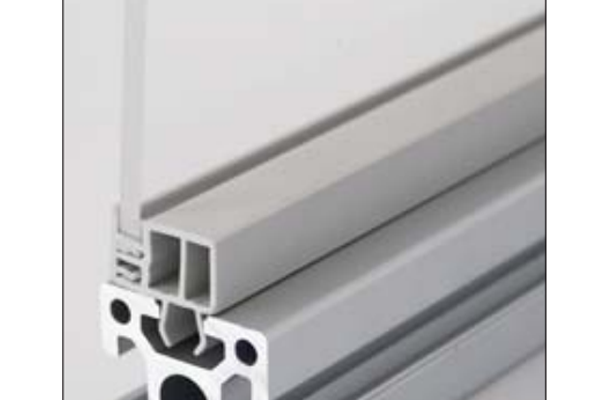
Panel installation elements are the strips, gaskets and retainers that hold a sheet panel in an aluminium profile frame. There are three methods: a slot cover strip that traps the panel against the profile face, a sealing gasket that grips the panel edge, and a mechanical retainer that clamps the panel positively. Which one is correct depends on whether the panel is decorative, protective or load-bearing.
Below: how each method works, why a drilled panel usually fails, and how much clearance a panel actually needs.
The three retention methods
| Method | How it works | Retention | Use it for |
|---|
| Slot cover strip | A cover presses into the slot and overlaps the panel edge, trapping it against the profile face | Friction and compression | Light panels, infill, decorative faces |
| Sealing gasket | A flexible strip in the slot grips the panel edge and seals against it | Friction and compression, with a seal | Glazing, dust and splash protection, panels that must be weather-resistant |
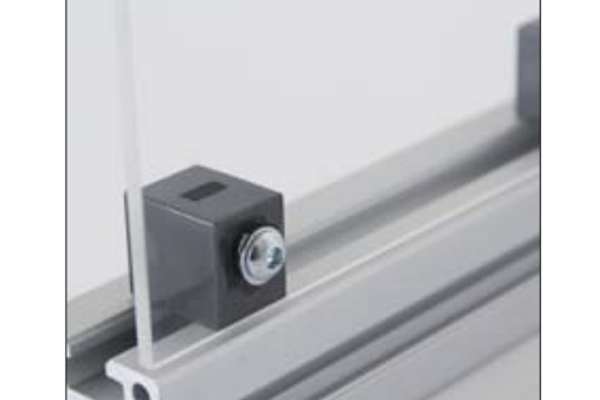
| Mechanical retainer | A cleat, clamp or bracket bolts into the slot and clamps the panel positively | Positive mechanical fixing | Guarding, safety screens, panels that carry pressure or impact |
The distinction that matters is between the first two and the third. A strip or a gasket retains a panel by friction, which is perfectly adequate for an infill panel and not adequate for a guard that a person could lean on. Where a panel has a safety function, it needs a mechanical retainer, and the retainer needs to be sized for the load the standard requires.
Why drilling a panel usually fails
Drilling a polycarbonate or acrylic panel to bolt it to a frame looks like the obvious approach and is the most common cause of cracked guards. Three separate problems combine.
- Stress concentration. A drilled hole in a brittle sheet concentrates stress at the hole edge. A crack starts there and runs.
- Thermal movement. Plastics expand and contract far more than aluminium. A panel bolted at fixed points with no allowance will be loaded as the temperature changes, and it will crack at a fixing.
- Over-constraint. A panel fixed at many points cannot move at all, so every movement of the frame — and frames do move — is fed into the panel as stress.
Retaining a panel in a slot avoids all three: the panel is not penetrated, it can move within the groove, and the frame can flex without loading the sheet.
Practical point: where a panel must be drilled — for a lock, a vent or a handle — use oversized or slotted holes and a soft washer under each fixing. The oversize gives the panel somewhere to move, and the washer spreads the load away from the hole edge.
How much clearance a panel needs
Panels are almost always cut too tight. A panel that fits the opening exactly at 20°C will be under compression at 40°C and will bow or crack.
| Panel material | Movement relative to aluminium | Practical allowance |
|---|
| Polycarbonate | High expansion; the usual guarding material | Leave clearance at every edge and do not trap the panel at more than two opposite sides |
| Acrylic (PMMA) | High expansion and more brittle than polycarbonate | Generous clearance, no sharp-cornered holes, and avoid clamping |
| Aluminium sheet | Matches the frame almost exactly | Minimal clearance, but still leave a nominal gap so the panel does not become structural |
| Steel sheet | Lower expansion than aluminium | Small clearance; watch for a steel panel stiffening the frame unintentionally |
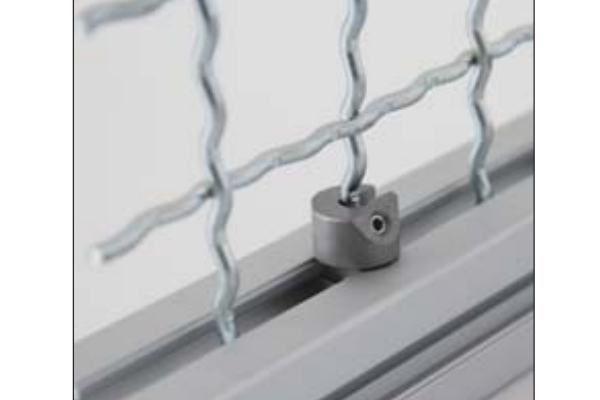
| Mesh and perforated sheet | Depends on material; usually thin and flexible | Retain positively at several points; mesh carries little load but moves a lot |
The working rule is to leave clearance rather than to aim for a tight fit, and to retain the panel on two opposite sides where possible rather than on all four. A panel trapped on all four sides with no clearance has nowhere to go.
Panels that carry a safety function
Where a panel forms part of machine guarding, the design basis changes from appearance to a defined load case, and the frame has to satisfy whatever standard applies to the installation. Three requirements come up repeatedly.
- Positive retention. The panel must be held by a mechanical retainer, not by friction. A gasket alone is not a guard fixing.
- Fixings that cannot be removed without a tool. A guard that a person can push out by hand is not a guard. Retainers should need a tool to release.
- Defined apertures. Mesh and perforated panels are specified by aperture size as well as by strength, because the aperture decides what can reach through. Confirm the aperture requirement before ordering the panel.
General machine guarding design is discussed in more detail in our guide to aluminium profile machine guard design.
Where panels are installed
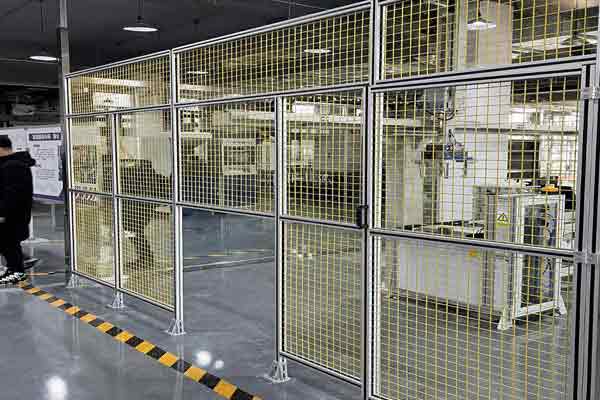
Machine guardingPolycarbonate or mesh panels retained in the frame with mechanical retainers, sized for the applicable load case.
Enclosure claddingSheet panels covering the frame on non-access sides, usually with a slot cover strip.
Cleanroom wallsPanels with sealed gaskets, where cleanability rather than strength is the design driver.
Workbench infillPanels closing the back and sides of a bench, retained by covers rather than fixings.
Signage and fasciaDecorative panels held by a cover strip so they can be changed without tools.
Ordering panel elements
Four items decide which element you need: the profile series and slot width, the panel material and thickness, whether the panel has a safety function, and whether the joint has to be sealed. Give us those and we will identify the correct strip, gasket or retainer. Where a panel is being supplied with the frame, send the panel dimensions as well and we will cut the panel to the clearance rather than to the opening — that is where most panel failures originate. Standard elements are quoted within one working day. Related ranges: profile accessories, door and window elements, hinges, strut profiles and 30 series aluminium profiles.