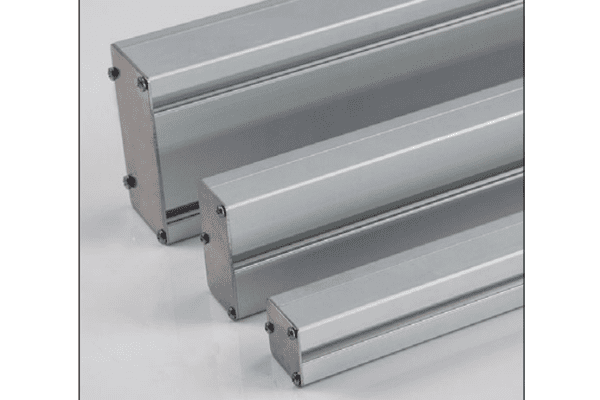
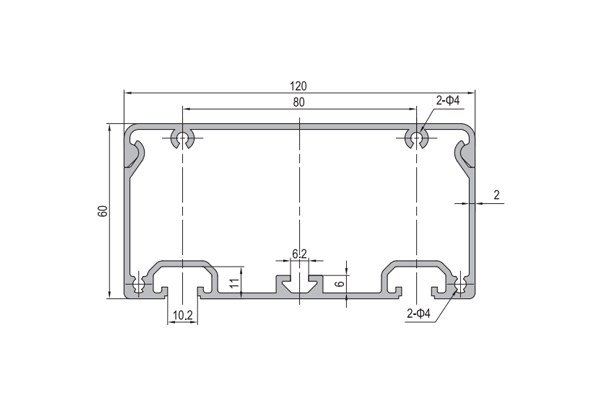
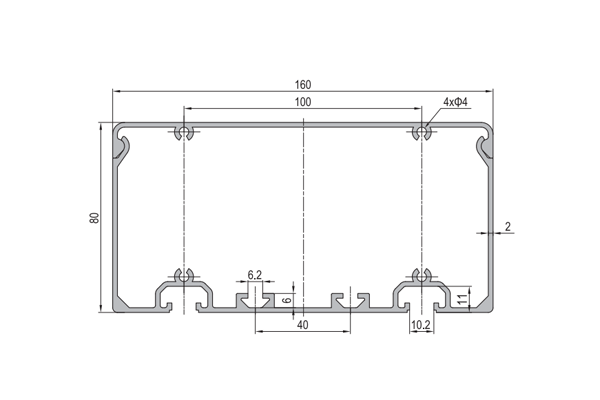
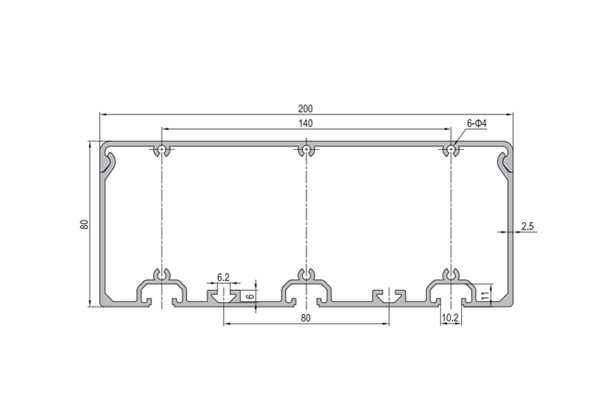
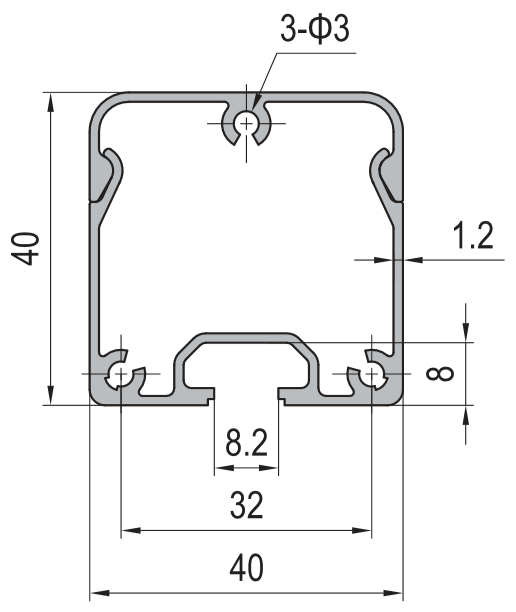
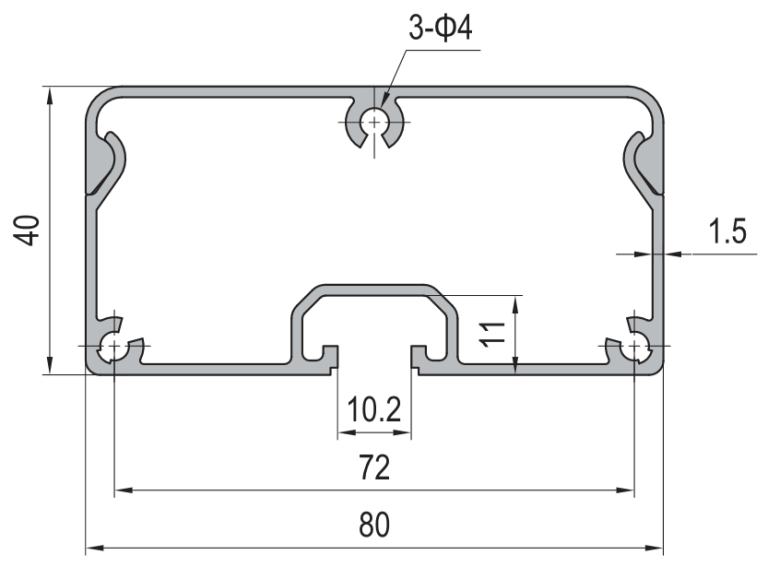
Aluminium conduit profiles are extrusions with a channel or chamber formed into the section so that cable, pneumatic hose or sensor leads can be routed inside the frame. They fall into two families: closed conduit, where a cover encloses the run, and open conduit, where the cable sits in a channel and is retained by a lip or a clip. The choice depends on whether the installation has to be protected or simply tidy.
Below: how conduit sections are configured, what the cover retention actually does, and the routing rules that matter more than the profile itself.
Why route cable inside the frame
There are three practical reasons, and only the first is about appearance.
- Protection. Cable inside a closed profile cannot be snagged by a moving part, stepped on, or hit by a pallet. On a machine that is loaded and unloaded by hand, this is the single largest cause of intermittent faults.
- Serviceability. A defined route with removable covers can be opened, inspected and re-terminated. Cable that is zip-tied to a frame member cannot.
- Compliance. Where a build falls under machinery or electrical standards, the route of the cable and its separation from moving parts and from heat are inspection items. A conduit section makes them easy to demonstrate.
Closed conduit and open conduit
| Type | Configuration | Best for | Watch out for |
|---|
| Closed conduit | A chamber with a removable or sliding cover | Power and control cable that must be protected, wash-down areas, visible frames | Fill ratio and bend radius are set by the chamber, not by the cable |
| Open channel | A U-shaped channel with retaining lips | Sensor leads, air hose, short runs that need to be re-routed often | Nothing protects the cable; only use where the route is out of harm's way |
| Two-chamber conduit | A single profile with a divided chamber | Keeping power and signal cable physically separated in one member | The divider reduces usable width in each chamber |
| Conduit with a cover groove | A chamber plus a groove that takes a panel or a cover | Frames where the same member routes cable and carries a panel | Check that the panel and the cover do not need the same groove |
How the cover is retained
The cover retention is what decides whether a conduit profile is convenient or infuriating, and there are three common arrangements.
Snap-on cover
The cover presses into a groove and is held by a lip. Fast to fit and to remove, and the usual choice where the run will be opened during commissioning. The limitation is that repeated removal wears the lip, and a snap-on cover is not a seal.
Slide-in cover
The cover slides into the profile from the end. It is secure and cannot be knocked off, but it cannot be removed without access to the end of the run, so it has to be planned before assembly. Slide-in covers are the better choice on a frame that will be shipped and installed elsewhere.
Screw-fixed cover
A separate flat strip screwed or bolted onto the profile. Strong and fully removable, but it adds fasteners and assembly time. Used mainly where the cover also has to carry a load or be tamper-resistant.
Practical point: decide the cover arrangement before the frame is assembled, not after. A slide-in cover fitted to a run that is already closed at both ends has to be cut out and replaced, and on an anodised frame the repair is visible.
Do not use an open T-slot as a cable route
It is tempting to run cable down the slot of a standard slotted profile, and it is a mistake for four reasons. The slot is a fastening feature, so the cable competes with T-nuts for the same space. The edges of an extruded slot are sharp enough to abrade insulation over time. A cable in an open slot collects chips and swarf. And a cable running in a structural slot cannot be inspected or replaced without dismantling the frame.
Where a frame needs to route cable, use a conduit profile as one of the members, or fix a separate conduit section onto the frame. Both approaches keep the slot free for its intended purpose.
Routing rules that matter more than the profile
- Bend radius. Every cable has a minimum bend radius, usually expressed as a multiple of its diameter. A conduit run has to accommodate it at each corner, which often means a larger corner radius than the frame layout suggests.
- Fill ratio. Leave room to pull additional cable later. A run that is full on installation cannot be modified, and the whole conduit has to be opened to add one sensor lead.
- Separation. Keep mains power and low-level signal cable physically apart, ideally in separate chambers. Where they must cross, cross at right angles rather than running parallel.
- Drainage and ingress. On an outdoor or wash-down installation, detail the run so water cannot stand in the chamber, and use a cover arrangement that suits the environment rather than a snap-on cover.
- Access points. Plan where the run can be opened for inspection. A continuous conduit with no access is a maintenance problem waiting to happen.
Conduit profile or separate trunking?
A conduit profile makes sense when the frame and the route are the same object — that is, when a member of the structure can also be the cable route. It saves a separate fixing operation, keeps the build compact and looks deliberate. Separate trunking or conduit is the better answer when the route does not follow the structure, when the cable count changes frequently, or when the installation has to meet a specific containment standard that the profile does not satisfy. On a large build the usual arrangement is a hybrid: conduit members in the frame for the local runs, and standard containment for the long runs between cabinets.
Machining and finishing
Conduit profiles are normally cut to length and may need entry holes, grommet holes, cover access cut-outs and mounting holes. Cutting the cover to match a mitred run is a manual operation, so it is worth keeping the run simple. Where the conduit has to pass through a panel, plan a grommet or a gland rather than leaving a bare cut edge against the cable.
Satin anodised is the usual finish, in clear, black or bronze, because the profile is often visible. Mill finish is used where the conduit will be enclosed or painted. Film grades are described under anodised aluminium profiles.
Specifying a conduit profile
Tell us the cable and hose count with their outside diameters, whether the run has to be closed or open, how the cover should be retained, and the lengths and cut list. If the conduit is part of the frame, send the frame layout as well so the conduit member can be dimensioned with the rest. Standard conduit sections are quoted within one working day; a bespoke chamber section is a new die, described under aluminium sections. Related ranges: aluminium sections, profile accessories, strut profiles and CNC machining.