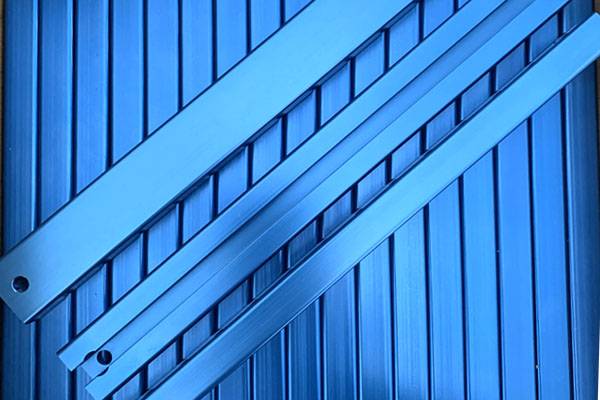
Anodised aluminium profiles are extruded sections whose surface has been converted electrolytically into a controlled layer of aluminium oxide. Because the layer grows out of the metal rather than sitting on top of it, it cannot peel, blister or chip — the usual failure modes of paint and powder. Industrial framing normally specifies a 10–15 µm film on 6063-T6; architectural and exterior work usually specifies 20–25 µm.
Below: what the process does to a section, how to choose a film grade, and the four points that should appear on every anodised-profile drawing.
What anodising actually does to an extrusion
The profile is first etched and desmutted so the surface is chemically uniform. It then passes through a sulphuric-acid bath where a direct current drives oxygen into the aluminium surface and builds a dense, vertically structured oxide layer. Finally it is sealed — normally in hot deionised water — which closes the pores and locks the layer in place.
Two consequences matter commercially. First, the finish is part of the substrate, so there is no interface for moisture to creep along; anodised sections survive repeated cleaning with detergents and solvents that would dull a coated surface. Second, the process is dimensional. Anodising adds roughly half the film thickness to every exposed face, so a 20 µm film grows a section by about 10 µm per side. On a 30 mm profile that is irrelevant. On a precision locating face it is not, and it has to be allowed for at the drawing stage.
Film thickness grades and where each one belongs
Film thickness is the single specification that decides how the profile will look and how long it will last. It is quoted in micrometres and verified on the finished part with an eddy-current gauge.
| Grade | Film | Typical use | What to watch |
|---|
| Decorative | 5–10 µm | Enclosures, display frames, indoor guarding | Dulls quickly where the frame is wiped with abrasive cleaners |
| Industrial | 10–15 µm | Machine frames, workbenches, conveyor guarding, jigs | The default for industrial aluminium framing |
| Architectural | 20–25 µm | Exterior frames, façades, balustrades, canopies | Specify where weathering and colour stability are contractual |
| Hard anodised | 25–50 µm | Wear surfaces, sliding rails, guide tracks | Type III; noticeably darker, and the dimension change must be planned |
Why 6063-T6 is the usual substrate
Anodising quality depends on the alloy as much as on the bath. Extrusion alloys are chosen for how they flow through a die, and the elements that help formability can leave the anodised surface streaky or grey. 6063 in the T6 temper is the workhorse for anodised architectural and industrial profiles because it takes a clean, bright film with little variation between batches. Where more strength is needed, 6005A and 6061 anodise acceptably but with a slightly darker and less uniform tone. High copper content in the charge shows up as a grey cast in the finished film — one reason a supplier should be able to say where the billet came from.
Satin, bright and brushed: the surface character
Film thickness is not the same thing as surface character. The etch step before anodising sets how much light the finished face scatters, and this is what the buyer actually sees.
Satin / mattProduced by a heavier chemical etch. Low glare, hides handling marks and fingerprints, and is the standard for machine frames and furniture-grade framing.
Bright / naturalA light etch over a polished extrusion. Reflective and premium-looking, but marks show quickly and it is rarely right for a frame that gets handled.
BrushedDirectional grain applied before anodising. Useful on decorative panels and fascia, less so on structural sections where the grain fights the shape.
Anodised or powder coated?
Both finishes are legitimate; they fail in different ways. This is the comparison we use when a customer is deciding.
| Property | Anodised | Powder coated |
|---|
| How it protects | Oxide layer grown from the metal; integral | Polymer film bonded over a chemical pre-treatment |
| Failure mode | Gradual dulling, or surface pitting in aggressive environments | Edge chipping, peeling from a scratch, UV fade |
| Colour range | Limited — clear, champagne, bronze, black, plus dyes | Effectively unlimited, including RAL and textures |
| Repeat colour match | Batch-sensitive; keep a physical sample | Very repeatable from a RAL reference |
| Dimensional effect | About half the film thickness per face | 60–120 µm per face, more on complex sections |
| Best for | Frames that are cleaned, handled, or used near solvents and abrasives | Exterior colour matching, thick coverage, cost-driven volume |
In practice most customers run satin anodised for the frame and powder coat only the parts that must match a corporate colour. That combination is normal and easy to produce in a single order.
Specifying an anodised profile
Four items on the drawing prevent almost every dispute.
- Alloy and temper — write 6063-T6 unless the section demands otherwise. "Aluminium" on its own is not a specification.
- Film thickness in micrometres — a word like "architectural" is interpreted differently by different suppliers; 20 µm is not.
- Surface character — satin, bright or brushed, plus a physical shade sample where the colour must match an existing installation.
- Critical dimensions before or after finishing — say explicitly whether the tolerance applies to the mill-finish or the anodised part.
Practical point: anodising cannot hide a bad extrusion. Surface streaks, die lines and weld marks that would be buried under 80 µm of powder become more visible after etching. If a visible face matters, agree the acceptance standard on a first-article sample rather than on the drawing alone.
Inspection and documentation
Dimensional inspection is normally carried out against EN 755-9 or the equivalent national standard, with the drawing taking precedence wherever it is tighter. Film thickness is checked with an eddy-current gauge across a defined number of readings per profile. Where a project requires it we can supply a dimensional report, a film-thickness record and a mill certificate for the billet, and can arrange salt-spray or colour-difference testing through an external laboratory.
Where anodised profiles earn their cost
Workbenches and assembly stationsESD-sensitive lines usually need an anodised, earthed frame rather than a coated one. Bench-top hardware is covered under profile accessories.
Cleanroom and wash-down equipmentAn integral oxide layer tolerates the detergents used in hygiene areas far better than a polymer film.
Exterior and architectural framingSpecified at 20 µm or more, anodised sections hold their appearance for decades without recoating.
How to get a quotation
Send a drawing or a section sample with the alloy, the film thickness and the shade, and state the quantity for the first order plus the expected annual volume. If there is no drawing yet, a sketch showing the overall envelope, the slot width and the critical faces is enough for us to quote and to tell you whether a standard section already exists. Orders against existing dies are normally quoted within one working day.
Anodised profiles sit alongside strut profiles, aluminium sections and connecting elements. Where a part needs holes, threads or machined faces after extrusion, see CNC machining.