Fastening elements are the nuts, bolts and washers that hold profile hardware in the T-slot. The main types are standard T-nuts, hammer nuts, flange nuts and the matching bolts and washers. They are series-specific: a T-nut for an 8 mm slot will not seat in a 10 mm slot, and bolt length is set by the slot depth rather than by the thickness of the bracket.
Below: how to pick a T-nut, why hammer nuts exist, how to choose a bolt length, and the torque limit that decides how long a joint lasts.
The T-nut family
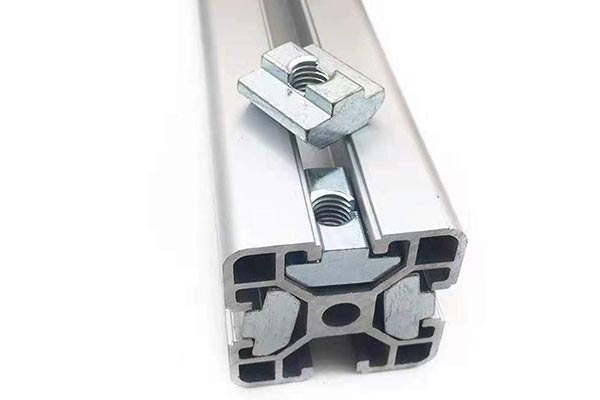
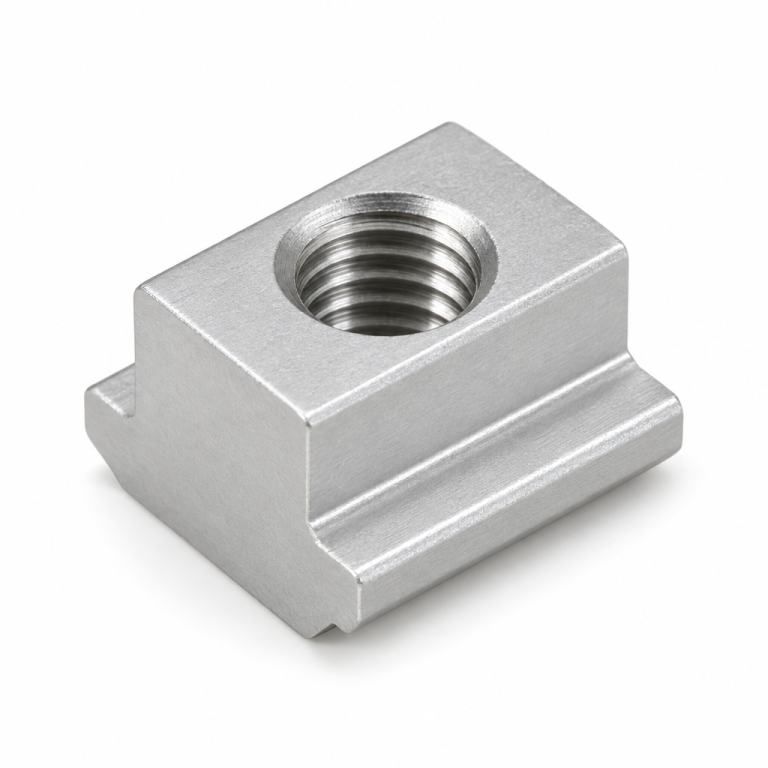
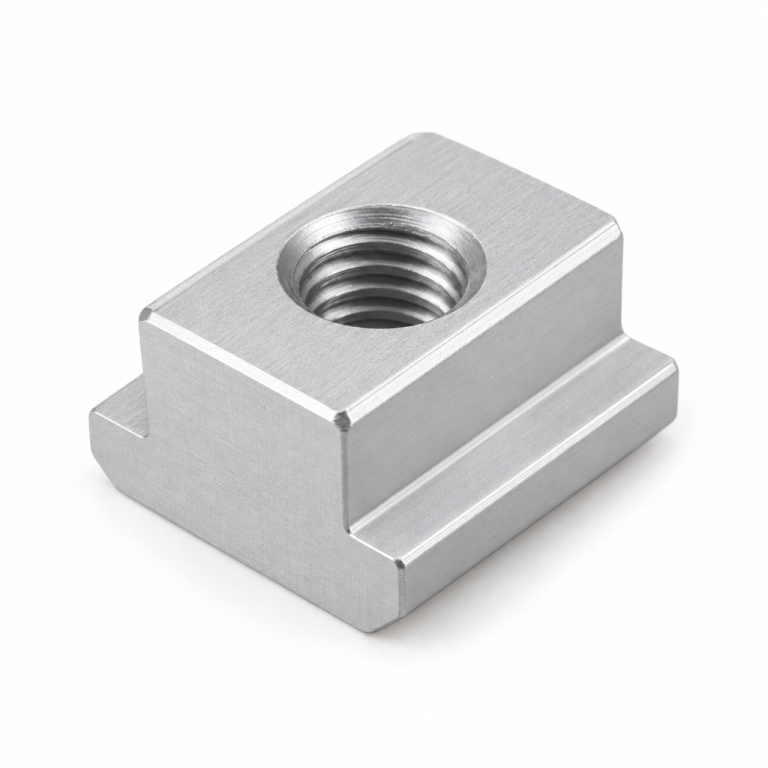
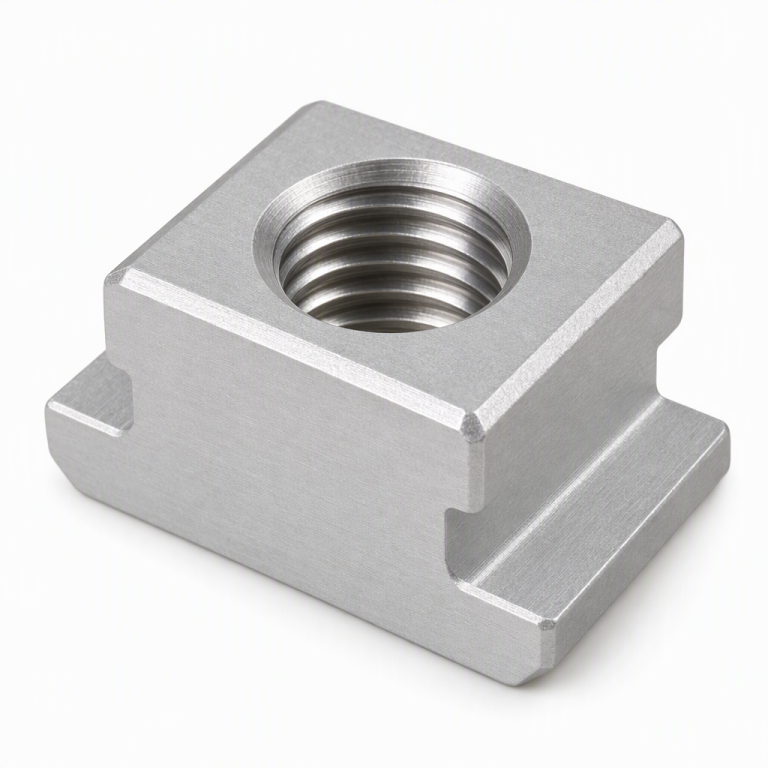
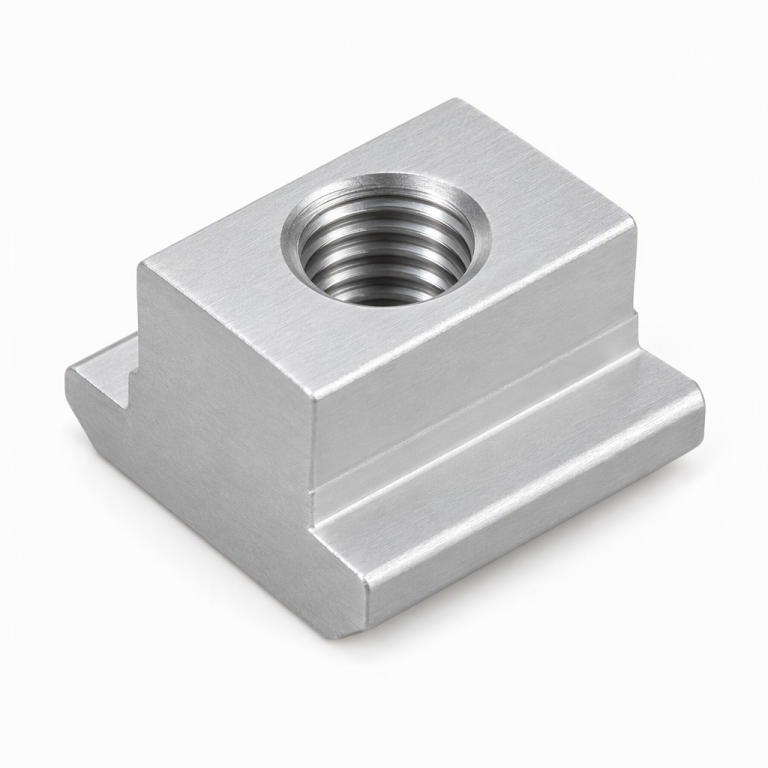
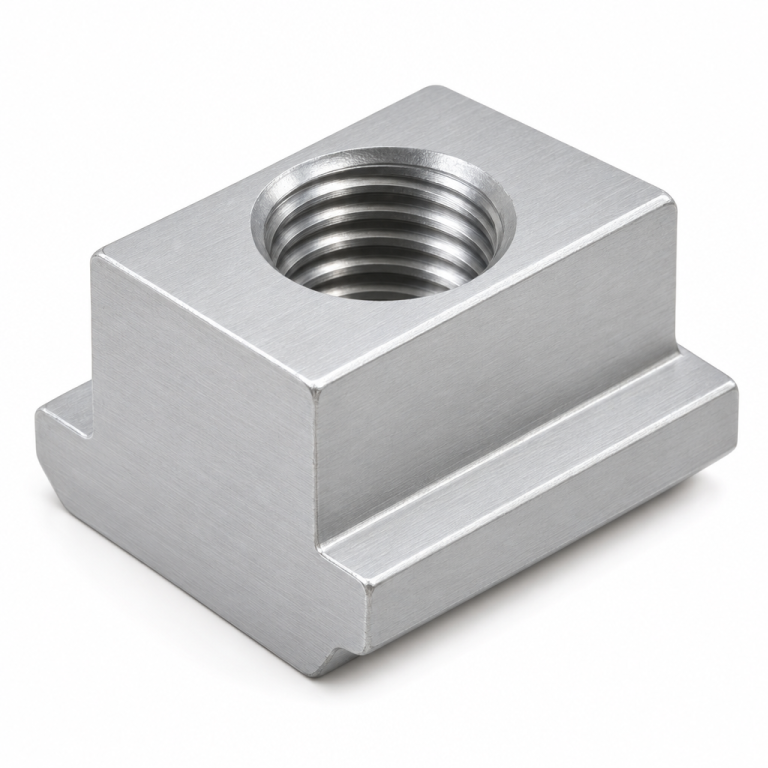
A T-nut is a rectangular nut that is inserted into the slot and rotates or slides into position so its thread lines up with a hole in the bracket. The variants exist because of how and when they are inserted.
| Type | How it is fitted | Use it when |
|---|
| Standard T-nut | Inserted into the slot and rotated 90° to lock | The usual choice where the slot is accessible |
| Hammer nut | Pushed into the slot from the side and slid to position | Pre-assembly: nuts can be loaded into a profile before the frame is built, which speeds assembly considerably |
| Flange nut | Rests on the outside face and picks up the slot | Where the fixing has to be adjustable along the slot after assembly |
| Spring-ball T-nut | Held in the slot by a spring ball so it cannot fall out | Vertical slots and overhead work, where a nut that drops out wastes time |
| Self-tapping screw | Cut directly into the profile core | Light fixings where no T-nut is needed, and where the wall is thick enough |
Why hammer nuts are worth the extra cost
A hammer nut is slightly more expensive than a standard T-nut and usually pays for itself on any frame of more than a few members. Because it slides in from the side rather than being rotated into position, the nuts can be loaded into each profile before assembly begins. That removes the most common cause of assembly re-work: discovering, after a frame is closed up, that a nut was left out and cannot now be inserted.
The second benefit is adjustability. A hammer nut can be slid along the slot after assembly, so a bracket can be repositioned without dismantling anything. Where a frame will be adjusted in service — a sensor rail, a guide, a stop — that is the decisive advantage.
Choosing a bolt length
Bolt length in a profile joint is not simply the bracket thickness plus a washer. It is set by the slot geometry, and getting it wrong produces one of two failures.
| Problem | Cause | Result |
|---|
| Bolt bottoms out | Too long for the slot depth | The joint feels tight but the bracket is not clamped; it moves under load |
| Too few threads engaged | Too short | The thread strips under load, often after the frame is in service |
| Correct length | Engages the full depth of the T-nut thread without touching the slot base | The joint reaches its rated preload |
The reliable approach is to use the bolt length the bracket maker specifies for that bracket and series, and to check the first joint on a sample before assembling the whole frame. Where a washer is added, the bolt length has to be increased by the washer thickness.
Practical point: a bolt that bottoms out is the most deceptive fault in profile framing, because the joint feels tight. If a corner will not hold its position and the bracket and profile are both correct, check the bolt length before assuming the design is wrong.
Torque and the slot lip
The slot lip is the weakest feature of an aluminium profile, and every fastener in the slot loads it. Torque is therefore limited by the profile rather than by the bolt, and the limit is lower than most people expect.
- Use a torque wrench on critical joints. Feel is not a reliable guide, particularly on small slots where the difference between correct and over-torqued is small.
- Over-torquing is permanent. A crushed slot lip does not spring back. The member has to be replaced, and the cost is the whole member rather than the fastener.
- Distribute the load instead of increasing the torque. Where a joint needs to be stronger, add a second fastener or a plate rather than tightening harder. Load spreading is the correct answer; more torque is not.
- Lock against vibration. Serrated washers, flange nuts with serrations and thread-locking compound all help. On a vibrating frame, a joint that is correct statically will still loosen.
Material and finish
| Material | Strength | Corrosion | Use it when |
|---|
| Zinc-plated steel | Standard | Indoor; plating can be damaged at edges | General indoor frames; the usual default |
| Stainless steel A2 | Slightly lower than steel | Good outdoor and wash-down performance | Food, pharmaceutical, outdoor and wet environments |
| Stainless steel A4 | Slightly lower than steel | Best; resists chlorides | Coastal, marine and chemical environments |
| Aluminium | Lower | Matches the frame; no dissimilar-metal issue | Light duty and where appearance matters |
One caution with stainless fasteners in aluminium: in a wet or salty environment, stainless and aluminium together can accelerate galvanic corrosion of the aluminium. Where that risk exists, use isolating washers or an aluminium-compatible fixing, or specify an appropriate anodised film on the profile.
Ordering the right hardware
Four items identify a fastener completely: the series (which sets the slot width), the thread size, the bolt length and the material. Where a frame is being supplied as a kit, it is usually cheaper and much more reliable to order the hardware with the profiles than to source it locally — the T-nut profile has to match the slot, and that is exactly the detail that goes wrong when parts are bought separately.
The structural connectors that these fasteners hold are described under connecting elements, die-cast brackets and joining plates.
Specifying a fastening order
Tell us the profile series, the thread size, the bolt length and the material, and give the quantity of each. If you are ordering a frame kit, send the layout and we will list the fasteners with it. Where the installation is outdoors, wash-down or coastal, say so — that changes the material recommendation. Standard hardware is quoted within one working day. Related ranges: strut profiles, 30 series, 40 series, connecting elements and profile accessories.