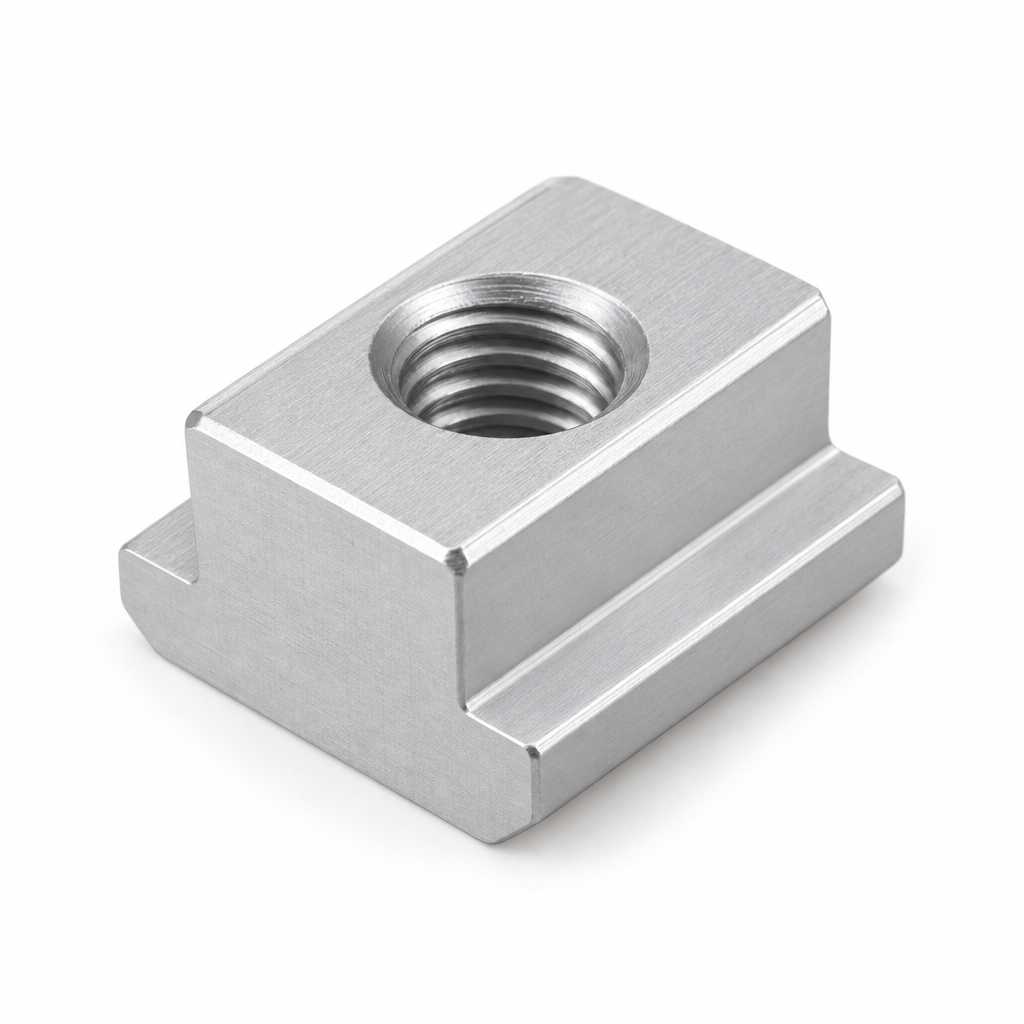
T-Slot Nut 30 Series M6 Hammer Nut for 30×30 Aluminium Extrusion
M6 hammer-head T-slot nut for the 8 mm groove of 30 x 30 mm aluminium extrusion, the standard fixing for 30 series framing. Carbon steel zinc plated or 304 stainless, 12 mm or 20 mm body, torque ceiling about 6 N m.
| Material | Carbon steel / 304 stainless steel |
|---|---|
| Alloy Grade | Grade 8.8 equivalent carbon steel / A2-70 stainless |
| Temper | custom |
| Section Size | M6, for 30 series 8 mm slot |
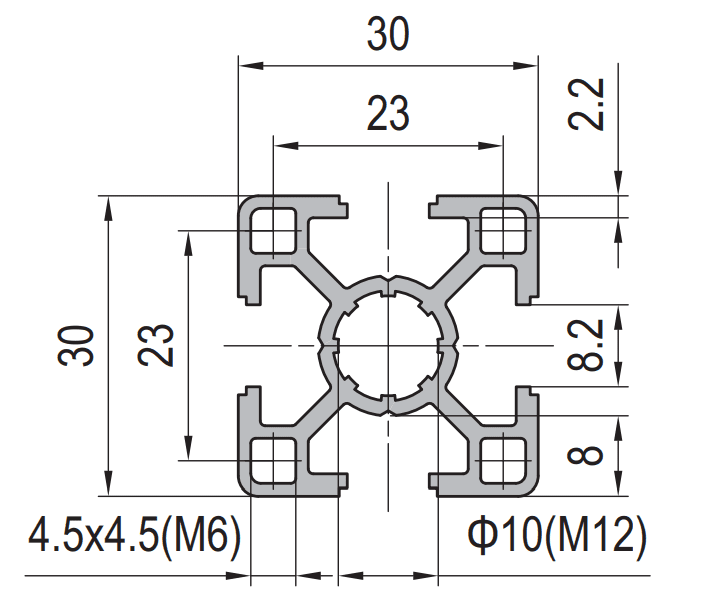
| Slot | Fits 8 mm slot mouth, 12 mm groove cavity, 6 mm cavity height |
| Length | 12 mm standard, 20 mm long body option |
| Tolerance | Thread to ISO 965-2 6H, head width -0.15 mm on the groove cavity |
| Surface | Zinc plated (clear trivalent) / passivated stainless |
| MOQ | 10000 |
| Lead Time | 12-20 days after deposit for zinc plated, 18-26 days for 304 |
| Loading Port | Shanghai / Ningbo |
| Supply Ability | 6 million pieces per month |
| Payment Terms | T/T 30% deposit + 70% before shipment | L/C at sight |
| Trade Terms | FOB | CIF | EXW |
| Certifications | ISO 9001:2015 | ISO 965-2 thread | RoHS | REACH |
Fastening elements · 30 series · M6
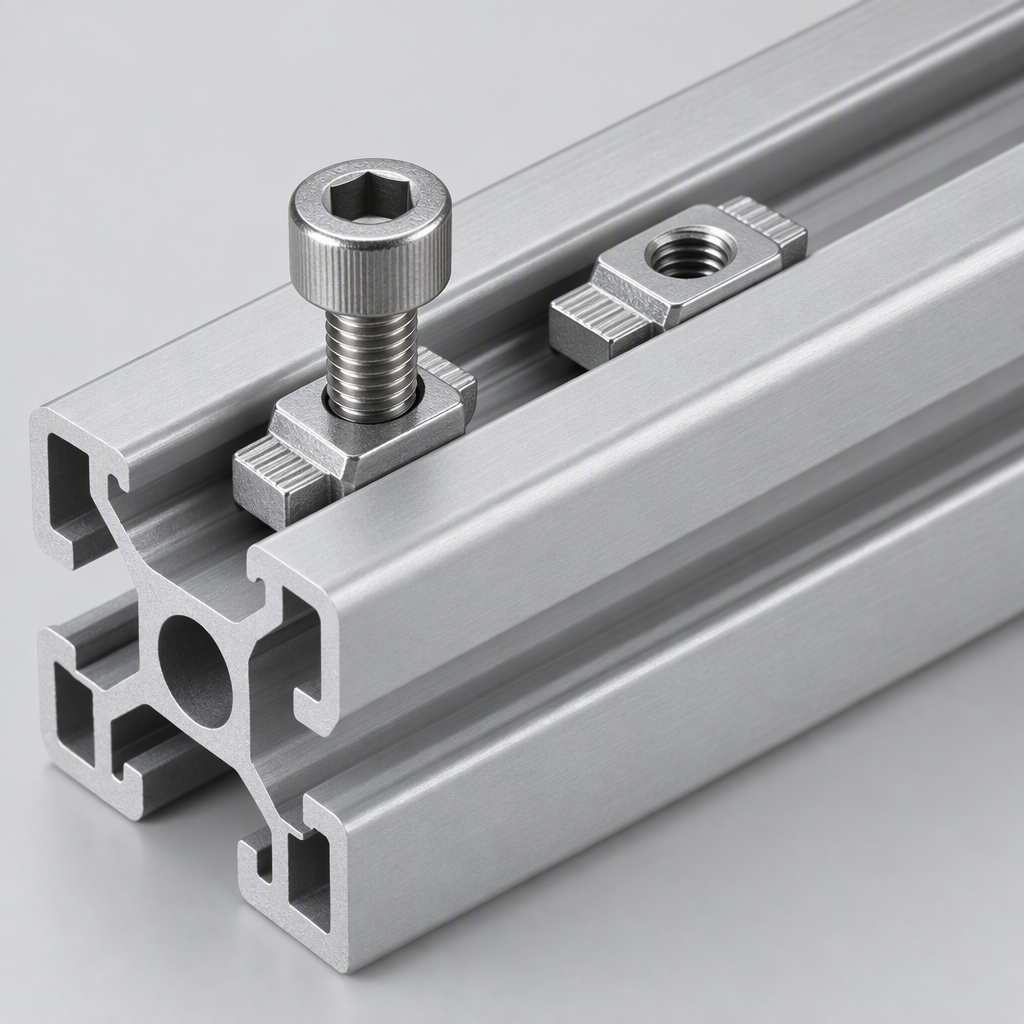
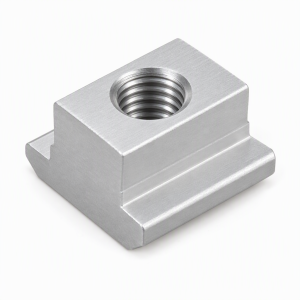
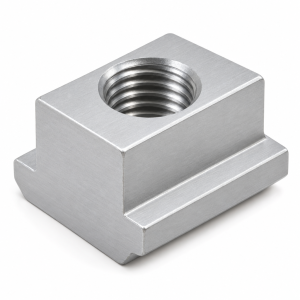
A 30 series T-slot nut is an M6 hammer-head nut sized for the 8 mm groove of a 30 x 30 mm aluminium extrusion. It is the single most used fastener in 30 series framing: brackets, hinges, feet, panel clips and cable supports for the whole system are held with an M6 nut and an M6 screw. The body is around 12 mm long and 4 g in steel, and the thread is M6 x 1.0 ISO metric coarse.
The number that governs how you use it is not the strength of the screw but the stiffness of the slot it pulls against. An 8 mm slot in a 30 series section has lips about 1.6 mm thick, and the whole load of the joint arrives on those two narrow strips through the nut head. Our empirical ceiling is about 6 N m; below that the joint is stable, above it the aluminium starts to yield under the head, the bearing area grows and thins, and the joint can slacken in service. Understand that ceiling and the rest of the selection follows from it.
The default fixing of the 30 series system
Thirty series sits in the middle of the T-slot range. The section is 30 x 30 mm with an 8 mm slot, which is enough to take a real bracket and a real panel load while staying light enough for a bench or a small machine guard. Almost every accessory in the system, from angle profile brackets to panel installation elements, is drawn around the M6 nut, so the practical question for a buyer is not whether M6 is right but how much tightening the joint will take and how well the nut fits the groove it is bought for.
Because the nut is the interface between a steel screw and an aluminium section, it is where the two materials meet and where the limits of the system appear. The screw is far stronger than the slot; a nut that is correct in every dimension can still damage a frame if it is tightened by feel with the wrong wrench. The rest of this page is about where that limit lies and what raises it.
| Property | M6 30 series nut |
|---|---|
| Thread | M6 x 1.0 ISO metric coarse |
| Groove | 8 mm slot mouth, 12 mm cavity, 6 mm deep |
| Body length | 12 mm along the slot |
| Head thickness | 4.5 mm |
| Unit weight | approx. 4 g in steel |
| Torque ceiling | approx. 6 N m, empirical |
| Typical pull-out | approx. 600 to 900 N per nut |
| Material | Carbon steel zinc plated / 304 stainless |
What the tightening torque does to the slot
Think of the joint as a clamp, not as a bolt. The screw pulls the nut head up against the inside of the lips, and the reaction is a pressure on two strips of aluminium about 1.6 mm thick and a few millimetres wide. A modest torque is enough to take that pressure past the yield point of the section, which for the usual 6063 alloy is in the region of 150 MPa. Once past yield the aluminium does not spring back; it flows, the strip becomes thinner, and the screw that was tight is now loose in a slot that has been reshaped.
This is why the failure is quiet. Nothing breaks, no thread strips, and the joint feels correct at the moment it is made. The damage shows up later as a bracket that will not stay square, a panel that rattles, or a nut that has to be re-tightened every few weeks. On a frame that is adjusted during commissioning, the joints that get re-tightened repeatedly are the ones that reach this state first.
| Torque at the M6 screw | Condition of the 8 mm slot |
|---|---|
| 3 to 4 N m | Clean joint, no marking, full bearing on both lips |
| about 6 N m | Ceiling for a standard nut, faint impression in the lip |
| 10 N m | Lip yields, bearing strip thins, preload starts to fall away |
| 15 N m and above | Lips flare, nut sits low, joint cannot hold preload |
Torque is not a quality check. Tightening an M6 slot nut harder does not make the frame stiffer, it makes the slot softer. If a joint moves under load, the answer is more bearing area or a different connection, never a longer spanner.
Three ways to raise the ceiling without changing the slot
The section is fixed once the frame is designed, so improving an M6 joint has to be done with the nut and the parts around it. The three levers below either spread the load over more aluminium, engage more of the lip, or move the load off the lip altogether. Knowing which one a change actually pulls is what stops a buyer paying for an improvement that does nothing.
The 8 mm groove and how the fit is controlled
A hammer nut is a loose part in a loose groove, but the fit still has to be controlled or the nut will not seat squarely. Three dimensions decide it: the slot mouth, which the neck has to pass through; the cavity width across the groove, which the head has to sit inside without rocking; and the cavity height, which decides how deep the head can sit and therefore how much of the lip it bears on. Each of these is held to a tolerance, and the tolerances are what a supplier should quote rather than a single nominal figure.
In practice the fit is a compromise. A nut that is a sliding fit in the cavity is easy to position but can rotate slightly when the screw is turned, which is felt as the nut spinning in the slot before it bites. A nut that is a closer fit locates better but is harder to slide along the member by hand. For most 30 series work the standard nut is a light interference on the cavity width and a clearance of around 0.3 mm on the mouth, which locates well and still slides.
| Dimension | Nominal | Typical allowance |
|---|---|---|
| Slot mouth width | 8.0 mm | +0.2 / -0.1 mm |
| Groove cavity width | 12.0 mm | +/-0.2 mm |
| Groove cavity height | 6.0 mm | +/-0.15 mm |
| Nut neck width | 7.7 mm | +0 / -0.15 mm |
| Nut head width | 12.2 mm | +0 / -0.15 mm |
| Nut head thickness | 4.5 mm | +/-0.1 mm |
| Thread | M6 x 1.0 | 6H, ISO 965-2 |
| Nut body length | 12 mm | +/-0.2 mm |
Where a section has been anodised the mouth closes slightly. A 15 micron anodic layer on both sides of an 8 mm mouth takes about 0.03 mm out of the opening, which is inside the tolerance but is enough to change a sliding fit into a tight one. On a frame that will be assembled and re-assembled, say at the enquiry stage whether the profile is anodised so the nut can be dimensioned for the finished mouth.
Ordering and price
The M6 nut is supplied in carbon steel zinc plated and in 304 stainless, with a 12 mm body as standard and a 20 mm body for joints that need more lip engagement. It is dimensioned for the 8 mm groove of the 30 series aluminium profiles, so a nut bought with the section is guaranteed to seat. The minimum order is 10,000 pieces per material and length, and the two lengths can be combined in one order for pricing. Mixed orders across 20, 30 and 40 series nuts are also priced on the total quantity, which is usually the cheapest way to stock a workshop.
Lead time is 12 to 20 days after deposit for zinc plated and 18 to 26 days for stainless. Terms are FOB, CIF or EXW from Shanghai or Ningbo, and payment is T/T 30 % deposit with the balance before shipment, or an L/C at sight. OEM and ODM are available: we mark the head with your part number, and we can produce a special head width or thickness where a frame uses a groove that is not the standard 8 mm.
Frequently asked questions
What is the torque limit for an M6 T-slot nut in 30 series?
About 6 N m as an empirical working figure. It is a limit set by the aluminium lip rather than by the screw, so a thin-walled section tolerates less and a heavier wall tolerates a little more. Treat 6 N m as the number to design around and check a sample joint before setting a wrench for production.
Will over-tightening damage the profile?
Yes, and it is the most common way a 30 series joint is ruined. Beyond about 10 N m the lip yields under the nut head, the bearing strip thins, and the joint loses preload over time. The damage is not visible from the outside, which is why it is normally found as a bracket that will not stay tight.
Does a longer nut increase the load capacity?
It increases the torque the joint will take without marking the slot, because the load is spread over more lip length. It does not change the load the joint can carry in tension, which is set by the lip thickness. Use a longer nut where the joint will be adjusted or re-tightened, not as a way to carry more weight.
How tight a fit should the nut be in the groove?
A light interference on the cavity width and about 0.3 mm clearance on the mouth is the usual standard: it locates the nut so it does not spin, and still lets it slide. Where the section is anodised, allow for the coating closing the mouth by about 0.03 mm.
Can you supply a nut for a non-standard groove?
Yes. Send the section drawing with the mouth width, the cavity width and the cavity height, and we will make the nut to suit rather than supplying a standard part that fits badly. Head width, thickness and body length are all adjustable on the same tooling.
Send the groove dimensions, not just the series
The mouth width, the cavity width and the cavity height decide whether an M6 nut seats squarely, so send those three numbers with the section drawing and we will confirm the fit or make the nut to suit. Tell us the material, the body length and the quantity, and we will quote unit price, packing and FOB lead time, with a sample nut for a trial joint before you commit.
Request a QuoteRelated Products
 T-Slot Nut 40 Series M8 Hammer Nut for 40×40 Aluminium Extrusion
M8 hammer-head T-slot nut for the 8 mm groove of 40 x 40 mm…
 T-Slot Nut 45 Series M8 Hammer Nut for 45×45 Aluminium Extrusion
M8 hammer-head T-slot nut for the 10 mm slot of 45 x 45 mm…
 T-Slot Nut 50 Series M10 Hammer Nut for 50×50 Aluminium Extrusion
M10 hammer-head T-slot nut for the 10 mm groove of 50 x 50 mm…
 PG30 30×30 mm Two Slot Type A Aluminium Strut Profile Closed Face T-Slot Extrusion
30 x 30 mm Type A two slot PG30 aluminium strut profile in 6063-T5…
 PG30 30×30 mm Two Slot Type B Aluminium Strut Profile Symmetric T-Slot Extrusion for Corner Posts
30 x 30 mm Type B two slot PG30 aluminium strut profile in 6063-T5…
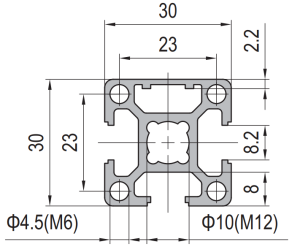 PG30 30×30 mm Three Slot Aluminium Strut Profile Light Frame Column
30 x 30 mm aluminium strut profile with three 8.2 mm T-slots and one…
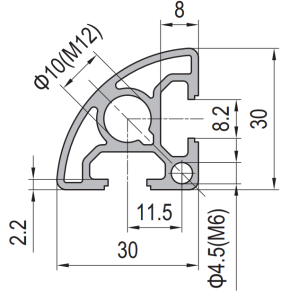 PG30 30×30 mm R90 Two Slot Aluminium Strut Profile Rounded Corner Rail
30 x 30 mm quarter round aluminium profile with one 8.2 mm T-slot on…
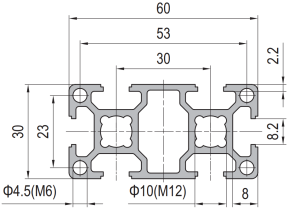 PG30 60×30 mm Six Slot Aluminium Strut Profile Rectangular T-Slot Extrusion for Cabinet Uprights
60 x 30 mm six slot PG30 rectangular aluminium strut profile in 6063-T5 with…
