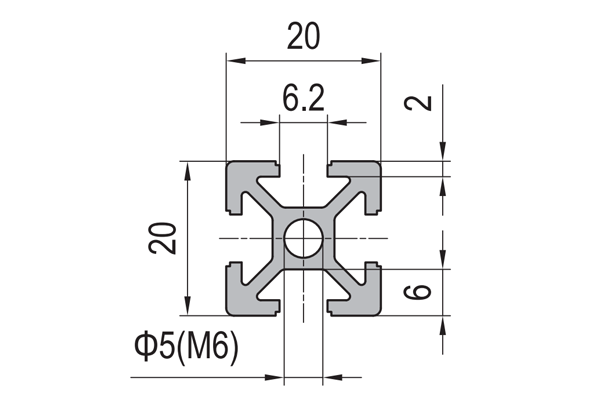
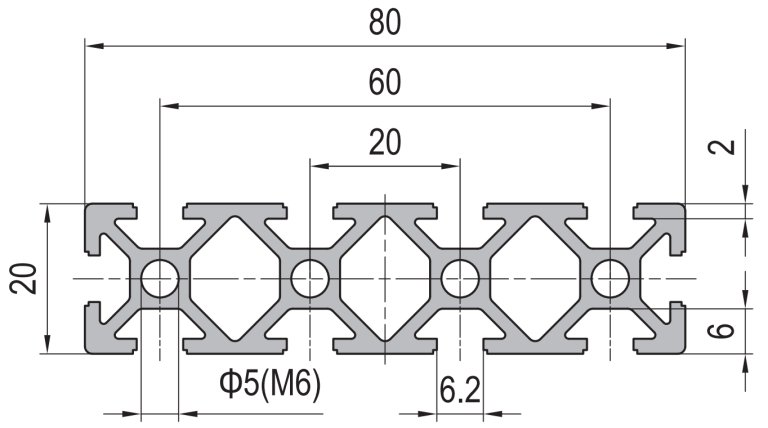
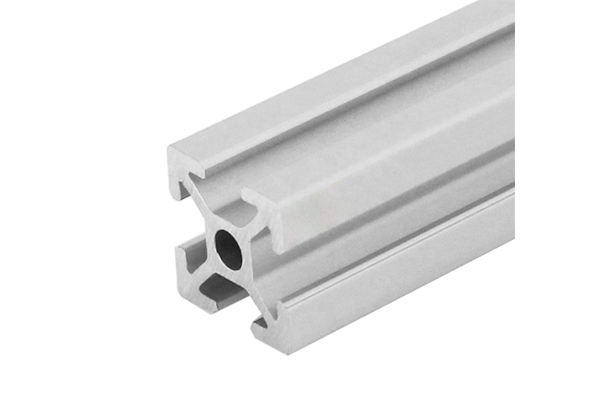
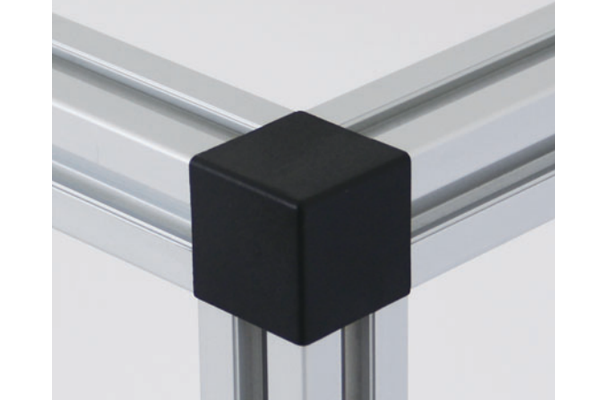
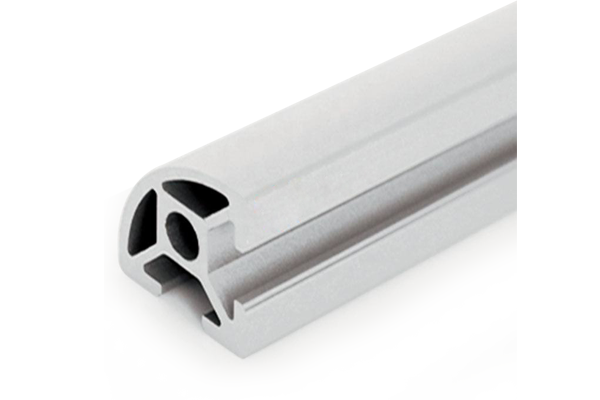
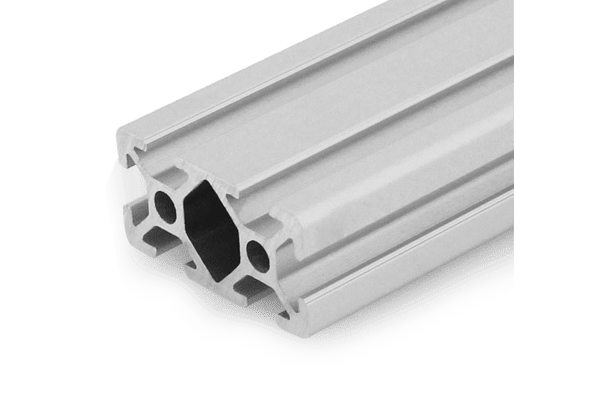
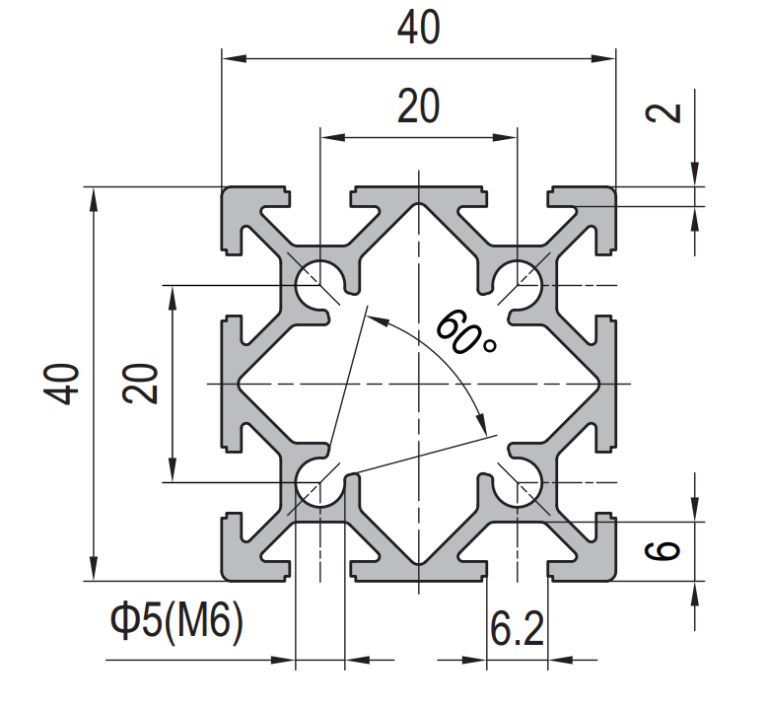
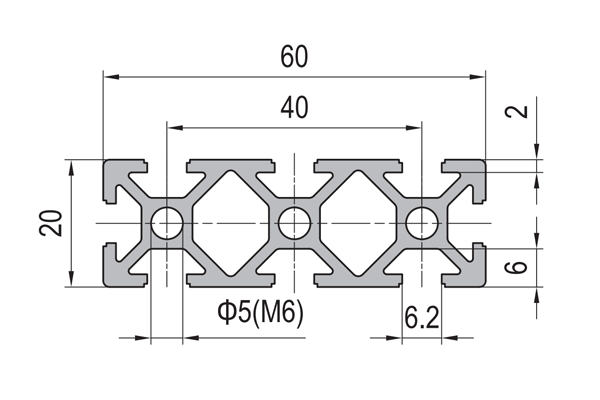
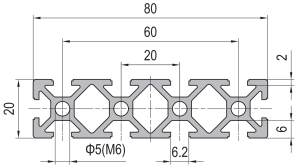
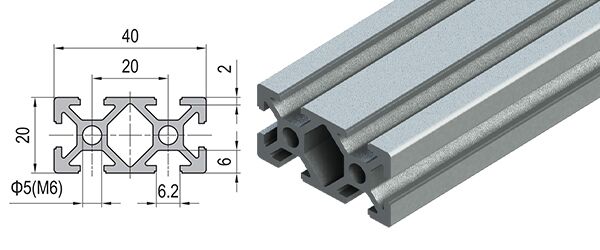
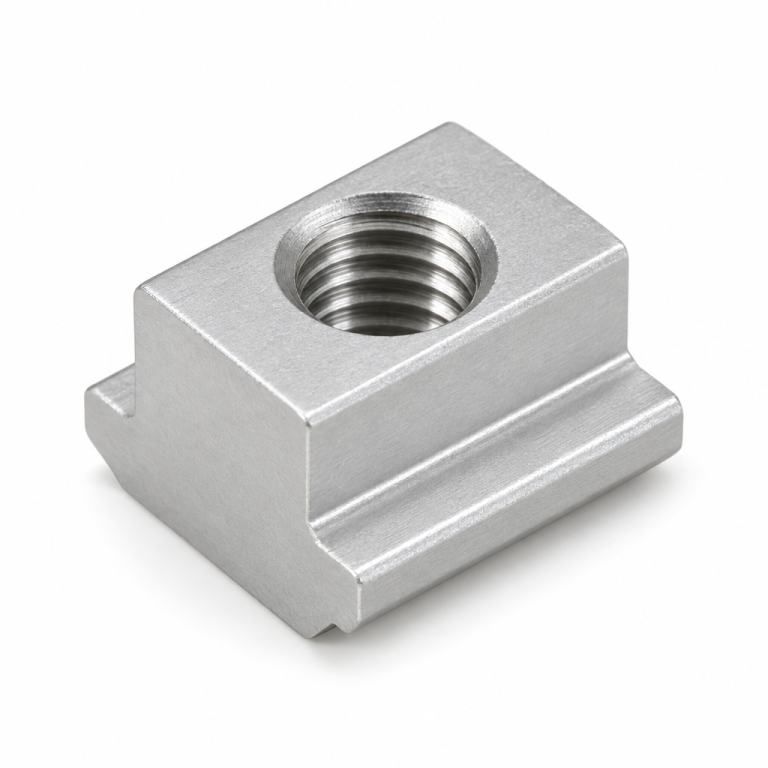
20 series aluminium profiles are slotted extrusions on a 20 mm module with a 6 mm T-slot. The range covers 20×20, 20×40, 20×60, 20×80, 40×40 and 40×80. They take M5 T-nuts as standard and M6 on the heavier members, and they are the usual choice for fixtures, gauges, small automation cells and bench-top equipment where repeatability matters more than load capacity.
Below: how 20 series is used as a precision frame rather than a structural one, where the 6 mm slot runs out of capacity, and how to decide between 20 and 30 series.
What defines the 20 series
The module is 20 mm and the slot is 6 mm. Those two numbers set everything else: the section family, the fastener range, and the size of bracket that will fit. A 6 mm slot takes an M5 T-nut comfortably and an M6 where the section is heavy enough, which is enough for a jig or a fixture but not for a machine base.
The reason 20 series has its own following is the ratio between its size and its accuracy. The extrusion is small enough that a fixture built from it stays compact and light, yet large enough that the slot has a flat datum face and a defined depth. That combination is what makes a 20 series fixture repeatable: parts are located against machined shoulders and locked with T-nuts in the slot, and the whole assembly can be re-set by loosening and re-tightening rather than by re-machining.
The size family
| Section | Slots | Typical role | Notes |
|---|
| 20×20 | 4 (also 2 and 3 slot variants) | Fixture frames, stops, rails, edge guides | Available light and standard |
| 20×40 | 6 | Fixture bases and uprights, small cell frames | The most-used member in the series |
| 20×60 | 8 | Beams over a small opening, gantry rails at low load | Depth in the bending direction is what buys stiffness |
| 20×80 | 10 | Wider fixtures, panels that carry two rows of hardware | Often used as a base member |
| 40×40 / 40×80 (6 mm slot) | 6–10 | Heavier bases inside a 20 series cell | Shares the slot with 20 series but is not interchangeable with 40 series 10 mm profiles |
Building a fixture rather than a frame
A structural frame and a fixture are designed for different failure modes. A frame fails by deflecting; a fixture fails by moving. That changes what matters.
- Locate against a machined face, not the slot. The slot is a fastening feature, not a datum. Where a part has to be positioned to 0.1 mm, locate it against a machined shoulder and use the slot only to clamp.
- Lock in two directions. A single T-nut resists sliding but not rotation. Use two fasteners, or a bracket that picks up two slots, wherever a part could pivot.
- Keep the load path short. A part mounted on a long cantilever from a 20×20 member will move under cutting or clamping force regardless of how tight the fasteners are.
- Allow for re-setting. The advantage of a 20 series fixture is that it can be re-configured. Leave access to every T-nut with a standard hex key rather than hiding hardware behind other members.
Practical point: if a fixture has to hold a tolerance tighter than about 0.2 mm, plan on machining one datum plate and building the rest of the fixture around it from 20 series profile. Extruded profile alone is not an accurate locating surface, and no amount of careful assembly changes that.
20 series or 30 series?
| Question | 20 series | 30 series |
|---|
| Slot | 6 mm | 8 mm |
| Fastener | M5, M6 | M6, M8 |
| Practical span | 500–900 mm | 600–1,200 mm |
| Best for | Fixtures, gauges, bench-top cells, small enclosures | Machine frames, workbenches, conveyor guarding |
| Choose 20 series when | Compactness and light weight dominate, and the frame sits on a bench | — |
| Choose 30 series when | — | The frame stands on the floor, carries guarding, or is moved as a unit |
The practical test is where the frame will live. Bench-top equipment rarely needs more than 20 series, and a compact frame is easier to move, cheaper to ship and visually better matched to small equipment. A floor-standing frame with panels and doors almost always wants 30 series, because the panel loads and the handling loads are what the frame sees, not the machine load.
The limits of the 6 mm slot
Three situations take a 20 series frame beyond what the slot can carry.
Cantilevered loads
A bracket holding a part out on an arm concentrates load on a short length of slot lip. Doubling the arm length roughly doubles the moment at the joint. Where an arm is unavoidable, use two brackets separated along the profile, or a joining plate that spreads the load over a longer length of slot.
Repeated assembly
Small slots are more easily damaged by repeated tightening than large ones. A fixture that is re-set several times a day will eventually show crushed slot lips. Where that is the duty, use hardened T-nuts and torque to the fastener maker's figure rather than by feel.
Moving loads
A 20 series frame carrying a sliding or rotating load will vibrate. If the frame cannot be braced, moving to 30 series is usually cheaper than adding damping.
Machining and finishing
Most 20 series parts need at least one machined face, because that is what makes the fixture accurate. We cut to ±0.2 mm with square ends, and can add drilled and tapped holes, counterbores, milled shoulders, slots and chamfers in the same order. See CNC machining for the processes available.
Satin anodised is the normal finish, in clear, black or bronze. Anodising adds roughly half the film thickness to each face, which is worth noting on a fixture where a machined shoulder is used as a datum: state on the drawing whether the datum dimension applies before or after finishing. The grades are described under anodised aluminium profiles.
Specifying a 20 series order
Send the section, the slot width, the finish, the cut list and the quantity, and mark any face that has to be machined or used as a datum. Where the fixture already exists as a photograph or a sketch, that is usually enough for us to propose the members and the accessory list. Standard sections are quoted within one working day. Related ranges: 15 series, 30 series, strut profiles, connecting elements and fastening elements.