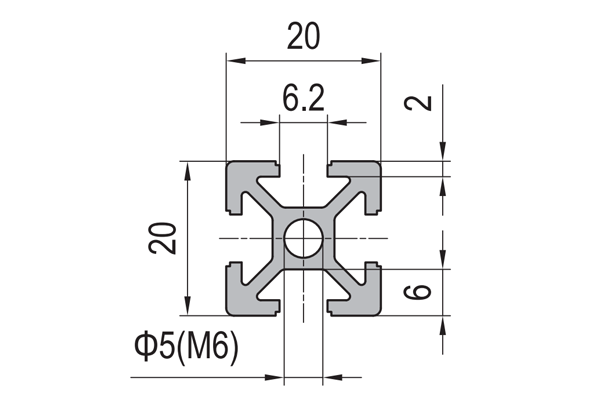
20 x 20 Aluminium Extrusion 6.2 mm Slot Stock Lengths and MOQ
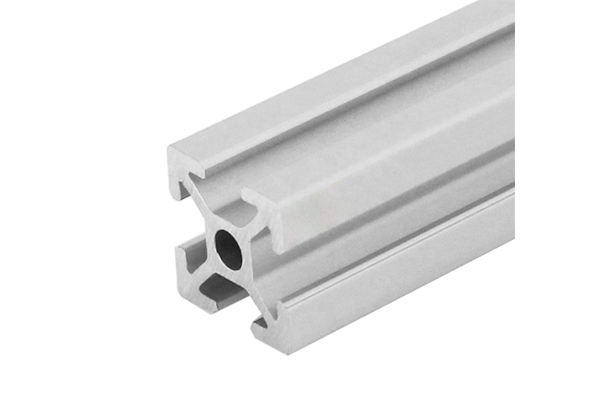
20 x 20 mm aluminium extrusion with a 6.2 mm slot, supplied in 6 m stock lengths or cut to size. 0.62 kg/m, 6063-T5, entry from a single bar.
| Material | Aluminium |
|---|---|
| Alloy Grade | 6063-T5 |
| Temper | T5 |
| Section Size | 20 x 20 mm |
| Slot | 4 x 6.2 mm groove, 6 mm mouth, 20 mm pitch, 1 slot per face, M5 and M6 |
| Length | 6 m stock length; cut to list to +/-0.5 mm, chamfer on request |
| Tolerance | EN 755-9 / GB/T 6892, wall +/-0.15 mm; cut length +/-0.5 mm |
| Surface | Mill finish / clear anodised / black anodised |
| MOQ | One bar from stock in mill finish; anodised orders limited by the anodising batch, often 100 to 300 kg |
| Lead Time | Typically 2 to 3 weeks for mill finish from stock, plus about a week for anodising |
| Loading Port | Shenzhen, Guangzhou, Ningbo |
| Supply Ability | Stock holding of standard sections plus in-house saw cutting; about 20 tonnes per month of cut profile |
| Payment Terms | T/T 30 per cent deposit, balance against copy of bill of lading |
| Trade Terms | FOB, CIF, CFR, EXW |
| Certifications | Mill certificate to EN 10204 3.1 on request, RoHS and REACH declarations |
01What does “stock length” actually mean here?
It means 6 metres, mill finish, from a die that is already running. You can buy one bar or one bundle without paying for a die, because the die exists and the section is being extruded for other customers. That is the practical difference between a stock section and a made-to-order one, and it is the reason a 20 x 20 mm extrusion at about 0.62 kg/m is the cheapest way into an aluminium frame project.
Six metres is not a arbitrary number. It is the longest length that most extruders can handle consistently through the press, the anodising line and the ageing oven, and it is the length that packs and ships without a special crate. It is also, as the next section explains, exactly one metre too long for a 20 ft container.
- Standard stock length
- 6 m
- Weight per bar
- about 3.72 kg at 0.62 kg/m
- Bars per tonne
- about 269
- Cut to size
- available, quoted per cut plus material
- Die charge
- none on a stock section
02Why will a 6 m bar not fit in a 20 ft container?
Because a 20 ft container has an internal length of 5.898 m. Six metre bars do not go in, at any angle that does not destroy the load. This catches out first-time buyers regularly: the freight is quoted for a 20 ft, the material arrives at the port, and the forwarder comes back asking for a 40 ft.
| Container | Internal length | Can it take 6 m bars | Practical note |
|---|---|---|---|
| 20 ft GP | 5.898 m | No | Cut to 5.8 m, or ship in a 40 ft |
| 40 ft GP | 12.032 m | Yes | Bars loaded lengthwise, two bundles deep |
| 40 ft HQ | 12.032 m | Yes | Extra height helps with bundle stacking |
| LCL | varies | Usually yes | Check the consolidation warehouse, not just the vessel |
The weight side is simpler. A 40 ft high cube has a payload of about 26.5 tonnes, and aluminium profile is dense enough to be weight limited rather than volume limited. In practice a 40 ft takes about 20 to 24 tonnes of profile, which in 20 x 20 at 0.62 kg/m works out at roughly 32,000 to 38,000 metres. That is a lot of frame, and it is why most buyers never approach a full container on this section.
If your order is under about 3 tonnes, the freight per tonne usually costs more than the material. Consolidating with other sections into one shipment, or buying through a stockholder locally, is often cheaper overall even at a higher unit price.
03What does the MOQ actually depend on?
Not on a single number. Three different things set a minimum, and confusing them is why quotations appear inconsistent between suppliers.
| Situation | What sets the minimum | Typical entry point on this section |
|---|---|---|
| Stock section, mill finish | Packing and handling, not the die | One bar, or one bundle of about 50 to 80 kg |
| Stock section, anodised | Anodising batch size — the line runs full batches | Often 100 to 300 kg, because a part batch is charged as a full batch |
| Stock section, cut to list | Saw set-up and packing labour | About 100 m, or the quantity at which the set-up is worth amortising |
| Custom die | Die cost plus a minimum press run by weight | Die cost plus several hundred kilograms; the metre minimum follows from the weight |
| Custom colour anodising | Batch scheduling with other work of the same shade | Whatever the batch is, and it is usually the highest minimum of the five |
The consequence for this section is worth stating plainly. Because 20 x 20 is light, a weight-based minimum converts into a large metre minimum. A 500 kg die run is about 800 m of 20 x 20, but only about 116 m of a 60 x 60 at 4.3 kg/m. If a supplier quotes a metre minimum for a custom die, check whether it is really a weight minimum in disguise — the two give very different answers depending on the section.
04How do cut charges work?
Two models, and the difference matters on a long cut list. Either you are charged per cut, or you are charged a cutting allowance on the material — a few per cent added to the billed length for each piece. Per-cut is transparent and gets expensive on short pieces; allowance is cheaper on a big list and harder to audit.
- A cut takes about 10 to 20 seconds of machine time, but the handling dominates. Twenty short pieces cost far more per metre than two long ones.
- Cut tolerance is normally plus or minus 0.5 mm. Tighter than that moves the work from a saw to a machining centre and changes the price completely.
- Ends are deburred as standard. A chamfer on the end is a separate operation and should be asked for explicitly.
- If the pieces are going into an anodising batch, cut before anodising, never after.
- Ask what happens to the offcut. On a 6 m bar with a 2.3 m cut list you are paying for 3.7 m of material unless the offcut is credited or returned.
05How is tiered pricing normally structured?
Four steps, and each one exists for a different reason. Knowing which step you are on explains most of the price difference between two quotations for the same drawing.
| Step | Quantity | What drives the price | What changes at this step |
|---|---|---|---|
| Sample | 1 to 5 bars or short cuts | Handling and freight dominate | You are buying information, not material |
| Trial order | 50 to 200 kg | Set-up and packing per order | Price per kg is highest here in relative terms |
| Production | 500 kg to 5 tonnes | Material and machine time | The step where most of the real price reduction happens |
| Container or tonne | 10 tonnes and up | Mill scheduling and freight per tonne | Price approaches the metal plus conversion cost |
Two things do not follow this curve. Anodising is priced per batch, so it is flat and then steps down sharply at batch boundaries rather than sliding with quantity. Cutting is priced per piece, so it scales linearly and never gets a volume discount worth chasing. If a quotation looks out of line, check which of the three components — material, anodising, cutting — is carrying the difference.
066063-T5 or 6061-T6 on a 20 x 20?
6063-T5, the standard
- Better extrudability, so thinner walls and sharper corners are achievable
- Anodises to a more uniform appearance
- Lower yield strength, adequate for frames and enclosures
- Stocked, so no die charge and short lead time
- The default for anything architectural or visible
6061-T6, on request
- Higher yield strength, useful where the frame carries load
- Harder to extrude in thin wall, so tooling cost rises
- Anodised appearance is less uniform, more grey
- Usually made to order, so a die and a longer lead time
- Worth it only when a calculation says 6063 is not enough
On a 20 x 20 section the wall is thin, so 6061 is the more difficult alloy to run and the benefit is smaller than it would be on a heavy section. If a 20 x 20 frame is marginal in 6063, the usual correct answer is a larger section in 6063 rather than the same section in 6061.
07What has to be in the enquiry for the price to hold?
Eight items. A quotation missing any of them is an estimate, and it will move once the details arrive — usually upward.
Enquiry checklist for 20 x 20 extrusion
- Section and alloy, or the application if you want a recommendation
- Total quantity in metres, and the number of pieces
- Cut list, if cutting is required, with tolerance
- Finish: mill, clear anodised or black anodised, and the micron range
- Whether cut faces need re-sealing after anodising
- Packing requirement: bundle, crate, or individual bagging
- Destination port, and whether the order is FOB or delivered
- Whether the offcut from the cut list is to be returned or credited
The two items that most often change a price after the fact are the finish and the cut list. Both are easy to state up front and expensive to add later, because both force a re-schedule rather than an adjustment.
08Questions buyers ask before placing a first order
Related sections and categories
Browse 20 Series Aluminium Profiles, Aluminium Sections, the 20 x 20 mm four slot section, or see the 20 x 60 mm eight slot rail for the full section data.
What is the minimum order for 20 x 20 aluminium extrusion?
For mill finish from stock, a single bar. For anodised stock, the minimum is usually set by the anodising batch rather than the profile, often 100 to 300 kg. For a custom die the minimum is a die charge plus a press run by weight, which on this light section converts into a large number of metres.
Can you ship 6 m bars to a 20 ft container?
No. A 20 ft container has an internal length of 5.898 m. Either the bars are cut to 5.8 m, or the shipment goes in a 40 ft. This is worth settling before the freight is booked.
How much is a 6 m bar of 20 x 20?
About 3.72 kg of material at 0.62 kg/m, plus cutting if required and plus finish. Price is quoted per metre against quantity and finish rather than per bar, because the bar is a packing unit and not a commercial unit.
Do you credit the offcut if my cut list does not fill a bar?
It can be quoted either way. State the preference on the enquiry: material billed on the cut list with the offcut returned, or material billed on whole bars with the offcut kept. Whole-bar billing is normally cheaper per piece and leaves you with usable short lengths.
What is the lead time for a trial order?
Typically 2 to 3 weeks for mill finish from stock, plus about a week if anodising is required. A trial order does not get a faster slot than a production order, so the lead time is set by the finish, not by the size.
What to send for a 20 x 20 extrusion quotation
- Total metres and number of pieces
- Cut list with lengths and tolerance, if cutting is needed
- Finish and micron range, or mill finish
- Alloy: 6063-T5 standard, or 6061-T6 on request
- Packing: bundle, crate, or bagged
- Destination port and trade term
- Offcut preference: returned, credited, or kept
- Required delivery date, so the anodising batch can be scheduled
If the project is at an early stage, ask for a price at three quantities — trial, production and container. The shape of the curve tells you more about the supplier than any single number does.
Ask for three quantities, not one
Send the total metres, the cut list and the finish. We will price a trial order, a production order and a container so you can see where the price actually steps down.
Request a quotationRelated Products
 Aluminium 60 x 60 mm Four Slot Extrusion for Robot Cell Gantries
60 x 60 mm four slot aluminium extrusion for robot cell gantry columns and…
 Aluminium 4040 Extrusion 40 x 40 mm Single Slot for Machine Fixtures
40 x 40 mm single slot aluminium 4040 extrusion for machine fixture bases. Three…
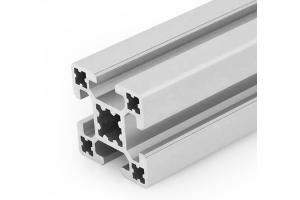 Aluminium 40 Series Extrusion 40 x 40 mm for PV Module Lines
40 x 40 mm aluminium 40 series extrusion for photovoltaic module lines. Four slots,…
 Anodised Aluminium Profile 40 x 40 mm AA15 Clear Finish for Visible Frames
40 x 40 mm anodised aluminium profile in 6063-T5 with an AA15 clear anodised…
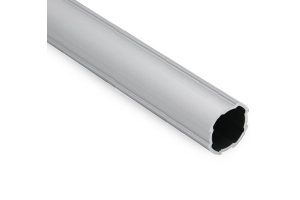 Aluminium Lean Pipe Joint System 28 mm for Kaizen Cart Frames
28 mm lean pipe joint system in aluminium tube with a 1.0 mm wall,…
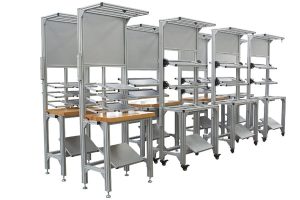 ESD Aluminium Profile Workbench 40 x 40 mm Anti-Static Assembly Frame
ESD workbench built on a 40 x 40 mm aluminium profile frame, supplied mill…
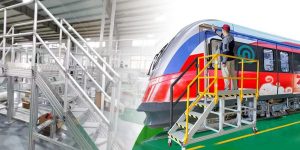 Aluminium Profile Stair Stringer 45 x 90 mm for Access Platforms
45 x 90 mm six slot heavy aluminium profile at about 4.85 kg/m, cut…
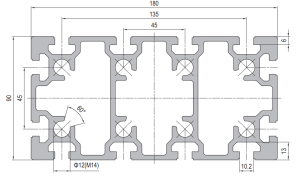 Aluminium Profile CNC Router Gantry 90 x 180 mm Twelve Slot Beam
90 x 180 mm twelve slot aluminium profile at about 9.50 kg/m for a…
