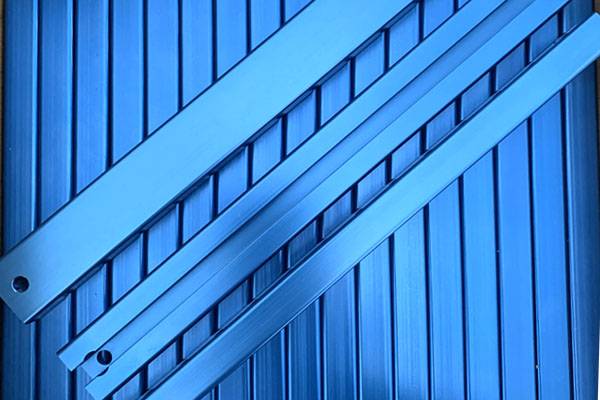
Anodised Aluminium Profile 40 x 40 mm AA15 Clear Finish for Visible Frames
40 x 40 mm anodised aluminium profile in 6063-T5 with an AA15 clear anodised finish. Four M6 slots on a 30 mm pitch, 1.30 to 2.35 kg/m, cut to list, with masking and lot control available on request.
| Material | Aluminium |
|---|---|
| Alloy Grade | 6063-T5 |
| Temper | T5 |
| Section Size | 40 x 40 mm, four slots |
| Slot | M6 slot, 8 mm mouth, four faces, 30 mm pitch |
| Length | 6 m stock, cut to list to +/-0.5 mm |
| Tolerance | EN 755-9 / GB/T 6892, wall +/-0.15 mm; coating thickness measured on a flat face clear of edges |
| Surface | Clear anodised AA15 to EN ISO 7599; black anodised, electrolytic colouring, AA10 / AA20 / AA25 on request |
| MOQ | 500 m for a standard clear AA15 run; lower for stock lengths |
| Lead Time | 15 to 25 days after deposit for mill finish, plus about a week for anodising; longer for coloured or lot-controlled work |
| Loading Port | Shanghai / Ningbo |
| Supply Ability | 600 t per month extrusion, with in-house anodising and masking |
| Payment Terms | T/T 30% deposit + 70% before shipment | L/C at sight |
| Trade Terms | FOB | CIF | EXW |
| Certifications | Coating thickness report per lot, ISO 2143 or ISO 2931 seal test on request, EN ISO 9227 salt spray on request, RoHS and REACH declarations |
01What does AA15 actually mean on a drawing?
It means a nominal coating mass or thickness of 15 micron, in the designation system of EN ISO 7599. The letters are not a quality grade and they are not a brand — they are a thickness class, and the four classes you will see on aluminium extrusion drawings are AA10, AA15, AA20 and AA25. A 40 x 40 mm anodised aluminium profile with an AA15 callout is the middle of that range and is what most visible machine frames in Europe are specified to.
The important word is *nominal*. A 15 micron class does not mean every point on the profile measures 15.0 micron. It means the coating meets the minimum and mean values the class defines when measured the way the standard says to measure it. Buyers who write “15 micron +/- 1 micron” on a drawing create a specification that cannot be inspected, because the natural variation across a single extrusion is wider than that.
| Class | Nominal thickness | Where it is the right answer | Where it is not |
|---|---|---|---|
| AA10 | 10 micron | Indoor frames, hidden structure, low handling | Anywhere it is wiped with solvent or handled daily |
| AA15 | 15 micron | Visible machine frames, workbenches, guard posts indoors | Outdoor exposure, coastal air, washdown |
| AA20 | 20 micron | Outdoor sheltered, humid plant rooms, light chemical exposure | Immersion or regular caustic cleaning |
| AA25 | 25 micron | Coastal, marine, heavy cleaning regimes | Still not a substitute for a proper marine alloy and system |
The class sets thickness, not colour, not gloss and not hardness. If colour matching matters, it has to be written separately, and it has to be tied to an approved sample rather than to a number.
02Which faces do you measure the coating on?
Not the corners, not the slot mouths, and not the cut ends. Anodising grows from the surface outward and into the metal at the same time, and the current density is highest at edges and corners, so corners always read thicker and the flat face is the only honest place to measure. On a 40 x 40 section that means the middle of a flat face, clear of the slot mouth by at least a few millimetres.
- Eddy current, ISO 2360 — the method used for goods-in check. Fast, non-destructive, and reliable on a flat face. It reads high near an edge, so keep the probe back.
- Microscopical cross-section, ISO 1463 — the referee method. Slow and destructive, used when a dispute has to be settled or when the coating is very thin.
- Coating mass — the alternative expression of the same thing, in grams per square metre. Some drawings use it, and it converts to thickness through the density of aluminium oxide. Ask which one the drawing means before arguing about a result.
- Cut ends are bare aluminium. Anodising does not cover a face that was cut after coating. Every cut end, every drilled hole and every tapped thread is exposed metal, and that is where corrosion starts on a coated frame.
This is the single most common misunderstanding on an incoming inspection report: the inspector measures near a corner, gets 21 micron on an AA15 part, and rejects a batch that is entirely correct. Agree the measurement position in writing before the first shipment, and put it on the drawing.
03Why is there always a colour difference between batches?
Because clear anodising is not colourless. The coating is transparent, and what you see is the aluminium underneath it, slightly darkened and shifted by the oxide layer. That means the visible colour is a function of the alloy, the billet chemistry within the alloy, the extrusion temperature and the anodising bath — four variables, none of which is fully fixed by “6063-T5”.
| What varies | What you see | Can it be controlled | How |
|---|---|---|---|
| Alloy and temper | 6063 reads warm grey, 6061 reads noticeably darker and greyer | Only by fixing the alloy | Do not mix 6063 and 6061 parts in one visible assembly |
| Billet chemistry within 6063 | A batch can look slightly pink or slightly green | Partly | Buy all visible parts from one extrusion lot, and say so on the order |
| Extrusion cooling rate | Faint banding along the length | Partly | Accept it, or move to a painted finish |
| Anodising bath age and temperature | Batch-to-batch shift | Yes, within a lot | Ask for a retained sample per lot and match against it |
| Dye lot, for coloured finishes | The largest single cause of mismatch | Yes, within a dye lot | Fix the dye lot for the whole project, not per shipment |
The practical instruction is blunt: if two parts will be seen side by side, they must come from the same lot. That is a purchasing decision, not a technical one, and it costs almost nothing if it is made before the order rather than after the complaint. Where a project runs for months, we hold a retained sample and match each subsequent lot against it — but only if the customer asks for it at the quotation stage.
04Rack marks: why they are unavoidable, and where to put them
Anodising is an electrolytic process. Every profile has to be held by a contact that carries current, the contact has to be aluminium, and the point where the jig touches the work does not get anodised. That is not a defect. It is the process.
The useful conversation is therefore not “can you avoid rack marks” but “which face may carry them“. On a 40 x 40 frame post there is usually one face that ends up against a panel, facing a wall, or inside a closed assembly. Tell us which one, and the jig is set to contact there. If no face is acceptable, the alternatives are a masked contact area that is later covered, or a different finish entirely.
What to put on the anodising drawing
- Coating class: AA10 / AA15 / AA20 / AA25, and the standard it refers to
- Colour: clear, black, or an approved physical sample — never a colour name alone
- Which faces are visible, and which face may carry rack marks
- Whether threads, bores and mating faces must be masked
- Whether parts are anodised before or after machining, drilling and tapping
- Measurement position for the coating thickness check
- Whether a retained sample per lot is required
- Packing: interleaved, so coated faces do not rub in transit
05Anodise before machining, or machine before anodising?
Almost always machine first, anodise last — with two exceptions that are worth knowing because they catch people out.
- The coating moves the surface. Sulphuric anodising grows roughly half into the metal and half outward, so a 15 micron coating raises the original surface by about 7 to 8 micron. On a 40 x 40 frame that is irrelevant. On a machined datum face, or on a bore that has to take a bearing, it is not — mask those faces.
- The coating tightens threads. A tapped M6 hole anodised without masking will not accept a standard M6 bolt cleanly. Either mask the thread, or anodise first and tap afterwards, or specify a thread that is cut oversize to allow for the coating. The third option is common in Europe and needs to be stated, because a standard tap will produce a thread that is too tight.
- Cut ends stay bare. Anodising after cutting means the cut end is coated only on the faces that were already there. If the cut end is visible, that bare edge is a different colour and will oxidise to white powder outdoors. A coated end cap solves it more cheaply than a second anodising operation.
- Masking is a manual operation and it is priced per part. If a drawing has twelve masked features, that is twelve operations, and the price will say so.
06Is black anodising UV stable?
It depends entirely on how the black was made, and this is where a lot of outdoor projects go wrong. There are two routes and they behave very differently in sunlight.
Black dye, organic
- Wide colour range, deep neutral black
- Fades toward bronze or purple under sustained UV
- Fine indoors, and fine for machine frames under a roof
- Cheaper and available in small lots
- Ask for a UV exposure statement if the part is outdoors
Black by electrolytic colouring
- Noticeably more light-fast, holds colour far longer
- Slightly warmer, less neutral black
- The right answer for outdoor or sunlit parts
- Costs more and needs a dedicated bath
- Specify it explicitly — it is not the default
Neither route makes anodising into a paint system. An anodised layer is thin, hard and integral to the metal, which makes it excellent against abrasion and poor at hiding anything underneath. If the requirement is a specific colour held to a number over many years outdoors, powder coating is the honest recommendation and anodising is not.
07What does the coating do to electrical continuity?
It breaks it. An anodised layer is an electrical insulator — that is the same property that makes anodised aluminium useful as a substrate in electronics. On a machine frame that has to be earthed, or on an ESD workbench, a fully anodised frame is electrically the same as a plastic frame until you deliberately create bare-metal paths.
If the frame has to carry an earth or an ESD bond, plan the bare-metal path at drawing stage: a masked area, a masked thread, or a dedicated earth stud with star washers biting through the coating. It cannot be retro-fitted neatly once the frame is built.
This matters more than it looks. A guard frame that is anodised everywhere and earthed through one bolt into a painted machine base has no earth at all in practice. The test is a low-resistance bond from the far end of the frame back to the earth point, and it fails on anodised assemblies far more often than people expect.
08What does seal quality mean, and how is it checked?
After anodising, the coating is porous. Sealing closes those pores, and an unsealed or badly sealed coating looks identical to a good one until it starts to stain, chalk or corrode. There are two standard checks and both are laboratory tests rather than production line tests.
| Test | What it measures | Practical use |
|---|---|---|
| ISO 2143, acid dye spot | Whether dye penetrates the pores — a stain means poor sealing | Simple, needs a trained operator, good for a spot check |
| ISO 2931, admittance | Electrical response of the sealed layer | The quantitative referee test, done in a laboratory |
| EN ISO 9227, neutral salt spray | Overall corrosion resistance of the finished part | The test most customers ask for, and the one most often misread |
On salt spray, one caution that saves arguments: a coated part with bare cut ends will fail in salt spray at the cut ends long before the coating fails. If the test coupon includes a saw cut, the result describes the cut, not the coating. Specify whether coupons are cut or as-anodised, and compare like with like.
09Questions buyers ask before the first order
Related sections and categories
Browse Anodised Aluminium Profiles, 40 Series Aluminium Profiles, the 40 x 40 mm four slot section for the full section data, or the 40 x 40 mm single slot section if the frame also needs a machined datum face.
What is the difference between AA10, AA15 and AA20?
They are thickness classes in EN ISO 7599: nominally 10, 15 and 20 micron. AA15 is the usual choice for visible indoor machine frames. AA20 and AA25 are for outdoor, coastal or heavily cleaned parts, and they still do not turn an indoor alloy into a marine one.
Can I get an exact colour match between two orders?
Only within one lot. Clear anodising shows the alloy underneath, so colour shifts with billet chemistry, extrusion conditions and bath age. Fix one extrusion lot for all visible parts of a project, or specify a retained sample that each lot is matched against.
Will anodising change the dimensions of my machined part?
Yes, by roughly half the coating thickness outward — about 7 to 8 micron for AA15. It also tightens tapped threads. Mask machined datum faces and threads, or anodise first and machine afterwards.
Are the cut ends anodised?
No. A face cut after anodising is bare aluminium. That is where white corrosion starts outdoors, and it is why cut ends are usually covered with an end cap on visible frames.
Is black anodising suitable outdoors?
Only if it is electrolytically coloured rather than dyed. Dyed black fades toward bronze under UV. Specify electrolytic colouring explicitly, because dye is the default for most small lots.
Does an anodised frame conduct electricity?
No. The anodised layer is an insulator. If the frame has to be earthed or used as an ESD bond path, the bare-metal contact has to be designed in — a masked area, a masked thread or a dedicated earth stud.
What to send for an anodised profile quote
- Section: the 40 x 40 four slot, or a drawing of the section you need
- Cut list with lengths, and which ends are visible
- Coating class, and the standard it is called out to
- Colour, and whether a physical sample exists to match against
- Which faces are visible, and which face may carry rack marks
- Threads, bores and datum faces that must be masked
- Whether parts are machined before or after anodising
- Quantity per length, and whether one lot must cover the whole project
- Any salt spray or seal test requirement, and whether coupons are cut or as-anodised
The two questions that change the price most are masking and lot control. Tell us both at enquiry stage and the quotation will be realistic rather than optimistic.
Send the anodising callout
Tell us the coating class, the colour reference, which faces are visible and whether the whole project must match one lot. We will quote the profile, the masking and the finish as one package.
Request a quotationRelated Products
 CNC Machined Aluminium Profile 40 x 40 mm Drilled and Tapped Cut List
40 x 40 mm aluminium profile supplied CNC machined to a cut list: saw…
 Aluminium Profile Hinge 40 Series 180 Degree for 8 mm Slot Guard Doors
180 degree hinge for 40 series aluminium profile guard doors. Two leaves clamp into…
 Aluminium Profile Sliding Door 40 Series 8 mm Slot for Machine Enclosures
Sliding door leaves framed in 40 series aluminium profile for machine enclosures. Top hung…
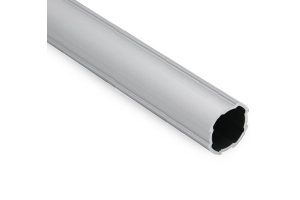 Aluminium Lean Pipe Joint System 28 mm for Kaizen Cart Frames
28 mm lean pipe joint system in aluminium tube with a 1.0 mm wall,…
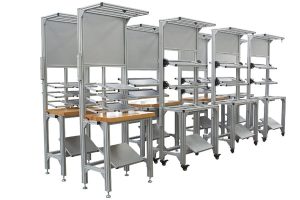 ESD Aluminium Profile Workbench 40 x 40 mm Anti-Static Assembly Frame
ESD workbench built on a 40 x 40 mm aluminium profile frame, supplied mill…
 Aluminium Profile Stair Stringer 45 x 90 mm for Access Platforms
45 x 90 mm six slot heavy aluminium profile at about 4.85 kg/m, cut…
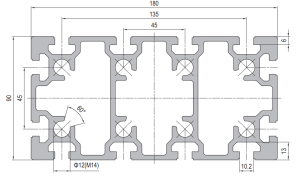 Aluminium Profile CNC Router Gantry 90 x 180 mm Twelve Slot Beam
90 x 180 mm twelve slot aluminium profile at about 9.50 kg/m for a…
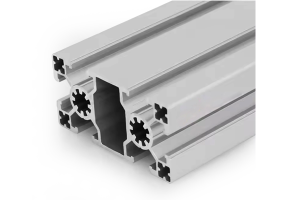 Aluminium Profile Truck Body Frame 50 x 100 mm for Dry Freight Boxes
50 x 100 mm six slot aluminium profile at about 5.40 kg/m for dry…
