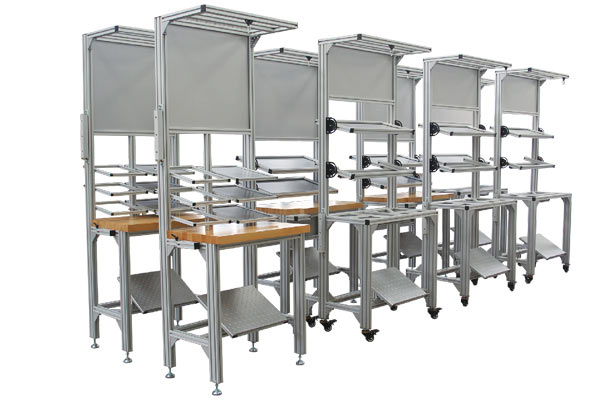
ESD Aluminium Profile Workbench 40 x 40 mm Anti-Static Assembly Frame
ESD workbench built on a 40 x 40 mm aluminium profile frame, supplied mill finish as standard so the frame is conductive, or anodised with masked earth pads where a coloured frame is required.
| Material | Aluminium |
|---|---|
| Alloy Grade | 6063-T5 |
| Temper | T5 |
| Section Size | 40 x 40 mm, four slots, 30 mm pitch |
| Slot | M6 slot, 8 mm mouth, four faces, 30 mm pitch |
| Length | Cut to the bench drawing to +/-0.5 mm |
| Tolerance | Cut length +/-0.5 mm; earth pad position to the drawing; frame continuity checked on assembly |
| Surface | Mill finish standard; clear or black anodised with masked earth pads on request; powder coating not recommended for ESD frames |
| MOQ | No fixed minimum; priced per bench |
| Lead Time | 2 to 3 weeks for mill finish, plus about a week where anodising and masking are required |
| Loading Port | Shanghai / Ningbo |
| Supply Ability | Frame, bench and bonding points from one drawing, with continuity checked before shipment |
| Payment Terms | T/T 30% deposit + 70% before shipment | L/C at sight |
| Trade Terms | FOB | CIF | EXW |
| Certifications | Continuity test record per bench, material declaration, RoHS and REACH; ESD acceptance against the site plan |
01Why is an anodised aluminium frame a problem for ESD?
Because anodising is an electrical insulator. The anodic layer on aluminium is aluminium oxide, and that is the same material used as a dielectric in some capacitors. A beautifully finished black anodised 40 x 40 mm aluminium profile workbench frame has a surface resistance many orders of magnitude above the dissipative range, which means that in ESD terms it behaves like a plastic frame with a nice finish.
This is the single most common error in ESD bench design, and it is invisible: the frame looks like metal, it feels like metal, it is metal — and it does not conduct. A bench built this way will pass a visual inspection and fail a resistance measurement, usually at the worst possible moment.
| Frame finish | Surface behaviour | Suitable as an ESD earth path |
|---|---|---|
| Mill finish, bare aluminium | Conductive, essentially a short circuit | Yes, that is the point of using it |
| Clear anodised | Insulating | No, unless a bare-metal path is created |
| Black anodised | Insulating | No, unless a bare-metal path is created |
| Powder coated | Insulating | No |
| Bare aluminium with masked contact pads | Conductive at the pads only | Yes, and this is how a coated-looking bench is made to work |
If the customer wants a coloured frame and an ESD bench, the answer is a masked earth pad or a dedicated earth stud, not a thinner coating. There is no coating thickness that makes anodising conductive.
02What resistance is the bench actually supposed to have?
Three different things are being measured on an ESD bench, and they have three different targets. Confusing them is why benches get rejected for the wrong reason.
| What is measured | Target range | Why |
|---|---|---|
| Worksurface, point to point | 1 x 10^4 to under 1 x 10^9 ohm | Dissipative: slow enough to avoid a discharge, conductive enough to drain |
| Worksurface to ground | under 1 x 10^9 ohm | The charge has to reach the earth point, not sit on the mat |
| Frame to the common point ground | under 1 ohm | The frame is equipment, not personnel, so it is hard grounded |
| Operator wrist strap to ground | about 1 x 10^6 ohm | The resistor limits the current through a person, and it is a separate path |
The ranges above are the ones used in programmes built around IEC 61340-5-1 and ANSI/ESD S20.20, with worksurface testing to ANSI/ESD S4.1 and grounding to ANSI/ESD S6.1. The exact limits for a given site are set by that site’s ESD control plan, so the plan is the document to design to — not this page.
The important structural point is the third row: the frame is hard grounded, the operator is soft grounded. They are not the same circuit and they must not be mixed. A bench where the wrist strap is plugged into the frame, and the frame is earthed through a 1 megohm resistor, has put the operator’s limiting resistor in the equipment path and the equipment’s hard ground in the operator path. It measures plausibly and it is wrong.
03How is the earth path built on a profile frame?
One point, one conductor, and a deliberate bare-metal contact at every joint in the path. That is the whole design, and the difficulty is entirely in the word *deliberate*.
- Choose the finish first. Mill finish frame, or anodised frame with masked pads. Decide before the frame is ordered, because masking cannot be added afterwards.
- Pick one common point ground on the bench — usually a stud on one leg near the floor. Everything on the bench bonds back to that point and nothing bonds to anything else.
- Bond each leg to the frame with a star washer. A star washer bites through oxide and gives a gas-tight contact. A plain washer on aluminium gives a contact that reads fine when new and drifts.
- Check continuity leg to leg. On a bolted frame the joints are the weak links: an anodised frame reads open between legs, and even a mill finish frame can read a few ohms across a joint that has been assembled dry.
- Bond the worksurface mat to the same point, with its own conductor. Do not rely on the mat sitting on the frame.
- Bring the wrist strap to the same point through its own 1 megohm path. Two conductors to one point, not one conductor shared.
| Mistake | What it measures | Why it is wrong |
|---|---|---|
| Anodised frame with no masked pad | Open circuit from frame to earth | The coating is the insulator; there is no path at all |
| Wrist strap plugged into the frame | Looks correct, reads a few ohms | The operator loses the 1 megohm limiting resistor, and the equipment path gains it |
| Several earth points on one bench | Reads low, and drifts | Multiple paths make ground loops and give a reading that depends on where you probe |
| Mat laid on the frame with no bonding | Mat reads correct on its own | The mat is isolated from earth; charge accumulates until something else discharges it |
| Painted or coated bench top | Reads open | A coating over a dissipative material is an insulator |
The first row is the one to design out at quotation stage. Once the frame is anodised, the only fix is to drill and scrape a bare pad at each leg, which is a rework operation on a finished part and looks exactly like what it is.
04What does an ESD auditor actually do at the bench?
Six checks, in this order, and a bench that fails any one of them is written up regardless of how good the others are.
The six questions an ESD audit asks
- Is there a documented common point ground, and is it labelled?
- Does the frame read under 1 ohm from the farthest leg to that point?
- Does the worksurface read inside the site’s dissipative range, point to point?
- Does the worksurface read under 1 x 10^9 ohm to the common point?
- Is the wrist strap tested and logged, with its 1 megohm path intact?
- Are all conductors on the bench — frame, mat, tooling, containers — bonded to the same point, with nothing bonded to anything else?
Notice that only one of those six is about the frame material. The other five are about the topology of the earth path, and topology is what actually fails in service. A bench with a mill finish frame and a careless earth arrangement fails more often than a bench with a masked anodised frame and a carefully drawn one.
05What else on the bench has to be dissipative?
Everything that touches the product, and this is where the cost of an ESD bench accumulates faster than the frame.
- Worksurface: dissipative laminate, or a dissipative mat over a conductive substrate. A standard laminate top is an insulator and will fail the point-to-point test.
- Shelving and bins: dissipative or conductive containers. A standard plastic tote is one of the best charge generators on a bench.
- Tooling and fixtures: bonded to the common point if they are metal and large; small hand tools are usually left to the operator’s wrist strap.
- Sitting or standing: a conductive or dissipative floor, or a dissipative mat under the operator, and footwear or a heel strap as part of the personnel path.
- Ionisation: where insulators cannot be removed, an ioniser is the control, and it needs its own maintenance schedule and its own audit item.
A bench is only as good as its weakest conductor. A perfect frame with a standard laminate top and standard plastic bins is an ESD bench in name only.
06How does this differ from a cleanroom bench?
They overlap and they are not the same requirement. A cleanroom cares about particle shedding and cleanability; an ESD bench cares about charge. A profile frame suits both, for the same reason — it is straight, it has no horizontal ledges to collect dust, and it can be wiped down.
Cleanroom requirements
- No particle shedding from the frame or the top
- Wipeable surfaces, no open fasteners collecting dust
- Anodised frame is usually preferred, because it wipes clean
- Airflow must not be blocked by solid panels
- Grounding is not the governing requirement
ESD requirements
- Every conductor bonded to one common point
- Bare or masked metal on the frame, not a full coating
- Dissipative top, dissipative bins, dissipative flooring
- Personnel path through a 1 megohm resistor
- Particle shedding is not the governing requirement
Where both apply — electronics assembly in a cleanroom — the usual resolution is a masked anodised frame: anodised for cleanability, with bare pads at each leg and a documented bond. That is a drawing decision, and it is the reason this page keeps returning to the finish.
07What to check before ordering
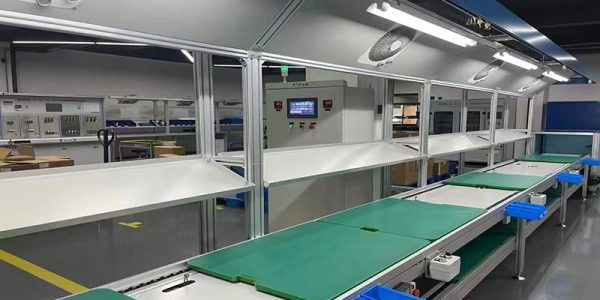
ESD workbench checklist
- Frame finish: mill finish, or anodised with masked earth pads
- Where the common point ground sits, and whether it is labelled on the drawing
- Worksurface material, and its resistance range against the site ESD plan
- Whether the mat is bonded with its own conductor or relies on contact
- Wrist strap provision, and whether it is a separate 1 megohm path
- Shelving and bins: dissipative or standard plastic
- Flooring and footwear, if the bench is part of a standing ESD area
- Whether an ioniser is needed, and where it mounts
- Whether the site’s ESD plan or a customer standard governs the acceptance test
08Questions from ESD coordinators and production engineers
Related sections and categories
Browse 40 Series Aluminium Profiles, Strut Profiles, or see the 40 x 40 mm four slot section for the frame data, and the assembly workstation frame page if the bench is part of a line rather than a single station.
Is anodised aluminium conductive enough for an ESD bench?
No. The anodic layer is aluminium oxide, which is an insulator. An anodised frame needs a masked bare pad or a dedicated earth stud before it can be part of the earth path.
What resistance should an ESD worksurface have?
Commonly 1 x 10^4 to under 1 x 10^9 ohm point to point, and under 1 x 10^9 ohm to ground. The exact limits come from the site’s ESD control plan, written around IEC 61340-5-1 or ANSI/ESD S20.20.
Should the wrist strap be connected to the bench frame?
Only if the frame is bonded to the common point ground and the wrist strap keeps its own 1 megohm path. The frame is hard grounded as equipment; the operator is soft grounded through a resistor. The two circuits must not be merged.
How many earth points should a bench have?
One. Everything on the bench bonds back to a single common point, and nothing bonds to anything else. Multiple points create loops and give readings that depend on where the probe is placed.
Can I have a black ESD bench frame?
Yes, with masked bare pads at each leg, or with a separate earth stud. The colour comes from the anodising, and the anodising is what has to be interrupted at the bonding points.
Do you supply the mat and the wrist strap?
The frame, the bench and the bonding points are ours. Mats, wrist straps, testers and ionisers are specified by the site’s ESD plan and are usually sourced locally, but we will build the bench to accept them.
What to send for an ESD bench quote
- Bench drawing or dimensions, and the working height
- Frame finish: mill finish, or anodised with masked earth pads
- Worksurface material and thickness, or the resistance range required
- Where the common point ground will be, if it is already fixed
- Shelving, drawers and bin rails required
- Castors, levelling feet, or fixed feet
- Whether the bench is a single station or part of a line
- The site ESD plan or customer standard the bench will be tested against
- Quantity, and whether a first article bench is to be tested before the batch
Tell us which standard the bench will be tested to. It changes the finish, the bonding points and the drawing, and it is free to say at enquiry stage.
Send the bench drawing and the ESD standard
Tell us the bench size, whether the frame must be a colour, and which ESD plan the bench will be tested against. The finish and the bonding points follow from those three answers.
Request a quotationRelated Products
 Aluminium Profile Stair Stringer 45 x 90 mm for Access Platforms
45 x 90 mm six slot heavy aluminium profile at about 4.85 kg/m, cut…
 Aluminium Profile CNC Router Gantry 90 x 180 mm Twelve Slot Beam
90 x 180 mm twelve slot aluminium profile at about 9.50 kg/m for a…
 Aluminium Profile Truck Body Frame 50 x 100 mm for Dry Freight Boxes
50 x 100 mm six slot aluminium profile at about 5.40 kg/m for dry…
 Solar Mounting Aluminium Rail 45 x 45 mm for PV Array Frames
45 x 45 mm four slot aluminium profile at about 2.55 kg/m, used as…
 45 x 180 mm Aluminium Extrusion for Typhoon-Zone Frames
45 × 180 mm aluminium extrusion in 6063-T5 for outdoor frames in the Philippine…
 Aluminium Profile for Sale: 45 x 60 mm Cut to Length, No Minimum Run
45 x 60 mm aluminium profile in 6063-T5, sold by the length or by…
 20 x 80 mm Narrow Aluminium Profile for Textile and Diamond Machinery
20 x 80 mm ten slot narrow aluminium profile in 6063-T5 for machinery where…
 45 x 180 mm Aluminium Extrusion: Arrival Inspection for Importers
45 × 180 mm aluminium extrusion in 6063-T5 for importers clearing at Nhava Sheva.…
