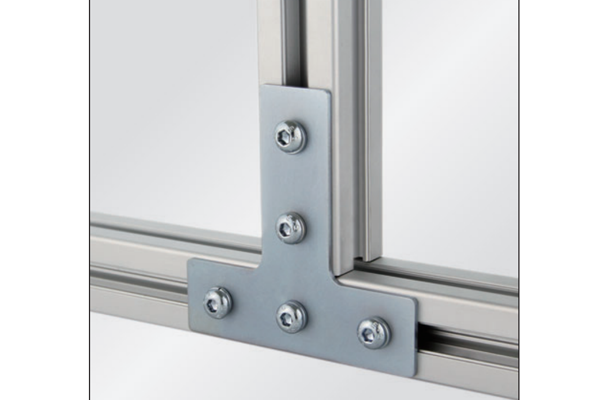
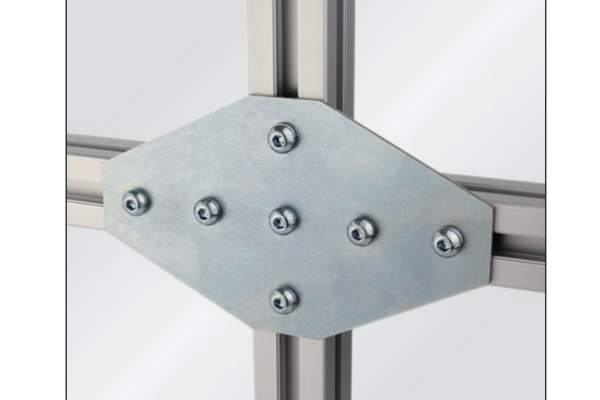
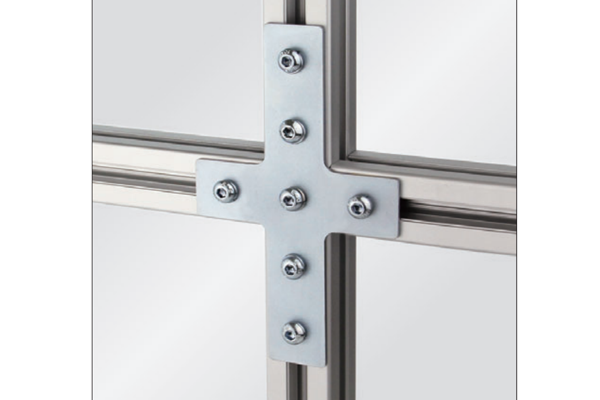
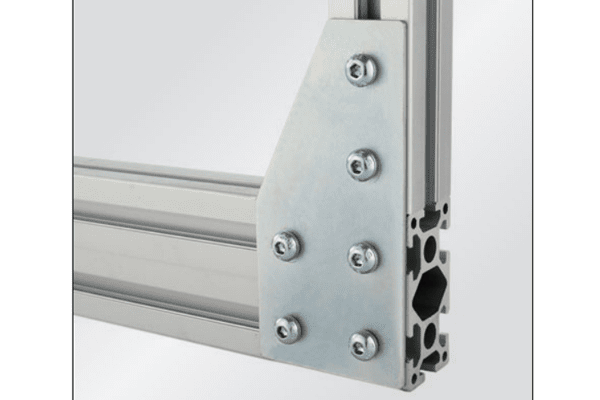
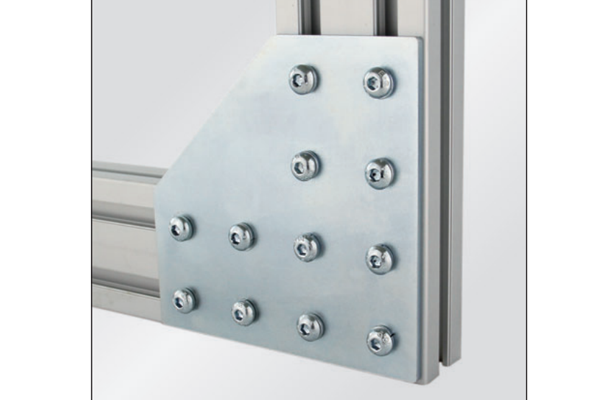
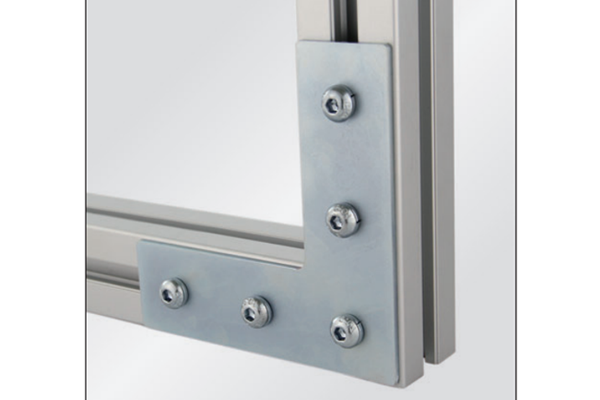
A joining plate is a flat plate drilled with a pattern of slots or holes that matches the T-slot spacing of a profile series. It bolts into the slot and can be used to join two members end to end, to double two profiles together into a stiffer composite member, or to reinforce a corner by spreading the load along the profile rather than concentrating it at one point.
Below: the three jobs a plate does, why doubling is the most under-used technique in profile framing, and how to choose a plate pattern.
What a plate does that a bracket cannot
Brackets and plates are often treated as interchangeable, and they are not. A bracket joins two members at a point. A plate joins them along a length.
That difference produces three capabilities.
- Alignment. Two members joined end to end with a plate on the outside face are held in a straight line, because the plate spans the joint and the slot pattern fixes both members to the same reference. A bracket cannot do this: it holds an angle, not a line.
- Load spreading. Because the plate bolts into the slot at several points along its length, the joint load is distributed over a much longer run of slot lip. That is the single most effective way to raise the capacity of a joint without changing the profile.
- Doubling. Two profiles bolted side by side with plates behave as one much stiffer member. A composite of two 40×40 members is far stiffer than a single 80×40 of similar weight, and it is built from standard parts.
Doubling: the technique worth knowing
Where a span is too long for one profile but a larger section is unavailable, too heavy or too expensive, doubling is usually the answer. Two members are laid side by side, separated by a small gap or butted together, and joined with plates on one or both sides at intervals along the length.
| Arrangement | Effect | Best for |
|---|
| Two members side by side, flat | Doubles the width; modest increase in bending stiffness in the vertical plane, large increase in resistance to twisting | Gantry beams and rails where torsion is the problem |
| Two members side by side, on edge | Doubles the depth in the bending plane; very large increase in stiffness | Long spans where a single deeper section is not available |
| Two members with a gap and a spacer | Creates a box-like section; high torsional stiffness | Machine beams that carry an eccentric or moving load |
| Member plus a flat plate web | Converts an open section into a closed one on one face | Quick stiffening of an existing beam |
Two rules apply. The plates must be repeated along the length rather than used at the ends only, because the joint between the two members has to be maintained over the whole span. And the gap between the members should be small or closed with a spacer, because two loosely coupled members behave as two separate beams, not one.
Practical point: doubling with plates is usually cheaper than moving up a profile size, and it can be done to a frame that is already built. If a beam deflects more than you want, plate a second member alongside it before ordering a heavier section.
Plate patterns and how to choose one
| Pattern | Bolts | Use it for |
|---|
| 4-slot plate | 4 | Short butt joints and light corner reinforcement |
| 6-slot plate | 6 | General butt joints on 30 and 40 series; the usual all-round plate |
| 8-slot plate | 8 | Longer joints and heavier load spreading |
| Corner plate | 4–8 | Inside a corner, spreading load along both members |
| Custom plate | As drawn | Where the plate also has to carry a bracket, a hinge or a mounting pattern |
The plate thickness matters as much as the pattern. A thin plate will dish as the bolts are tightened, which loses the alignment the plate was fitted to provide. As a working guide, a plate should be thick enough not to bow visibly when the bolts are torqued, and on heavy joints it is worth using a thicker plate with fewer bolts rather than a thin plate with many.
Where plates are the right answer
Extending a memberA frame that needs a longer member than the standard 6 m extrusion can be built by butting two members with a plate on each face.
Reinforcing a base cornerA plate bolted inside a base corner spreads the load from a machine foot along the profile instead of concentrating it at one point.
Stiffening a long beamDoubling with plates is the cheapest fix for a beam that deflects too much.
Carrying a hinge or a doorA plate provides a flat, drilled mounting surface for hinges and door and window elements without drilling the profile itself.
Mounting a componentWhere a motor, a bearing block or a sensor has a fixed bolt pattern that does not match the slot spacing, a custom plate adapts it.
Repairing a damaged slotA plate can bridge a locally damaged slot and carry the load past it, which is often cheaper than replacing the member.
Installation notes
A plate is only as good as the surface it is bolted against. Four points come up repeatedly on site.
- Deburr the ends before assembly. A burr on a butted end face holds the plate off the profile and shows as a visible step in an otherwise straight run.
- Check straightness after tightening. Tightening a plate can pull a run out of line if the ends are not square. Check with a straight edge rather than by eye.
- Use the full bolt pattern. Leaving positions empty concentrates load on fewer points and defeats the purpose of a plate.
- Do not mix series. Plate patterns are series-specific. A 30 series plate will not align with a 40 series slot spacing, and the same trap exists between 40 and 45 series.
Materials and finishing
Plates are normally supplied in aluminium or zinc-plated steel. Aluminium plates can be anodised to match the frame, which matters where the plate is visible; steel plates are stronger but a different colour. Where a plate is used inside a frame and never seen, material choice is purely about strength and cost. The frame finishes are described under anodised aluminium profiles.
Specifying a joining plate order
Give us the profile series, the joint type, the length of the joint, the material, the finish and the quantity. If the plate has to carry a mounting pattern for a motor, a bearing or a hinge, send that pattern and we will drill the plate to suit, which is usually cheaper than adapting on site. Custom plates are a machined item rather than a catalogue part; see CNC machining for lead times. Standard plates are quoted within one working day. Related ranges: connecting elements, anchor connectors, die-cast brackets, angle profile brackets and fastening elements.