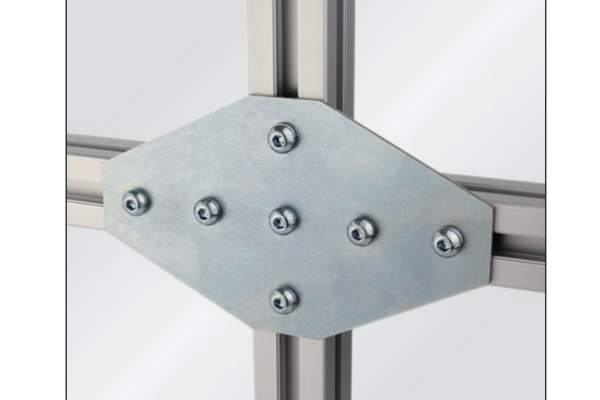
Joining Plate PG40
The 40 series joining plate range — L, T and cross variants that bolt into the 8 mm profile slot with T-nuts to build corner, tee and four-way joints.
| Material | Die-cast aluminium ADC12 or machined 6063-T5 |
|---|---|
| Alloy Grade | ADC12 die-cast or 6063-T5 |
| Temper | custom |
| Section Size | Fits 40x40, 40x80 and 40x120 mm profiles |
| Slot | 8 mm slot; M8 T-nuts and bolts |
| Length | Plate 80x80 to 120x120 mm |
| Tolerance | ±0.25 mm on bolt slot positions |
| Surface | Anodised or powder coated |
| MOQ | 500 |
| Lead Time | 15-25 days after deposit |
| Loading Port | Shanghai / Ningbo |
| Supply Ability | 300,000 pcs per month |
| Payment Terms | T/T 30% deposit + 70% before shipment | L/C at sight |
| Trade Terms | FOB | CIF | EXW |
| Certifications | ISO 9001:2015 | ISO 14001 | RoHS | REACH |
Joining plates · 40 series range
The PG40 range is the family of joining plates for 40 series profiles. The L plate makes a corner, the T plate makes a tee, and the cross plate makes a four-way joint. All of them fix the same way: they sit on the outside of the joint and bolt into the T-slot of each member with T-nuts, so no machining of the profile is needed and the joint can be taken apart with a hex key.
Treating the range as a family rather than as individual parts is how a frame is designed efficiently. A designer who knows the three variants can plan a whole frame from one plate family and one bolt size, which keeps the bill of materials short and the assembly simple. That is why 40 series is the default series for machine frames: the plate range covers almost every joint a frame needs.
The three plate variants and the joint each makes
How the plate fixes, and why it matters
Every plate in the range fixes the same way: a T-nut is dropped into the profile slot, the plate is laid over it, and a bolt is passed through the plate into the nut. As the bolt tightens, the T-nut is drawn against the inside of the slot and the plate is clamped to the outside face of the profile. The joint is held by friction between the plate and the profile face, plus the shear capacity of the bolt and the slot.
That is a good joint in shear and a moderate one in bending. The plate is what improves the bending performance: because it is a flat plate clamped over a large area, it resists the corner rotating by bearing on the profile face, not just by the bolt. A larger plate with more bolts resists a larger moment, which is the basis of the heavier plates in the range.
| Plate | Legs | Bolts | Typical use | Moment capacity |
|---|---|---|---|---|
| L (corner) | 2 | 2 + 2 | Rail to leg | Moderate |
| L heavy | 2 | 3 + 3 | Loaded corner, machine frame | High |
| T (tee) | 3 | 2 + 2 + 2 | Shelf rail, divider | Moderate |
| Cross | 4 | 2 × 4 | Four-way joint, mid-rail | Moderate |
| Flat splice | flat | 2 + 2 | In-line butt joint | Low (backing only) |
- Choose the plate for the joint Corner, tee or cross. Where a joint carries a moment, choose the heavy variant rather than two standard plates.
- Confirm the slot and the bolt size 40 series uses an 8 mm slot and M8 T-nuts. Confirm the profile is a genuine 40 series slot before ordering, because slot geometry varies between ranges.
- Set the T-nuts first Drop the T-nuts into the slot and slide them to position before offering the plate up. Fitting the nuts after the plate is in place is slow and unreliable.
- Square the joint before tightening Hold the corner square with a square, then tighten finger-tight. Only torque the bolts once the joint is square.
- Torque in two diagonal passes Tighten to the recommended torque in two passes, diagonally. On an M8 T-nut in a 40 series slot the usual figure is around 20 Nm, but confirm against the profile supplier’s data.
Practical point: a plate bolted into the slot is a friction joint, and a friction joint depends on the torque. A plate that is finger-tight will hold the frame together while it is built and let it move in service. Torque every bolt, and re-check after the frame has carried its load for a shift.
Frequently asked questions
Which PG40 plate should I use for a corner?
The L plate. For a loaded corner use the heavy L, or fit two standard L plates, one on each visible face of the corner.
Do the plates require any machining of the profile?
No. They bolt into the slot with T-nuts. That is the main advantage over a machined joint, which needs the profile end drilled and tapped.
What torque should the bolts be tightened to?
Around 20 Nm for an M8 T-nut in a 40 series slot, but confirm against the profile supplier’s data. A friction joint is only as good as its torque.
Can I mix plate sizes on one frame?
Yes, and it is normal. A frame might use heavy L plates at the loaded base corners and standard L plates everywhere else. Keep the bolt size consistent so one tool fits the whole frame.
Are the plates available in stainless?
Yes, for wash-down and outdoor frames, with stainless T-nuts and bolts to match.
Send the frame drawing and we will pick the plates
Send the frame drawing or the joint list. We will mark up which plate variant belongs at each joint, the bolt size and the quantity, and return FOB pricing within one working day.
Request a QuoteRelated Products
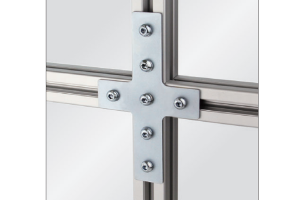 Joining Plate PG40-4040
Joining plate sized for two 40 × 40 mm profiles meeting at 90°, the…
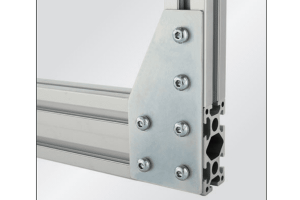 Joining Plate PG40-4080
Transition joining plate that joins a 40 mm member to an 80 mm member…
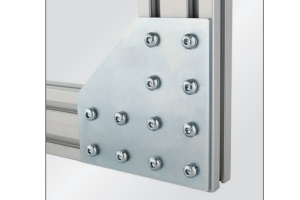 Joining Plate PG40-8080
Heavy joining plate for two 80 mm profiles at 90°, a structural corner joint…
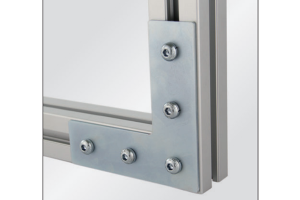 Joining Plate PG45-4545
Joining plate for two 45 × 45 mm profiles at 90°, sized to the…
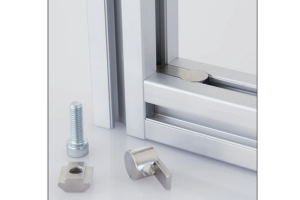 Butt Connector
Connector that joins two profiles end to end in a straight line, transmitting bending…
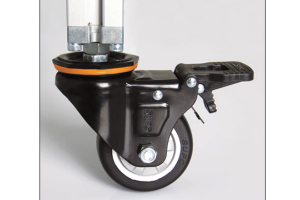 Aluminium Profile Castors
Castors for aluminium profile frames in seven configurations — plate fixed, swivel, braked and…
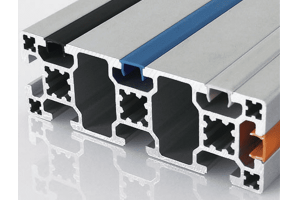 T-Slot Cover Profile
Snap-in T-slot cover strip that closes the open slot on aluminium framing profiles, giving…
 Aluminium Conduit End Cap
Snap-fit or screw-fixed end caps for aluminium conduit profiles from 40x40 to 80x200 mm,…
