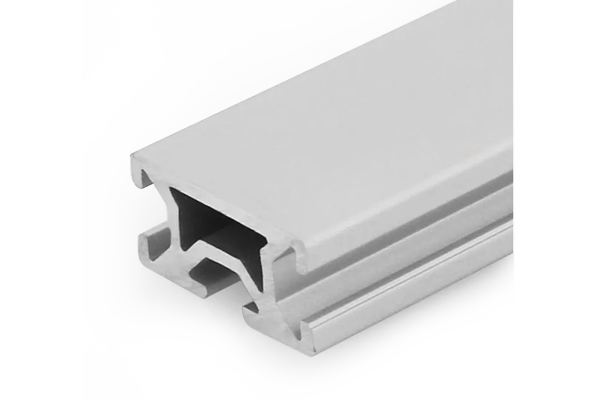
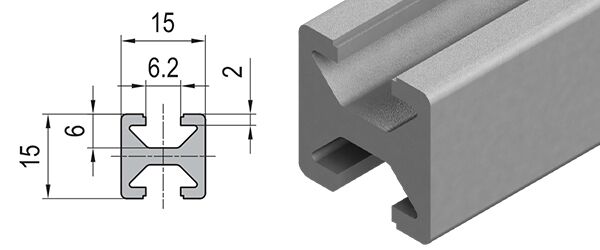
15 series aluminium profiles are slotted extrusions on a 15 mm module with a 5 or 6 mm T-slot. The range covers 15×15, 15×30, 15×45, 15×60, 15×90, 30×30 and 30×60 in the small-slot family. They take M4 and M5 T-nuts, are light enough to be carried by hand, and are used where a frame has to be visually slim rather than load-bearing. In some European and Asian catalogues the range appears as PG15.
Below: where 15 series beats 20 and 30 series, what the small slot will and will not take, and the assembly rules that keep a fine slot from being damaged.
What defines the 15 series
The module is 15 mm, so the base square is 15×15 and larger members are multiples of that. The slot is 5 mm on the slimmest sections and 6 mm on the heavier ones in the family. That narrow slot is the whole point: it lets the profile stay thin while still carrying a concealed fastener, which is what makes a 15 series frame look like a finished product rather than a machine structure.
One naming caution. Catalogue numbering is not consistent between suppliers — some call a 6 mm slot on a 15 mm module the "16 series", others keep "15 series" for both slot widths. Always quote the slot width in millimetres alongside the series number, because the slot decides which nuts and brackets will fit.
The size family
| Section | Slot | Typical role | Notes |
|---|
| 15×15 | 5–6 mm | Sensor rails, light posts, panel edges | Available as a solid and as a light variant |
| 15×30 | 5–6 mm | Small frame uprights, brackets, door stiles | The most-used member in the series |
| 15×45 | 6 mm | Frame sides that also carry a small panel | Two slots on the wide face |
| 15×60 | 6 mm | Compact beams over a small opening | Keep the span short; stiffness is limited by the 15 mm depth |
| 15×90 | 6–7 mm | Low-profile beams and step edges | Useful where the overall frame height has to stay small |
| 30×30 / 30×60 (small slot) | 6 mm | Transition members into a 20 series frame | Shares the slot but not the bolt centres of a 30 series 8 mm frame |
Where 15 series is the right answer
Sensor and camera railsA 15×15 rail can be positioned to the millimetre in a slot and then locked, without the visual bulk of a 30 series member.
Small enclosures and control boxesThe frame disappears behind a panel, which is usually what an equipment designer wants.
Laboratory and test rigsHand-portable structures that are rebuilt between experiments and often sit on a bench.
Display and exhibition framesSlim, anodised, and light enough that a single person can assemble a 2 m frame.
15 series or 20 series?
This is the decision most designers get wrong, usually by going too small. Both series take a small slot and both look slim; they differ in how much abuse the frame will take.
| Question | 15 series | 20 series |
|---|
| Slot width | 5–6 mm | 6 mm |
| Typical fastener | M4, M5 | M5, M6 |
| Practical span | Under roughly 500 mm | 500–900 mm |
| Best for | Rails, brackets, slim frames, portable structures | Jigs, fixtures, small automation cells, benches |
| Step up when | The frame will be moved as one piece, or a panel is bolted on | The frame has to stay square under load |
If the frame will be lifted and carried as a unit, or if a rigid panel will be bolted across it, choose 20 series. The extra 5 mm of module buys a great deal of resistance to twisting, and the cost difference is small compared with rebuilding a frame that flexes.
The limits of a small slot
A 5 or 6 mm slot is not a structural fastener system, and treating it as one is the main cause of failed 15 series frames.
- Torque is limited. Overtightening a small T-nut will deform the slot lip before the fastener reaches its rated torque. Use a torque driver rather than a standard hex key.
- Point loads are the enemy. A single bracket carrying a cantilevered load will crush the lip. Spread the load with a plate or a second bracket, as described under joining plates.
- Vibration loosens small fasteners. Where a machine vibrates, use a thread-locking compound or a serrated washer, or move up to 20 series.
- Do not mix slot widths in one joint. A 5 mm nut in a 6 mm slot will turn under load; check the slot width on every member before ordering hardware.
Practical point: the cheapest way to stiffen a 15 series frame is not a bigger profile — it is a closed panel. Bolting a rigid sheet across the back of the frame typically raises its torsional stiffness more than any change of section, and it also hides the frame.
Assembly notes for a fine slot
15 series frames are usually assembled with concealed connectors, because a visible bracket on a 15 mm member defeats the purpose of using a slim profile. That means the joint needs an end tap in one member, so the frame should be planned before it is cut. Where the frame is supplied as a kit we mark each member and tap the ends to the drawing, which removes the most common source of assembly error.
Cut squareness matters proportionally more at this scale. A 0.3 mm error over a 300 mm member is as visible in the finished corner as a 1 mm error over a metre, so cut members to ±0.2 mm with square ends and deburr them.
Finishes
Satin anodised is the normal finish, in clear, black or bronze. Because the members are thin, the appearance of the finish is more prominent than on a heavy profile, so a shade sample is worth having before a production order. Mill finish is used where the frame will be painted or enclosed. Film grades and their dimensional effect are described under anodised aluminium profiles.
Specifying a 15 series order
Give us the section, the slot width in millimetres, the finish, the cut list and the quantity, and tell us whether the frame will be assembled with concealed connectors or with visible brackets — that decides which ends need tapping. Standard sections are quoted within one working day. Related ranges: 20 series, 30 series, strut profiles, connecting elements and profile accessories.