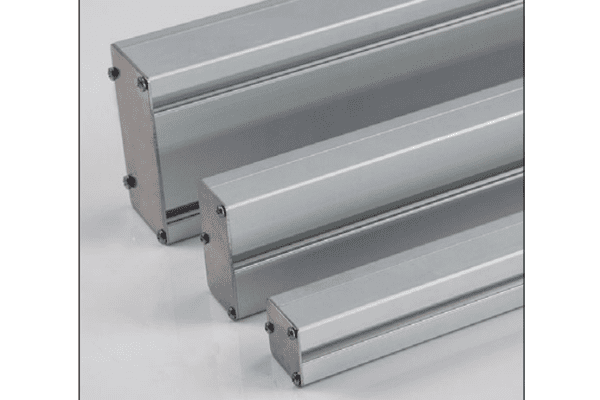
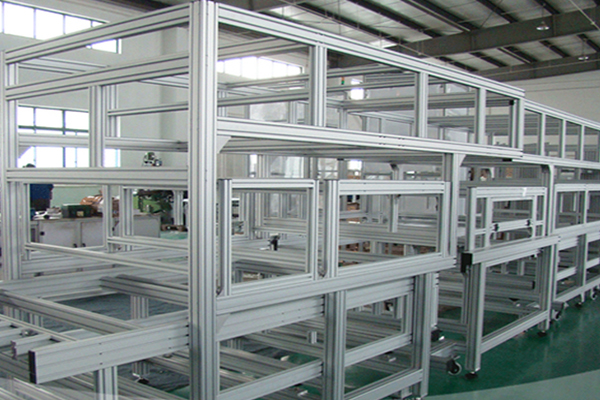
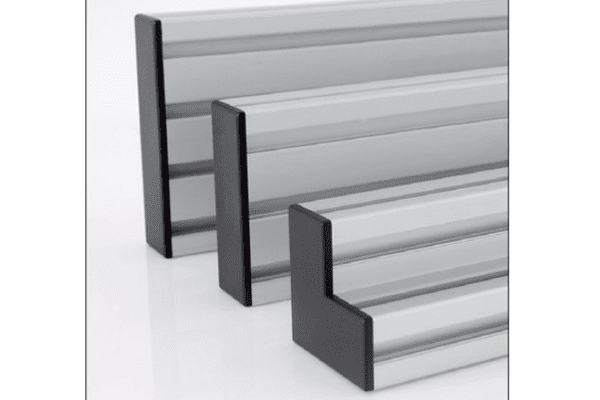
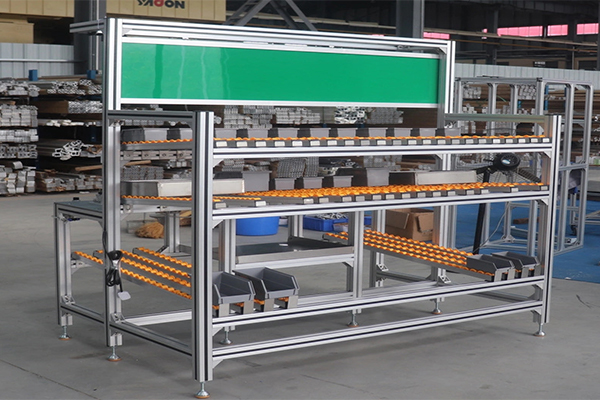
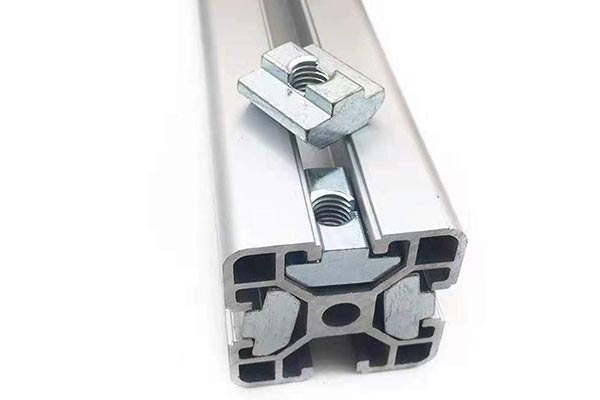
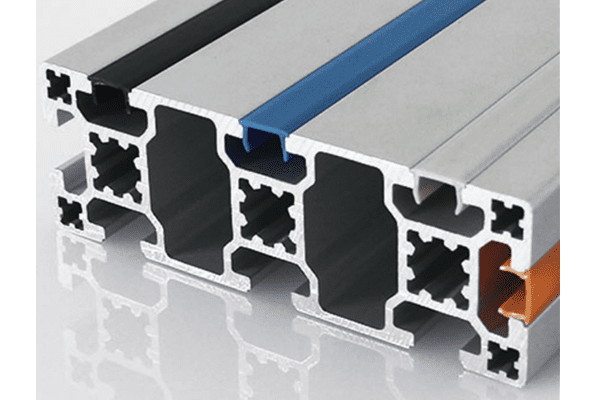
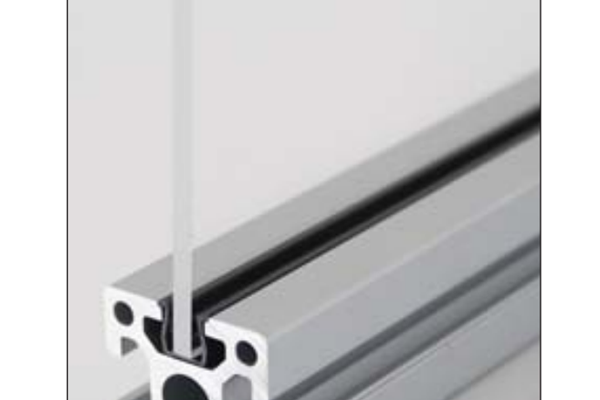
Profile accessories are the finishing and detail parts that fit into or onto an extruded profile: end caps that close an open section, slot covers that seal or dress the T-slot, sealing strips that retain panels, and slot-mounted fittings such as handles, hinges and cable clips. They are low-cost items that decide whether a frame looks finished and whether it stays clean in service.
Below: what each accessory family actually does, and the four cases where leaving one out costs more than fitting it.
End caps
An extruded profile has an open end that shows the section, and on a slotted profile that end is also a collection of sharp slot lips. An end cap closes it.
| Type | Fitting | Use it when |
|---|
| Push-in cap | Presses into the end of the section | The standard finish for visible frame ends |
| Slotted cap | Closes the end while leaving a slot open for a panel or a connector | Where a panel runs to the end of a member |
| Cover cap | Clips over the end and the first part of the slot | Where the slot also needs to be closed at the end |
| Foot pad | Sits under a frame leg | Protecting a floor and stopping a frame from sliding |
End caps are usually supplied in a plastic or nylon in a colour matched to the profile, and they are the cheapest single improvement to the appearance of a frame. They also serve a practical purpose: an open end will damage whatever it is dragged across, and it will hold a pool of coolant or wash water.
Slot covers and sealing strips
An open T-slot is a functional feature and, on a finished product, an untidy one. Two families of accessory deal with it.
Slot covers
A slot cover is a strip that presses or slides into the slot and closes it flush with the profile face. It has three uses: it stops swarf, dust and liquid collecting in the slot; it presents a smooth face where a person may come into contact with the frame; and it hides the slot on a frame that is meant to look like a single piece of aluminium.
Sealing strips and glazing gaskets
A sealing strip is a flexible profile that is fitted into the slot and provides a grip or a seal for a panel. It is the standard way to retain a sheet of polycarbonate or glass without drilling it, and it also provides a degree of sealing against dust and water.
| Accessory | Function | Panel retention |
|---|
| Slot cover | Closes the slot flush | None |
| Sealing strip | Grips the panel edge and seals against it | Yes, by friction and compression |
| Glazing gasket | Two-part system, one strip each side of the panel | Yes, and it allows thicker panels |
| Brush strip | Closes a gap while allowing movement | None; used on sliding guards |
Practical point: a sealing strip retains a panel by friction, so it is not a structural fixing. Where a panel has to resist pressure, impact or a person leaning on it, retain it mechanically as well. The mechanical options are described under panel installation elements.
Slot-mounted fittings
Because the slot is a continuous fixing track, almost anything that has to be attached to a frame can be attached through it rather than by drilling.
HandlesBolt into the slot on a door or a drawer front. No drilling means no swarf inside a closed profile and no risk of hitting a cable.
Cable clipsPress into the slot and hold a cable or a hose against the frame. Cheaper and tidier than adhesive clips, and repositionable.
HingesSlot-mounted hinges let a door be fitted and adjusted without machining the profile. See hinges.
Feet and padsLevelling feet and protective pads mount in the slot at the base of a leg. See levelling feet.
Tool and document holdersBench-side holders that clip into the slot on a workstation frame.
Label and sign holdersSlide into the slot so machine identification and safety signage can be changed without tools.
Four cases where leaving an accessory out costs more
- Cleanroom and food equipment. An open slot collects material and cannot be cleaned effectively. Slot covers and sealing strips are not cosmetic here; they are what makes the frame cleanable.
- Wash-down areas. Water standing in an open slot will find its way into a joint and stay there. Covers and seals protect the joint rather than the appearance.
- Any frame a person can reach. An open slot has edges, and a slot with a T-nut at an exposed position has a thread that will be filled with debris. Covers protect the user and the hardware.
- Frames that are shipped. An open profile end and an open slot are the two places a frame gets damaged in transit. Caps and covers are cheaper than a repair.
Colour matching and appearance
Accessories are supplied in a range of colours, and the choice affects how the finished frame reads. Black caps and covers on a black anodised frame make the profile look like a single extrusion; light grey covers on a clear anodised frame are almost invisible. Where a frame is powder coated to a specific RAL colour, ask for covers in a matching shade rather than accepting a near-match, because the cover is usually the most visible accessory on the finished product.
The frame finishes themselves are described under anodised aluminium profiles.
Ordering accessories
Accessories are series-specific: a cover for an 8 mm slot will not fit a 10 mm slot, and a sealing strip is sized to both the slot and the panel thickness. When ordering, give the profile series, the accessory type, the colour and the quantity. If you are ordering a frame kit, tell us that the frame will be visible, will be cleaned, or will be shipped, and we will include the accessories that go with it — that is almost always cheaper than ordering them separately later. Standard accessories are quoted within one working day. Related ranges: panel installation elements, hinges, levelling feet, fastening elements and conduit profiles.