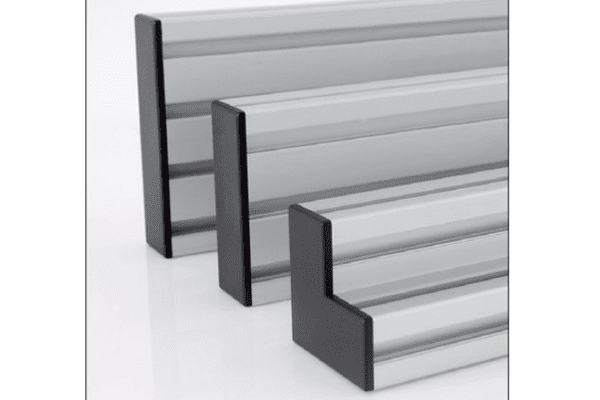
Aluminium Profile End Cap
Push-fit end caps for T-slot framing profiles from 15 to 60 series, sized to the outside dimensions of the section so the cap sits flush with the anodised face.
| Material | PA6 nylon |
|---|---|
| Alloy Grade | Not applicable (polymer accessory) |
| Temper | custom |
| Section Size | 15x15 to 60x120 mm profile sections |
| Slot | Covers the full end face including the slot mouth |
| Length | Cap height 6-12 mm depending on section |
| Tolerance | ±0.25 mm on outside dimensions |
| Surface | Moulded, UV stabilised |
| MOQ | 500 |
| Lead Time | 15-25 days after deposit |
| Loading Port | Shanghai / Ningbo |
| Supply Ability | 500,000 pcs per month |
| Payment Terms | T/T 30% deposit + 70% before shipment | L/C at sight |
| Trade Terms | FOB | CIF | EXW |
| Certifications | ISO 9001:2015 | RoHS | REACH |
Profile accessories · Frame finishing
An end cap closes the open end face of a T-slot profile. On a finished frame that single small part does three jobs at once: it removes the sharp edge left by the saw, it stops dust and swarf collecting in the slot that runs out of the end, and it makes the frame read as a designed product rather than a cut extrusion.
We hold caps for the 15, 20, 30, 40, 45, 50 and 60 series, square and rectangular, in PA6 nylon. The cap is sized to the exact outside dimensions of the section, so it sits flush with the anodised face rather than standing proud of it. Standard colours are black and grey; a colour matched to the profile anodising is available on moulded parts.
Three jobs, one part
It is worth being explicit about the three jobs, because a buyer who only thinks about appearance will specify the wrong cap.
Matching the cap to the section
The cap is matched to the outside dimensions of the profile, not to the slot width. A 30×30 profile and a 30×60 profile take different caps even though both have an 8 mm slot, and the rectangular cap is not simply two square caps joined.
| Series | Square sections | Rectangular sections | Cap type |
|---|---|---|---|
| 15 / 16 series | 15×15, 16×16 | 15×30, 16×32 | Push-fit, 1 detent rib |
| 20 series | 20×20 | 20×40, 20×60, 20×80 | Push-fit, 2 detent ribs |
| 30 series | 30×30 | 30×60, 30×90, 30×120 | Push-fit, 2 detent ribs |
| 40 series | 40×40 | 40×80, 40×120 | Push-fit, 2 detent ribs |
| 45 series | 45×45 | 45×90 | Push-fit, 2 detent ribs |
| 50 / 60 series | 50×50, 60×60 | 60×120 | Push-fit, 2 detent ribs |
Why the cap is sized to the outside, not the slot
A cap that grips inside the slot is cheaper to mould but leaves a visible step: the wall of the profile stands proud of the cap on all four sides. On a frame where the end is visible, that step is the first thing a buyer notices.
Sizing to the outside dimensions means the cap covers the whole end face, including the wall. It costs slightly more material and needs a tighter moulding tolerance, but it is the difference between a part that looks specified and one that looks added.
Practical point: caps are the cheapest part on the bill of materials and the easiest to forget. On an OEM frame programme we automatically include caps on every cut member that ends open, unless the customer tells us the end is being closed by a connector or a plate.
Fitting the cap on a frame that is already assembled
- Check the cut is square A cap on an out-of-square cut shows a wedge-shaped gap on one side. The members we supply are cut square to within 0.2 mm, but a site-cut end should be checked before the cap goes on.
- Deburr, do not file the profile down The burr should be removed from the profile, not the cap. Filing the cap rib removes the retention it was moulded for.
- Push in squarely by hand Both detent ribs should engage together. If one side needs a mallet, the cap is the wrong size for the section.
- Fit caps last On an assembled frame, fit the caps after all fasteners are torqued, so a socket does not knock a fitted cap off.
Frequently asked questions
Do end caps fit any 30 series profile?
They fit any 30×30 profile with the same outside dimensions and wall thickness. Two suppliers can both call a section 30×30 and still differ in wall thickness, so the cap is matched on the section drawing rather than on the series name.
Are the caps needed if the end is covered by a bracket?
No. Where a corner bracket, joining plate or base plate closes the end face, a cap would not fit and is not required. Caps are for members that end open.
Can caps be fitted after the frame is assembled?
Yes, and that is the normal sequence. Fit them after all fasteners are torqued so a socket does not knock them off.
Do you supply caps with a hole for a cable?
That is a different part. Cable entries belong on a conduit profile cap, which is moulded with a radiused entry. See the conduit end cap range.
What is the smallest order for a custom colour?
Around 2,000 pieces for a moulded cap, which is where a separate colour run becomes economical against the moulding setup.
Order caps with the frame, not after it
Send the section list and the member cut list. We will return the cap sizes, the quantities and FOB pricing, and bag the caps with the matching members so the kit assembles without sorting.
Request a QuoteRelated Products
 T-Slot Reducing Profile
Reducing insert that narrows a wide T-slot to accept standard nuts and accessories from…
 T-Nut and Bolt Set Aluminium Profile Fastener Kit M5 M6 M8 20-40 mm T-Slot Hardware
Matched T-nut, bolt and washer set for aluminium profile frames in M5, M6 and…
 Assembly Line Workstation Aluminium Profile Frame 40×40 mm T-Slot Workbench Structure
A re-configurable assembly workstation frame in 40 x 40 mm T-slot aluminium profile with…
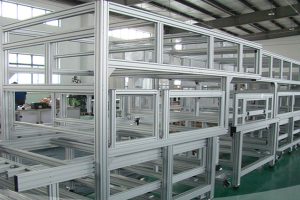 Aluminium Framing Extrusion Kit 40×40 mm 40 Series Cut List for Machine Frames
A cut-to-length aluminium framing extrusion kit in the 40 series: profile cut to a…
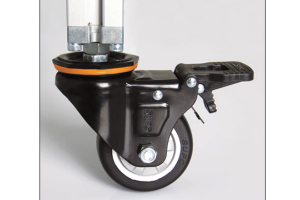 Aluminium Profile Castors
Castors for aluminium profile frames in seven configurations — plate fixed, swivel, braked and…
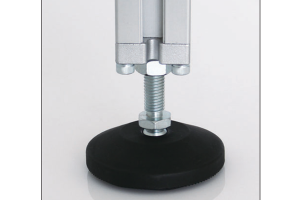 Swivel Ball Foot
Self-aligning levelling foot with a ball-and-socket joint between stem and pad, keeping the pad…
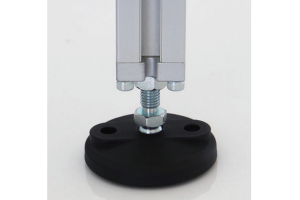 Swivel Foot with Mounting Holes
Levelling foot with a drilled base pad so the frame can be anchored to…
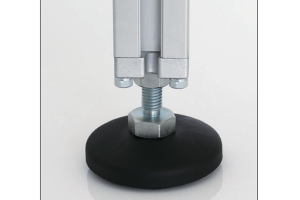 Nylon Pivot Foot
Levelling foot with a moulded PA6 nylon pivot joint and base, selected for vibration…
