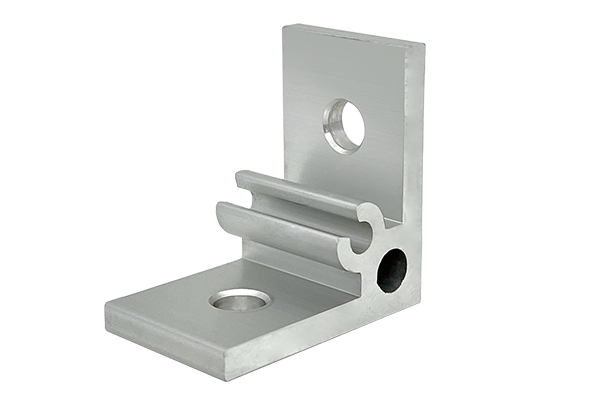
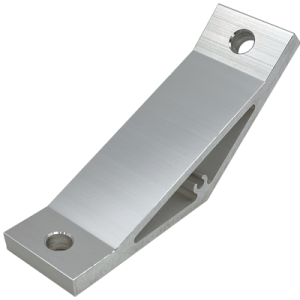
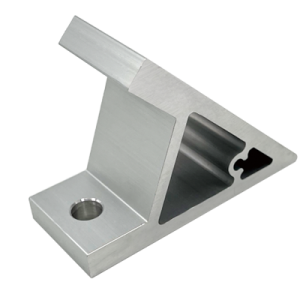
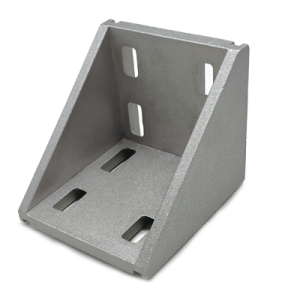
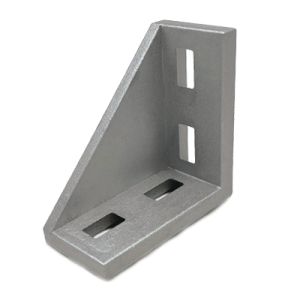
An angle profile bracket is an L-section bracket that fixes into the T-slot on each side of a joint. It comes in 90°, 45° and 135° forms, in leg thicknesses from about 3 mm to 10 mm, and in sizes matched to each profile series. Because it bolts into the slot with standard T-nuts, it needs no end machining and can be added to an assembled frame.
Below: when an angle bracket beats a die-cast bracket or a concealed connector, how the leg thickness decides the duty, and how to place brackets so they actually stiffen the frame.
Where an angle bracket earns its place
Three situations make it the obvious choice, and all three are about timing or access rather than about strength.
- Retrofitting a brace. A frame that has been built, moved or found to be too flexible can be braced without dismantling it. The bracket bolts into slots that are already there.
- Prototype and development frames. A frame that will be modified several times is better served by brackets that can be moved than by concealed joints that require machining at each change.
- Reinforcing a corner that carries more than it did. Where a machine has been changed and a corner now sees a higher load, a bracket plus a joining plate is the cheapest fix.
The trade-off is appearance and space. An angle bracket occupies the inside of the corner, which can obstruct a panel or a drawer, and it is visible unless the frame is clad.
Angles and where each is used
| Angle | Joint | Typical use |
|---|
| 90° | Right-angle corner | The standard frame corner; also used as a tee brace |
| 45° | Mitred corner | Frames where the members are cut at 45° so the joint is invisible from outside |
| 135° | Obtuse corner | Braces and stays, splayed legs, angled panels |
| Adjustable | Any angle | Two plates with a pivot, for prototype work and re-configurable rigs |
The 45° bracket is worth noting because it changes the appearance of the frame completely. With members mitred at 45° and braced from inside, a corner can look like a single piece of aluminium, which is the usual approach on furniture and retail frames where a visible joint is unacceptable.
Leg thickness decides the duty
Angle brackets look similar across a wide range of sizes, and the number that separates a light bracket from a structural one is the leg thickness.
| Leg thickness | Duty | Notes |
|---|
| 3–4 mm | Light frames, panels, alignment | Adequate to hold members in position; not intended to carry load |
| 5–6 mm | General machine frames | The usual choice for a braced corner on a 30 or 40 series frame |
| 8–10 mm | Heavy corners, cantilevers, base joints | Used where the corner resists a moment rather than just a shear |
A thicker bracket helps because the load is transferred into the profile over the length of the bracket leg. A longer, thicker leg spreads the load along more of the slot lip, which is where frames actually fail. That is why a heavy bracket usually outperforms two small ones at the same joint, even when the two small ones use the same total number of bolts.
Placing brackets so they stiffen the frame
Bolting a bracket to a corner makes the joint stronger. It does not necessarily make the frame stiffer, and confusing the two wastes money.
- Brace the rectangle, not the corner. A frame resists racking through its diagonals. One diagonal brace across a bay does more for stiffness than brackets at every corner.
- Put the bracket where the moment is. On a cantilever, the moment is at the root. A bracket at the tip does nothing.
- Use the bracket to spread load, not to add bolts. Two brackets at the same corner, mounted back to back, spread load along the profile; two brackets side by side at the same point do not.
- Do not rely on friction. A bracket that depends on friction between two flat faces will slip when it is loaded. Design the joint so the load is carried in shear by the bolts or by a shoulder.
Practical point: if a frame racks when you push it sideways, brackets will not fix it. Add a diagonal or clad one bay with a rigid panel, and the frame will become stiff for a fraction of the cost of extra brackets.
Angle bracket, die-cast bracket or concealed connector?
| Criterion | Angle bracket | Die-cast bracket | Anchor connector |
|---|
| Appearance | Visible inside the corner | Visible inside the corner | Fully hidden |
| Machining needed | None | None | End tap or counterbore |
| Retrofit onto a built frame | Yes | Yes | No |
| Load capacity | High; scales with leg thickness and length | Moderate; limited by the casting | Moderate; concentrated on the slot lip |
| Best for | Braces, repairs, heavy corners, prototypes | Fast assembly of standard corners | Frames where no hardware may show |
Hardware and installation
An angle bracket is fixed with T-nuts and bolts into the slot, so the fastener family matters as much as the bracket. Bolt length must suit the slot depth of the series; a bolt that is too long bottoms out and a bolt that is too short does not engage enough thread. Where the bracket is fitted into a slot that also carries other hardware, check that the T-nut and the neighbouring item do not compete for the same position.
Because the bracket bears on the slot lip, torque should follow the fastener maker's figure. Over-tightening a bracket is the usual cause of a crushed lip, and a crushed lip cannot be repaired.
Finishing
Brackets are supplied in the natural finish of their material — die-cast or machined aluminium, or zinc-plated steel. Where the bracket is visible on a frame that is anodised black, an anodised or powder-coated bracket in a matching shade is worth specifying, otherwise the joint will stand out. The frame finishes themselves are described under anodised aluminium profiles.
Specifying an angle bracket order
Give us the profile series, the joint angle, the leg size and thickness, the material, the finish and the quantity, and tell us whether the joint resists a shear load or a moment — that decides whether a standard bracket is adequate or a heavier one is needed. If the bracket is for a repair, a photograph of the joint is usually enough to identify the series. Standard brackets are quoted within one working day. Related ranges: connecting elements, die-cast brackets, joining plates, anchor connectors and fastening elements.