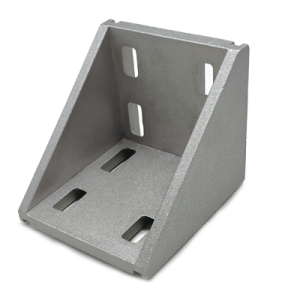
Heavy Duty Die Cast Corner Bracket for Aluminium Profile 60 80 90 100 mm Series
Heavy duty die cast corner bracket for large aluminium profile frames in 60, 80, 90 and 100 mm series. Two slotted holes per flange so the bolts form a couple and the corner resists a moment.
| Material | Zinc alloy |
|---|---|
| Alloy Grade | Zinc alloy, die cast |
| Temper | custom |
| Section Size | 60 / 80 / 90 / 100 mm series |
| Slot | M8 (M10 on 100 series) |
| Length | Flange 60 / 80 / 90 / 100 mm |
| Tolerance | Cast to ISO 8062 general tolerances |
| Surface | As cast / anodised / powder coated |
| MOQ | 1000 |
| Lead Time | 18-28 days after deposit |
| Loading Port | Shanghai / Ningbo |
| Supply Ability | 500,000 pieces per month |
| Payment Terms | T/T 30% deposit + 70% before shipment | L/C at sight |
| Trade Terms | FOB | CIF | EXW |
| Certifications | ISO 9001:2015 | RoHS | REACH |
Connecting · Heavy duty bracket
A heavy duty die-cast corner bracket is a right-angle bracket with a rib across the corner and two slotted holes in each flange instead of one. It is made for 60, 80, 90 and 100 mm series profiles, where the members are stiff enough that the corner, not the profile, decides how much the frame deflects.
The second hole in each flange is the important feature. With one bolt per flange the bracket is held by friction between the flange and the profile face, and friction is a weak and unreliable way to resist a corner trying to open. With two bolts the pair forms a couple: one bolt goes into tension and the other into compression, and the corner moment is resisted by a lever arm rather than by friction. For the same bolt size that is roughly three times the moment capacity, and it does not depend on how well the assembler tightened the joint.
On a large frame, the joint is the weak point
It is natural to assume that a big frame fails at the profile, because the profile is the part that visibly bends. In practice it usually fails at the joint. A 100 x 100 profile has a second moment of area of roughly 250 times that of a 20 x 20 section, so a large frame member is enormously stiff in bending. The corner is joined by a bracket with two to four bolts, and no amount of profile stiffness helps if the bracket lets the corner rotate.
That is why the bracket specification matters more on a large frame than on a small one. Doubling the profile size doubles the section depth and multiplies the stiffness by roughly sixteen, while the bracket usually goes up by one size. The gap between the two has to be closed by adding bolts, adding a brace, or both.
| Profile series | Flange | Slotted holes per flange | Bolts per corner | Bolt size |
|---|---|---|---|---|
| 60 series | 60 x 60 mm | Two | Four | M8 |
| 80 series | 80 x 80 mm | Two | Four | M8 |
| 90 series | 90 x 90 mm | Two | Four | M8 |
| 100 series | 100 x 100 mm | Two | Four | M8 or M10 |
Why two bolts per flange is a step change
A single bolt per flange resists the corner opening almost entirely by friction. The bolt preload presses the flange against the profile face, and the friction force resists sliding. That resistance is proportional to the preload and to the friction coefficient, and it acts at a very short radius, so the moment it can resist is small.
Two bolts change the mechanism. The pair forms a couple with a lever arm equal to the distance between them, which on a 100 mm flange is around 60 mm. Taking a typical M8 preload of about 10 kN and a friction coefficient of about 0.15, a single bolt flange resists roughly 30 Nm of corner moment. The same preload acting as a couple over a 60 mm arm resists roughly 90 Nm. The bolt size did not change; the arrangement did.
| Flange arrangement | How the moment is resisted | Approximate capacity, M8 |
|---|---|---|
| One bolt per flange | Friction at a short radius | About 30 Nm |
| Two bolts per flange | Couple over the bolt spacing | About 90 Nm |
| Two bolts plus a 45 degree brace | Couple plus an axial strut | Several times higher again |
When the corner needs a brace as well
A bracket resists the corner rotating. A brace resists the frame racking, which is a different and usually larger effect. The two are not interchangeable, and on a tall frame the brace is the one that matters.
A useful working rule is to look at the free height of the frame above the point where it is restrained, and compare it with the section width. Where the free height is more than about fifteen times the section width, the corner moment from an ordinary horizontal load exceeds what a bracket alone will hold reliably, and a diagonal brace should be added. Below that ratio the bracket is usually enough.
| Section width | Brace recommended above | Brace essential above |
|---|---|---|
| 40 mm | 600 mm free height | 1,000 mm |
| 60 mm | 900 mm free height | 1,500 mm |
| 80 mm | 1,200 mm free height | 2,000 mm |
| 100 mm | 1,500 mm free height | 2,500 mm |
The rule is a starting point, not a substitute for a check. A frame carrying a concentrated load at the top, or one that sees vibration, needs a brace at a much lower height than the table suggests. Send us the frame dimensions and the load and we will confirm whether a bracket alone is adequate.
Fitting a heavy duty bracket
- Load the nuts before the frame is standing Four bolts per corner means eight nuts on a typical two-member joint. Loading them into the groove while the member is on the bench is far easier than trying to feed them in once the frame is upright.
- Start all four bolts before tightening any Start the bolts by hand on both flanges first. Tightening one flange before the other is started pulls the bracket off position and the remaining bolts will not line up with the slots.
- Square the frame using the slots Measure the diagonals of the frame and move the brackets in their slots until the diagonals are equal. On a large frame this is the only practical way to square it, because the cut lengths will not be exact over several metres.
- Tighten in a diagonal sequence Tighten the four bolts in a diagonal pattern and in two stages, half torque then full torque. Tightening one flange fully before the other bows the flange and leaves the bracket sitting on one edge.
- Re-check the diagonals and the bolt torque Measure the diagonals again after tightening and re-check the torque after the frame has been standing for a day, because a large bracket settles into the profile face.
Bigger bracket or a brace? If the corner is opening under load, going up one bracket size helps by a limited amount, because the flange size is tied to the profile. Adding a diagonal brace helps by a great deal, because it changes the load path from bending to axial. On a frame that is already built, the brace is also the cheaper change.
Frequently asked questions
What is a heavy duty die-cast bracket for?
Making a rigid 90 degree corner in a large aluminium profile frame, in 60, 80, 90 and 100 mm series. It has two slotted holes per flange so the bolts form a couple rather than relying on friction alone.
Why does the second hole in each flange matter so much?
It changes the way the joint resists the corner opening. One bolt resists by friction at a short radius. Two bolts form a couple over the bolt spacing, which for the same bolt size is roughly three times the moment capacity.
When do I need a diagonal brace as well as a bracket?
When the free height of the frame is more than about fifteen times the section width. For a 40 mm section that is about 600 mm and for an 80 mm section about 1,200 mm. Send us the frame and the load and we will confirm.
Which series does it fit?
60, 80, 90 and 100 mm series profiles. The bracket has to match the series so the flanges land on the profile faces and the slots sit over the grooves, so tell us the section you are using.
Do you supply the bolts and nuts with the bracket?
Yes. The bracket can be supplied on its own or kitted with the bolts, washers and T-nuts for the series, which removes the risk of ordering a bolt that is the right thread but the wrong length for the flange.
Send the frame and the corner moment
Tell us the profile series, the free height of the frame and what the corner has to resist. We will confirm whether the bracket is enough or a brace is needed, quote the bulk price and supply samples.
Request a QuoteRelated Products
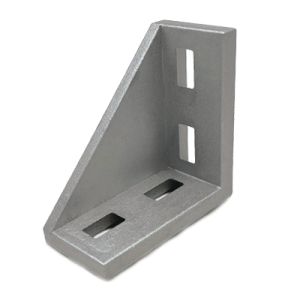 Rectangular Die Cast Corner Bracket Aluminium Profile 30×60 40×80 45×90 50×100 mm
Rectangular die cast corner bracket with unequal legs for aluminium profile frames built from…
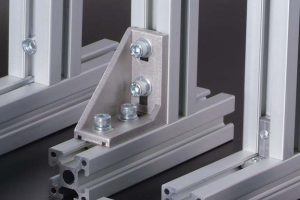 Aluminium Extrusion Connector System for 20×20 to 100×100 mm T-Slot Frames
A complete aluminium extrusion connector system covering visible brackets, hidden inner brackets, cubic corner…
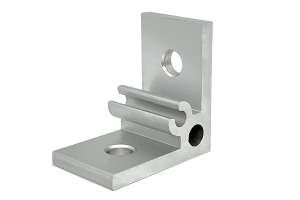 Aluminium Angle Profile Bracket 35x35x4 mm M6 Corner Brace for 20 and 30 Series Profiles
A 35 x 35 x 4 mm aluminium angle profile bracket for 20 and…
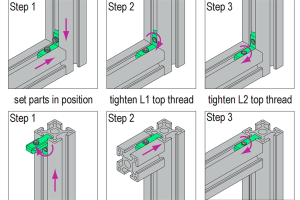 Aluminium Inner Bracket with Top Thread M5 M6 M8 for 20 to 40 mm T-Slot Profiles
A hidden inner bracket with top thread for aluminium T-slot profiles, supplied in M5…
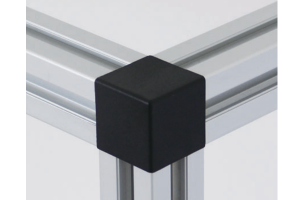 Aluminium Cubic Connector 2020 20×20 mm Three-Way Corner Joint with ABS Cap
A 20 x 20 x 20 mm three-way cubic corner connector for 20 series…
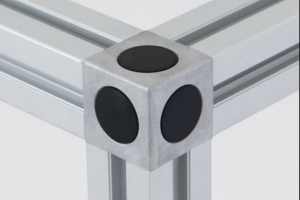 Cubic Connector 4545 45x45x45 mm Three-Way Aluminium Corner Joint Block for 45 Series
A 45 x 45 x 45 mm three-way cubic corner connector for 45 series…
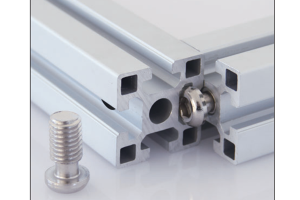 Self-Tapping Screw Connector for Aluminium Profile M6 M8 M10 to 50 mm Series
A self-tapping screw connector for aluminium profiles in M6, M8 and M10. Forms its…
 End Face Connector for Aluminium Profile M8 M10 up to 50 mm Series with Spring Clip
An end face connector for aluminium profiles in M8 and M10 with a spring…
