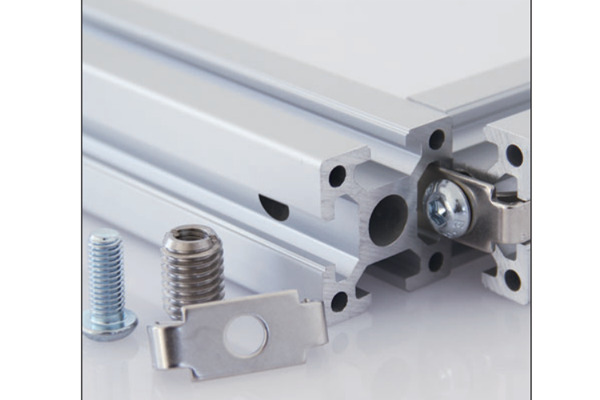
End Face Connector for Aluminium Profile M8 M10 up to 50 mm Series with Spring Clip
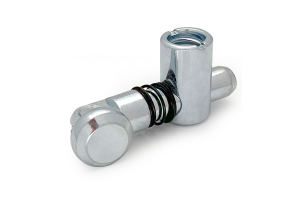
An end face connector for aluminium profiles in M8 and M10 with a spring clip. Bolts into a tapped end face for a hidden joint that can be dismantled and re-made many times.
| Material | Steel bolt and spring clip, zinc plated or stainless |
|---|---|
| Alloy Grade | Grade 8.8 steel bolt, spring steel clip, 304 stainless option |
| Temper | custom |
| Section Size | M8 and M10 to suit 40, 45 and 50 series core bores |
| Slot | Fits the core bore of 40, 45 and 50 series profiles |
| Length | Stocked in standard lengths, custom lengths on request |
| Tolerance | ISO 965-2 thread tolerance 6g |
| Surface | Zinc plated or stainless, passivated |
| MOQ | 1000 |
| Lead Time | 12-20 days after deposit |
| Loading Port | Shanghai / Ningbo |
| Supply Ability | 3 million pieces per month |
| Payment Terms | T/T 30% deposit + 70% before shipment | L/C at sight |
| Trade Terms | FOB | CIF | EXW |
| Certifications | ISO 9001:2015 | RoHS | REACH |
Connecting elements · End face joints
An end connector for aluminium profile is a bolt that fixes into a tapped hole in the end face of a member, supplied with a spring clip that holds it in position while the joint is assembled. It is made in M8 and M10 and it is one of the strongest hidden joints available, because the load goes into the profile through a thread rather than through the lip of a groove. Nothing shows on the outside of the frame.
Two things make this connector worth understanding properly. The first is the spring clip, which looks like a retaining detail and is really an assembly aid — it is the reason one person can build a frame that would otherwise need three hands. The second is the end face itself. Because the connector seats on the end face, any error in the squareness of that face is amplified by the length of the member, and the amplification is large enough to turn a tenth of a millimetre into five millimetres at the far end.
The spring clip is an assembly aid, not a structural part
Take the clip off and the connector still works — it will carry exactly the same load. What changes is how hard the frame is to build. Without the clip, the bolt sits loose in the core bore of the member and falls back out of reach as soon as you let go of it. You need one hand to hold the member, one to hold the bolt and one to start the thread, and most people do not have three.
The clip clips onto the connector and presses against the inside of the core bore, which holds the bolt at the mouth of the hole. The member can then be offered up to its neighbour and the bolt started with one hand. It also centres the connector in the bore, so the thread goes in straight rather than cross-threaded. On a frame with dozens of joints that is the difference between an hour and an afternoon.
The clip is not a lock. It holds the connector in place for assembly; the bolt holds the joint. Do not rely on the clip to keep a joint together, and do not torque against it.
End connector or anchor connector?
Both connectors fix into the end of a profile and both give a hidden joint, so they are often confused. The difference is the mechanism, and the mechanism decides how you assemble and disassemble the frame.
| End connector | Anchor connector | |
|---|---|---|
| Mechanism | Bolt in tension into a tapped end face | Expanding or locking element in the core bore |
| Assembly access | From the end only | Needs an access hole in a side face to actuate |
| Assembly aid | Spring clip holds the connector in place | Usually none; the element is actuated after the members meet |
| Disassembly | Unscrew and the joint comes apart cleanly | Release the element first, which needs side access |
| Rigidity | High — the load path is short and direct | High — the element locks against the bore wall |
| Best for | Frames that will be taken apart and re-built | Frames assembled once where the side face is accessible |
The practical rule is about access. If you can reach the end of the member and you want the frame to come apart again, use the end connector. If the end is inaccessible but a side face is open, the anchor connector becomes attractive. If neither end nor side is accessible, you are looking at a bracket or an inner bracket instead — see the anchor connectors range for the alternative.
The end face has to be square, and the error multiplies
An end connector seats on the end face of the member. If that face is not square to the axis of the profile, the whole member is tilted, and the tilt grows with distance. The relationship is simple: the deviation at the far end equals the end face error multiplied by the length of the member and divided by the width of the section.
Put numbers into it and the size of the problem becomes clear. A 0.1 mm squareness error on a 40 mm wide section is a slope of 1 in 400. Over a 2 m member that is a 5 mm deviation at the far end — five millimetres, from a tenth of a millimetre of saw error.
| End face error | At 0.5 m | At 1.0 m | At 2.0 m | At 3.0 m |
|---|---|---|---|---|
| 0.05 mm on a 40 mm section | 0.6 mm | 1.3 mm | 2.5 mm | 3.8 mm |
| 0.10 mm on a 40 mm section | 1.3 mm | 2.5 mm | 5.0 mm | 7.5 mm |
| 0.20 mm on a 40 mm section | 2.5 mm | 5.0 mm | 10.0 mm | 15.0 mm |
| 0.10 mm on a 90 mm section | 0.6 mm | 1.1 mm | 2.2 mm | 3.3 mm |
Two conclusions follow. First, the end face has to be machined, not just cut. A saw cut is typically square to within a few tenths of a millimetre; an end face connector joint wants the end faced on a machine to better than 0.1 mm. Second, the wider the section, the less the error is amplified, because the denominator in the formula is the section width. That is one more reason a large section is more forgiving than a small one.
Assembling an end face joint
- Face and tap the ends as a pair Cut, face and tap both ends of each member in one setup. Tapping to a depth of at least 1.5 times the bolt diameter gives full thread strength.
- Fit the clip to the connector and push it into the bore The clip holds the bolt at the mouth of the hole. Check it is seated squarely before offering the member up.
- Bring the members together and start the thread by hand Start the bolt by hand for the first two turns. If it does not go in freely, the members are not aligned — do not force it.
- Tighten in a sequence, not one at a time On a multi-bolt joint bring all the bolts up to half torque first, then finish them. Tightening one bolt fully before starting the next pulls the joint out of square.
- Check the frame diagonals before final torque Once the bolts are tight the geometry is fixed. Check the diagonals with the bolts just nipped up, and adjust before finishing.
Frequently asked questions
Can I use an end connector without tapping the profile?
No. The connector needs a thread in the end face. If you cannot tap the end, use a screw connector, which forms its own thread, or an anchor connector, which locks in the core bore.
How deep should the tapped hole be?
At least 1.5 times the bolt diameter for full strength, and one diameter as an absolute minimum. For an M8 bolt that is 12 mm for full strength and 8 mm as a minimum.
What torque should I use?
The thread is in aluminium, so limit it. About 15 N m for an M8 and about 28 N m for an M10 into an aluminium thread — lower than the same bolt would take in steel, because the aluminium thread is what strips.
Why did my frame come out out of square?
Almost always an end face that is not square, amplified by the length of the member. Face the ends on a machine rather than relying on a saw cut, and check the diagonals before final tightening.
Can the joint be taken apart and re-made?
Yes, many times. Unlike a self-tapping connector, an end connector uses a pre-cut thread, so re-assembly does not degrade the joint. This is the main reason to choose it over a screw connector on a frame that will be modified.
Send the member lengths and the frame drawing
Tell us the member lengths and how many joints there are. We will face and tap the profile ends to better than 0.1 mm squareness and quote the connectors, clips and hardware as a kit.
Request a QuoteRelated Products
 Aluminium Profile Shelf System 40×40 mm T-Slot Uprights for Workshop Racking
A bolted aluminium profile shelf system in 40 x 40 mm T-slot uprights and…
Aluminium Framing Extrusion Kit 40×40 mm 40 Series Cut List for Machine Frames
A cut-to-length aluminium framing extrusion kit in the 40 series: profile cut to a…
 Miter Connector Model C 90 Degree Corner Joint for 40 mm Aluminium Profiles
Miter connector Model C for 90-degree corner joints on aluminium T-slot profiles. Internal tie…
 Oblique Connector Model C Angled Joint for 40 mm Aluminium Profiles
Oblique connector Model C for adjustable-angle joints on aluminium T-slot profiles. Internal tie rod,…
 Oblique Connector Model P Angled Joint with Panel Face for 40 mm Aluminium Profiles
Oblique connector Model P with panel mounting face for angled joints on aluminium T-slot…
 Aluminium Angle Extrusion 40x40x5 mm for Frame Assembly and Bracing
40 x 40 x 5 mm aluminium angle extrusion in 6061-T6 for frame assembly…
 Aluminium Extrusion Profile Supply: 15 to 45 Series Kits, 8 mm Slot
Aluminium extrusion profile supply for Ahmedabad in 6063-T5: electrical cabinet frames with a designed…
 Aluminium Profile Hinge 40 Series 180 Degree for 8 mm Slot Guard Doors
180 degree hinge for 40 series aluminium profile guard doors. Two leaves clamp into…
