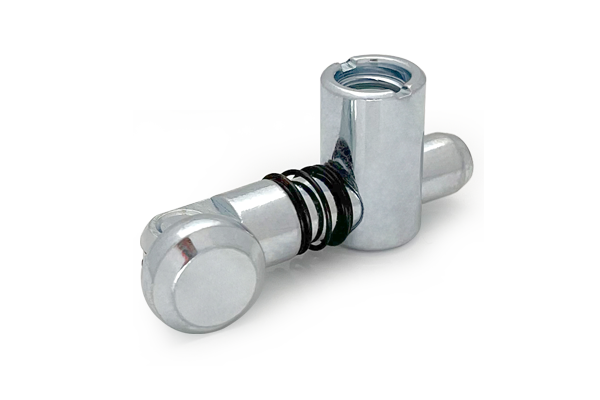
Oblique Connector Model P Angled Joint with Panel Face for 40 mm Aluminium Profiles
Oblique connector Model P with panel mounting face for angled joints on aluminium T-slot profiles. Adjustable 30 to 150 degrees, internal tie rod, panel face with tapped holes. For 20/30/40/45.
| Material | Zinc alloy housing with panel face / steel tie rod |
|---|---|
| Alloy Grade | Zamak zinc alloy / carbon steel |
| Temper | custom |
| Section Size | Fits 20 / 30 / 40 / 45 mm series profiles |
| Slot | Does not interact with profile slots; panel holes on the face |
| Length | Housing length varies by series; see data sheet |
| Tolerance | Housing to bore: H8/h7; angle set to +/-1 degree; panel face flatness 0.2 mm |
| Surface | Zinc plated / black zinc / nickel |
| MOQ | Stocked item; minimum 50 pieces per series |
| Lead Time | Typically 1 to 2 weeks for stocked series and finishes |
| Loading Port | Shanghai, Ningbo, Qingdao |
| Supply Ability | Die-cast and machined in-house; up to 100,000 pieces per month across all series |
| Payment Terms | T/T 30 per cent deposit, balance against copy of bill of lading; L/C at sight for larger orders |
| Trade Terms | FOB, CIF, CFR, EXW |
| Certifications | RoHS declaration on request |
01What is the Oblique Connector Model P?
How is the Model P different from the Model C?
The Model C is a pure structural connector: it joins two profiles at an angle and nothing else. The Model P adds a flat panel mounting face on one side of the joint, aligned with the angle. So if two profiles meet at 60 degrees, the Model P gives you a 60-degree face to bolt a panel onto. The Model C gives you only the structural joint.
Why would you need a panel at the angle?
On a clad frame — an enclosure, a machine guard, a display unit — the panels are the visible surface and they follow the frame geometry. If the frame has an angled corner, the panel at that corner has to sit at the same angle. Without the Model P, you would have to fabricate a custom bracket to hold the panel at the right angle, or mitre-cut the panel itself.
Is the panel face structural or cosmetic?
Both. The panel face has tapped holes or a short T-slot that takes panel fixings. When the panel is bolted on, it becomes part of the structure: the panel carries shear that the tie rod alone cannot, and the joint becomes stiffer. This is why the Model P is recommended for angles outside the 45 to 120 degree range where the Model C alone is weaker.
02How it works
The connector has four parts: the central housing (zinc alloy) with the panel face, the tie rod (steel) that pulls the profiles together, the threaded insert in the second profile, and the panel fixing points on the face.
| Part | Material | Function |
|---|---|---|
| Central housing with panel face | Zinc alloy (Zamak) | locates the corner, sets the angle, provides the panel surface |
| Tie rod | Steel, zinc plated | locks the angle and pulls profiles together |
| Threaded insert | Steel, zinc plated | receives the tie rod in the second profile |
| Panel fixing holes | Tapped M4 / M5 / M6 by series | bolt the panel to the face |
03The panel face: what it adds beyond the Model C
The panel face is the only difference between the Model P and the Model C, but it changes the application completely. Three things the panel face does:
| What the panel face does | Why it matters | How to use it |
|---|---|---|
| Provides a flat mounting surface at the joint angle | no need to fabricate a custom bracket | bolt the panel directly to the tapped holes on the face |
| Adds stiffness to the joint | the panel carries shear that the tie rod alone cannot | use for angles outside 45-120 degrees where the Model C is weaker |
| Gives a finished appearance | the panel covers the connector housing and the profile ends | use on visible frames where the connector would otherwise be exposed |
04Panel fixing: how to mount the panel
The panel face has a row of tapped holes sized to the series: M4 for 20 series, M5 for 30 series, M6 for 40 series and M8 for 45 series. The holes are on a pitch that matches the profile slot pitch, so a panel can be mounted with the same bolts and spacing used on the profile faces.
| Series | Panel hole thread | Hole pitch | Panel thickness |
|---|---|---|---|
| 20 series | M4 | 20 mm | 1.5 to 3 mm typical |
| 30 series | M5 | 30 mm | 2 to 4 mm typical |
| 40 series | M6 | 40 mm | 2 to 5 mm typical |
| 45 series | M8 | 45 mm | 3 to 6 mm typical |
The panel material can be aluminium sheet, acrylic, polycarbonate, composite panel or steel sheet. For a structural panel (one that adds stiffness to the joint), use aluminium at 2 mm minimum or steel at 1.5 mm minimum. For a cosmetic panel, acrylic or polycarbonate at 3 mm is typical.
05Model P vs Model C: when the panel face is worth it
Choose Model P (with panel face)
- You need to mount a panel at the joint angle
- The angle is outside 45 to 120 degrees and needs the panel for stiffness
- The connector will be visible and needs a finished cover
- You are building a clad enclosure with panels at every corner
- The panel is structural and carries shear
Choose Model C (no panel face)
- The joint is purely structural — no panel at the angle
- The angle is within 45 to 120 degrees where the C is adequate
- Cost matters — the C is cheaper than the P
- Panels are mounted elsewhere, not at the joint
- You want simpler assembly (fewer parts)
06Stiffness gain from the panel
When a structural panel is bolted to the Model P face, the joint gains shear stiffness that the tie rod alone cannot provide. The panel acts as a gusset: it carries the shear force that the housing would otherwise carry alone. The effect is most pronounced at extreme angles.
| Angle | Model C alone | Model P with structural panel | Improvement |
|---|---|---|---|
| 30 degrees | 4 kN shear | 8 kN shear | +100 per cent |
| 45 degrees | 5.6 kN | 9 kN | +61 per cent |
| 90 degrees | 0 kN shear | 0 kN | no gain (balanced) |
| 120 degrees | 4 kN | 8 kN | +100 per cent |
| 150 degrees | 7 kN | 10 kN | +43 per cent |
The panel stiffness values assume a 2 mm aluminium panel bolted to every hole on the panel face with the series-standard bolts. Thinner panels or fewer bolts give proportionally less improvement. The values are for joint design only.
07Applications: where the Model P earns its place
- Clad enclosures with angled corners: the panel follows the frame angle, bolted directly to the Model P face.
- Machine guards with angled access panels: a guard panel at 60 or 120 degrees, bolted to the connector face.
- Display units and exhibition frames: angled corners with a visible panel that covers the connector.
- Roof and canopy structures: the panel (roof sheet) bolts to the connector face at the ridge or eaves angle.
- Structural joints at extreme angles (below 45 or above 120): the panel adds the stiffness the tie rod alone cannot provide.
08Failure modes to design out
| What goes wrong | Why it happens | Design it out by |
|---|---|---|
| Panel does not sit flush on the face | the panel is warped or the face has a burr | specify a flat panel; deburr the face; use a gasket if needed |
| Panel bolts strip the tapped holes | over-tightened or the panel is too thick for the bolt | use the correct bolt length; torque to the data sheet value |
| Angle drifts with the panel mounted | the panel was mounted before the tie rod was torqued | torque the tie rod first, then mount the panel |
| Panel cracks at the bolt holes | the panel material is too brittle (acrylic) or the holes are too tight | use oversize holes in acrylic; use polycarbonate for impact |
| Joint is still weak at 30 degrees even with panel | the panel is too thin or not bolted to every hole | use a 2 mm minimum aluminium panel; bolt to every hole on the face |
09What to check before you order
Procurement checklist for the Oblique Model P
- Confirm the series: 20, 30, 40 or 45. The connector and panel hole size are sized to the series.
- Confirm the angle or range of angles the joint needs.
- Confirm the panel material and thickness: aluminium 2 mm minimum for structural, acrylic/polycarbonate 3 mm for cosmetic.
- Confirm the panel bolt pattern: match the hole pitch on the face.
- If the angle is within 45 to 120 degrees, consider the Model C instead — it is cheaper and the panel face is not needed for stiffness.
- Confirm the finish: zinc plated standard, black or nickel for aesthetic.
10Questions buyers ask
What is the difference between Model P and Model C oblique?
The Model P has a flat panel mounting face on one side of the joint, aligned with the angle. The Model C does not — it is purely structural. The P is used when a panel needs to sit at the joint angle.
Can I use the Model P without a panel?
Yes, but it is more expensive than the Model C for the same structural job. If no panel is needed, use the Model C.
What panel materials work with the Model P?
Aluminium sheet (2 mm minimum for structural), acrylic or polycarbonate (3 mm for cosmetic), steel sheet (1.5 mm minimum), composite panel. The panel bolts to the tapped holes on the face.
Does the panel add strength to the joint?
Yes. A structural panel (2 mm aluminium, bolted to every hole) acts as a gusset and can double the shear capacity at extreme angles (30 or 150 degrees).
What is the angle range?
Typically 30 to 150 degrees. At 90 it matches the miter Model C; at 45 the miter Model P.
What is the minimum order quantity?
Stocked item; minimum 50 pieces per series. Production runs quoted per piece.
What we need to quote this connector
- The series (20 / 30 / 40 / 45) and the profile bore diameter.
- The angle or range of angles.
- The number of joints (one connector per angled corner).
- The panel material and thickness if you need us to supply panels.
- The finish: zinc plated, black zinc, or nickel.
- The annual or per-order quantity.
Send those six items and the quotation comes back with the connector price, the panel price (if needed) and the lead time. Browse the connecting elements and other connecting elements ranges.
Need angled connectors with panel faces?
Send the series, the angles, the panel spec and the joint count. We quote connectors, panels and cut preparation as separate lines.
Request a quotationRelated Products
 Aluminium Angle Extrusion 40x40x5 mm for Frame Assembly and Bracing
40 x 40 x 5 mm aluminium angle extrusion in 6061-T6 for frame assembly…
 Aluminium Extrusion Profile Supply: 15 to 45 Series Kits, 8 mm Slot
Aluminium extrusion profile supply for Ahmedabad in 6063-T5: electrical cabinet frames with a designed…
 Aluminium Profile Hinge 40 Series 180 Degree for 8 mm Slot Guard Doors
180 degree hinge for 40 series aluminium profile guard doors. Two leaves clamp into…
 Linear Bar Connector with Top Thread
Hidden linear bar connector that joins two profiles end to end from inside the…
 Linear Bar Connector 8/10 with Top Thread
Hidden bar connector made in one length that serves both the 8 mm and…
 Butt Connector
Connector that joins two profiles end to end in a straight line, transmitting bending…
 T-Nut for 10 mm Aluminium Profiles M4 M5 M6 M8 M10
Full range of T-slot nuts from M4 to M10 for 15 to 60 series…
 Aluminium Angle Profile Bracket 80x80x9 mm 45 Degree Corner Gusset for Angled Bracing
45 degree corner gusset 80 x 80 x 9 mm machined from 6061-T6 plate,…
