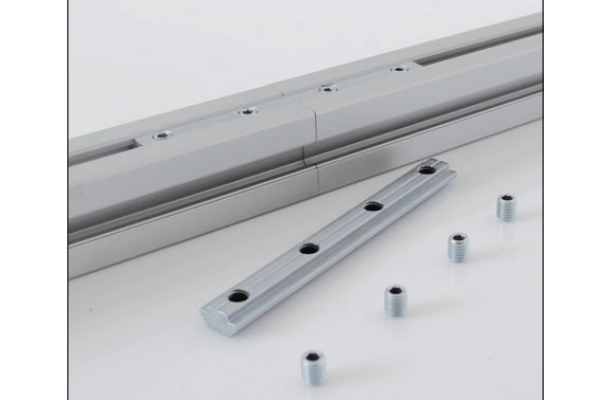
Linear Bar Connector with Top Thread
Hidden linear bar connector that joins two profiles end to end from inside the core hole, leaving the outer faces clean, with a top thread for a cap or fitting.
| Material | Zinc-plated steel or stainless steel bar; steel connecting screw |
|---|---|
| Alloy Grade | Not applicable |
| Temper | custom |
| Section Size | Fits the core hole of 30-60 series and 40x80 profiles |
| Slot | Access hole Ø8-Ø12 mm; top thread M6-M10 |
| Length | Bar 80-140 mm; connecting screw M8-M12 |
| Tolerance | ±0.1 mm on bar diameter |
| Surface | Zinc plated; stainless option |
| MOQ | 500 |
| Lead Time | 15-25 days after deposit |
| Loading Port | Shanghai / Ningbo |
| Supply Ability | 150,000 pcs per month |
| Payment Terms | T/T 30% deposit + 70% before shipment | L/C at sight |
| Trade Terms | FOB | CIF | EXW |
| Certifications | ISO 9001:2015 | ISO 14001 | RoHS | REACH |
Connecting elements · Hidden joint
A linear bar connector is a bar that sits inside the core hole of two profiles joined end to end. The joint is made inside the profiles, so nothing is visible on the outside faces: the frame reads as one continuous member rather than two members bolted together. The version with a top thread adds a tapped hole at the joint face, so a cap, a fitting or an accessory can be screwed into the joint after it is closed.
The trade for the clean appearance is that the joint has to be prepared. The profiles need an access hole drilled in one of them so the connecting screw can be reached, and the core holes have to match the bar. That is why a hidden connector is specified at the design stage rather than added on site — the drilling is a drawing decision.
Why use a hidden joint at all
- Appearance. The most common reason. A display frame, a retail fixture or any product where the frame is visible looks better without plates and bolts on the outside faces.
- Cleanability. A smooth outer face with no plate to trap dirt is easier to clean, which matters on food, pharma and medical equipment frames.
- Panel clearance. Where a panel or a glass sheet sits against the outside face, a plate would hold it off. A hidden joint leaves the face flush.
- Protection. A joint inside the profile is protected from knocks, from wash-down and from corrosion at the joint line, because the joint is not exposed.
How the joint is made
The bar is inserted into the core hole of one profile and the second profile is offered onto it. A connecting screw passes through a drilled access hole in the second profile and pulls the two members together along the axis of the bar. The bar carries the shear and the bending at the joint; the screw provides the clamping.
The access hole is the critical detail. It has to be drilled in the correct face, at the correct distance from the joint, to reach the connecting screw. On a frame with several hidden joints, a drilling jig is worth making — a few minutes with a jig saves the mis-drilled members that a freehand hole produces.
| Profile | Bar size | Access hole | Connecting screw | Joint strength |
|---|---|---|---|---|
| 30 × 30 mm | Ø20 × 80 mm | Ø8 mm | M8 × 30 mm | Moderate |
| 40 × 40 mm | Ø28 × 100 mm | Ø10 mm | M8 × 40 mm | High |
| 45 × 45 mm | Ø30 × 110 mm | Ø10 mm | M10 × 45 mm | High |
| 60 × 60 mm | Ø40 × 140 mm | Ø12 mm | M12 × 55 mm | Very high |
| 40 × 80 mm | 2 × Ø28 × 100 mm | Ø10 mm | 2 × M8 × 40 mm | High |
- Confirm the core hole The bar is sized to the core hole of the profile. Confirm the core diameter against the section drawing before ordering, because it varies between ranges.
- Drill the access hole Drill the access hole in the face of the second profile at the distance from the joint that the connecting screw requires. Use a jig where more than one joint is being made.
- Insert the bar Push the bar into the core hole of the first profile, leaving the connecting screw end exposed.
- Offer up the second profile Slide the second profile onto the bar until the members meet. Check that the profiles are aligned and the slots line up.
- Tighten the connecting screw Reach the screw through the access hole and tighten it to draw the members together. The joint is closed when the faces meet with no gap.
- Fit the top fitting Screw the cap, fitting or accessory into the top thread at the joint face.
Practical point: a hidden joint is strong in bending and shear but it is not adjustable once made, and it is difficult to take apart without marking the profiles. Where a frame has to be assembled and disassembled repeatedly, a plate joint is the better choice — it is visible, but it comes apart cleanly.
Frequently asked questions
Can a hidden joint be taken apart?
It can, by reaching the connecting screw through the access hole, but the screw is usually a one-time fixing and the profiles can be marked in the process. For a frame that is regularly dismantled, use a plate joint.
Does the access hole have to be on a specific face?
It has to be on a face from which the connecting screw can be reached, which is usually a face that is not visible in service. That is a drawing decision, so plan it before the members are cut.
Will the joint be as strong as a plate joint?
In bending and shear, a hidden joint is often stronger, because the bar is inside the member at the neutral axis and the joint is fully supported. In a corner application, a plate is the right choice.
What is the top thread for?
A cap, a fitting or an accessory that has to be fixed at the joint. It also lets the joint face be closed with a cap if it would otherwise be visible.
Can the bar be cut to a custom length?
Yes. The bar length is matched to the joint and the profile, and a custom length is a drawing change rather than a special part.
Send the section and where the joint must be invisible
Tell us the profiles, the joint position and which face must stay clean. We will specify the bar, the access hole and the drilling distance, and return FOB pricing within one working day.
Request a QuoteRelated Products
 Linear Bar Connector 8/10 with Top Thread
Hidden bar connector made in one length that serves both the 8 mm and…
 Butt Connector
Connector that joins two profiles end to end in a straight line, transmitting bending…
 T-Nut for 10 mm Aluminium Profiles M4 M5 M6 M8 M10
Full range of T-slot nuts from M4 to M10 for 15 to 60 series…
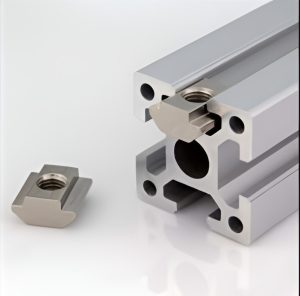 Pre-set T-Slot Nut for 8 mm Aluminium Profiles M5 M6 M8
Pre-set T-slot nut with anti-drop spring tab for 20, 30 and 40 series aluminium…
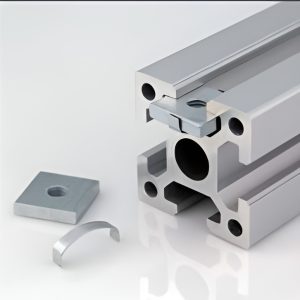 Square Nut for 8 mm T-Slot Aluminium Profiles M5 M6 M8
Square T-slot nut with four flat sides for 30 and 40 series aluminium profiles.…
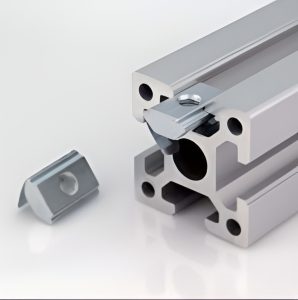 Subsequent Nut for 8 mm T-Slot Aluminium Profiles M5 M6 M8
Subsequent T-slot nut for 30 and 40 series aluminium profiles. M5, M6 and M8…
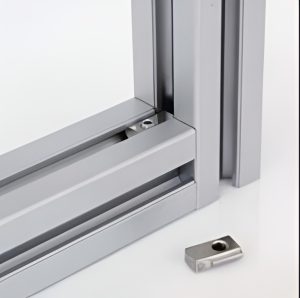 Anti-torsion Subsequent Nut for 8 mm T-Slot Aluminium Profiles
Anti-torsion subsequent T-slot nut with twin wings for 30 and 40 series aluminium profiles.…
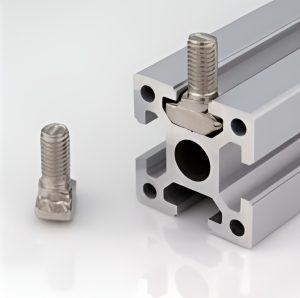 T-Bolt for 8 mm T-Slot Aluminium Profiles M6 M8 M10
T-bolt with integral T-head for 20, 30 and 40 series aluminium profiles. M5, M6,…
