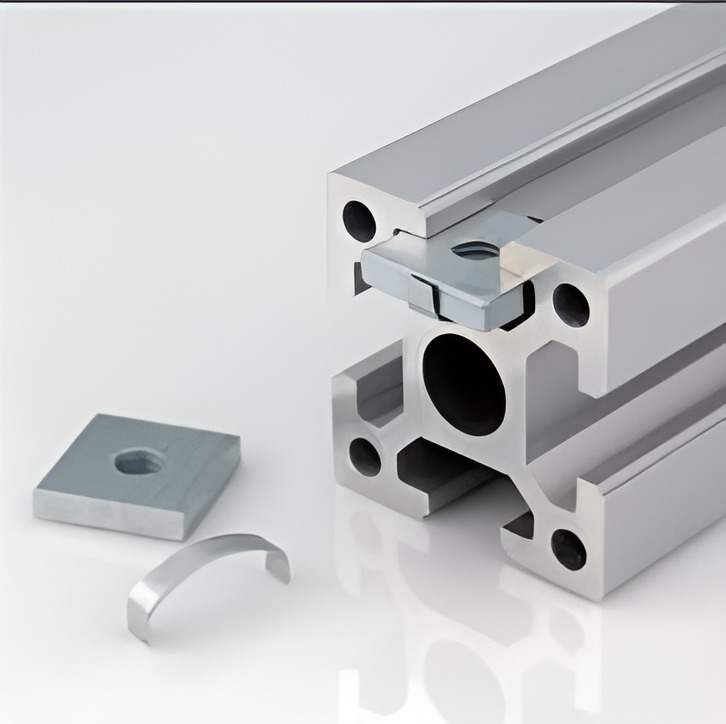
Square Nut for 8 mm T-Slot Aluminium Profiles M5 M6 M8
Square T-slot nut with four flat sides for 30 and 40 series aluminium profiles. M6 and M8 threads. Prevents rotation in groove, positioning accuracy +/-0.2 mm. For precision mounting.
| Material | Carbon steel |
|---|---|
| Alloy Grade | Carbon steel C1035, stainless A2 / A4 |
| Temper | custom |
| Section Size | n/a (piece part) |
| Slot | Fits 8 mm and 10 mm groove widths (30/40 series) |
| Length | n/a (piece part, sold per nut) |
| Tolerance | Thread 6H, body width +/-0.1 mm standard / +/-0.05 mm precision |
| Surface | Zinc plated / stainless steel A2 or A4 |
| MOQ | No MOQ for stock sizes; 500 pieces for precision tolerance |
| Lead Time | Stocked sizes ship in 2 to 3 days; precision and stainless about 2 weeks |
| Loading Port | Shanghai, Ningbo, Qingdao |
| Supply Ability | Stocked carbon steel sizes in volume; stainless and precision sizes produced to order |
| Payment Terms | T/T 30 per cent deposit, balance against copy of B/L; L/C at sight for larger orders |
| Trade Terms | FOB, CIF, CFR, EXW |
| Certifications | RoHS, REACH, material certificate for stainless steel |
01What is a square T-slot nut?
How is a square nut different from a hex nut in a T-slot?
A square nut has four flat sides that run along the slot axis. Two of those sides bear against the inner walls of the groove, preventing the nut from rotating when the bolt is tightened. A hex nut has six sides, and the contact points with the groove wall are two narrow edges — not enough surface area to prevent rotation. Under bolt torque, a hex nut will rotate in the groove and the threaded hole will shift position.
Why does rotation matter?
When the nut rotates, the threaded hole moves along an arc around the groove centre. For a 30 series M6 hex nut, the thread can shift up to 1.5 mm from its intended position. For precision mounting — sensor brackets, alignment fixtures, repeatable jig plates — that shift is unacceptable. The square nut’s flat sides lock the orientation, and the thread stays at a known position within +/-0.2 mm.
Can I use square nuts everywhere instead of hex nuts?
You can, but square nuts are slightly wider than hex nuts of the same thread, so they may not fit side by side in a narrow groove. They also cost about 20 per cent more because the square body is harder to cold-form than a hex body. Use square nuts where positioning accuracy matters and hex nuts where it does not.
02Square vs hex: the rotation test
We tested square and hex T-slot nuts in a 40 series groove with an M8 bolt torqued to 15 Nm. The nut was positioned at a marked point on the groove, and the thread position was measured before and after tightening. The hex nut rotated about 8 degrees during tightening, shifting the thread centre by 1.2 mm. The square nut did not rotate measurably — the thread centre stayed within 0.2 mm of its initial position.
| Nut type | Rotation (degrees) | Thread shift (mm) | Positioning accuracy |
|---|---|---|---|
| Square M8 (40s) | 0 | 0.2 | +/-0.2 mm |
| Hex M8 (40s) | 8 | 1.2 | +/-1.5 mm |
| Square M6 (30s) | 0 | 0.15 | +/-0.2 mm |
| Hex M6 (30s) | 12 | 0.9 | +/-1.0 mm |
The rotation test used a new groove with no wear. In a worn or corroded groove, the hex nut rotation increases because the contact edges have less grip. The square nut is less affected by groove wear because the flat sides have more surface area.
03When positioning accuracy matters: the +/-0.5 mm rule
The rule of thumb is: if your assembly requires positioning accuracy better than +/-0.5 mm, use a square nut. If +/-1.0 mm is acceptable, a hex nut will do. The threshold comes from the practical observation that hex nuts rotate unpredictably — sometimes 5 degrees, sometimes 15 — so the thread shift varies from joint to joint and cannot be designed out by offsetting the initial position.
Applications that need the square nut’s precision include sensor mounting where the sensor must align with a target within 0.5 mm, repeatable jig plates where the same part is mounted and remounted many times, and door and panel hinges where the hinge pin must stay concentric within 0.3 mm to prevent binding.
| Application | Positioning requirement | Nut type | Reason |
|---|---|---|---|
| Sensor bracket alignment | +/-0.2 mm | square | thread must not shift |
| Jig plate repeatable mount | +/-0.3 mm | square | same position every cycle |
| Door hinge concentric | +/-0.3 mm | square | pin must stay aligned |
| Panel fixing (cosmetic) | +/-1.0 mm | hex | position not critical |
| Cable clip mounting | +/-1.0 mm | hex | clip is adjustable |
| Structural bracket | +/-0.5 mm | either | bracket has slotted hole |
04Thread and series compatibility
Square nuts are available for 30 and 40 series grooves. The 20 series groove (6 mm) is too narrow for a square body to have meaningful flat-side contact — the square would be only 5 mm wide, with very little wall contact. For 20 series, a hex nut or a pre-set nut with a spring tab is the standard option.
| Series | Groove | Thread | Nut width (square) | Wall contact per side |
|---|---|---|---|---|
| 30 series | 8 mm | M6 | 7.5 mm | 3.5 mm |
| 40 series | 10 mm | M8 | 9.5 mm | 4.5 mm |
| 30 series | 8 mm | M5 (reducer) | 7.5 mm | 3.5 mm |
| 40 series | 10 mm | M6 (reducer) | 9.5 mm | 4.5 mm |
Wall contact per side is the length of flat surface bearing against the groove wall. This is the key dimension that determines the anti-rotation effectiveness. More contact means more friction and less rotation under torque.
05Body dimensions and groove fit
The square nut body is designed to slide freely along the groove but not rotate within it. The body width is about 0.5 mm less than the groove width, so the nut slides smoothly but the flat sides are close enough to the groove wall to bear against it when the bolt is tightened.
The body height (the dimension along the slot axis) is typically 1.2 times the thread diameter. For M6, that is about 7.2 mm; for M8, about 9.6 mm. A taller body gives more wall contact area but takes up more space along the slot.
| Dimension | M6 (30 series) | M8 (40 series) |
|---|---|---|
| Body width (across flats) | 7.5 mm | 9.5 mm |
| Body height (along slot) | 7.2 mm | 9.6 mm |
| Body thickness (radial) | 5.5 mm | 7.0 mm |
| Thread pitch | 1.0 mm | 1.25 mm |
| Wall contact area (per side) | 25 sq mm | 43 sq mm |
| Weight | approx. 2.5 g | approx. 6.0 g |
06When to choose square over hex
Choose square nuts
- Positioning accuracy of +/-0.2 mm or better is required
- Sensor brackets that must align with a target within 0.5 mm
- Repeatable jig plates where the same fitting is remounted many times
- Door and panel hinges where pin concentricity matters
- Precision assemblies where thread shift is unacceptable
Choose hex nuts
- Positioning accuracy of +/-1.0 mm is acceptable
- Cable clips and non-critical mounts where position can be adjusted after tightening
- 20 series grooves — too narrow for effective square body contact
- Budget-constrained projects where hex nuts save 20 per cent
- Tight spacing along the slot where the taller square body would interfere with adjacent nuts
07Failure modes to design out
| What goes wrong | Why it happens | Design it out by |
|---|---|---|
| Square nut rotates despite flat sides | groove wall is worn or anodised, reducing friction | use on mill finish grooves; or use anti-torsion nut for worn grooves |
| Nut too tight to slide along groove | anodising build-up in groove narrows the slot width | deburr and clean groove before installing; check width with gauge |
| Thread position varies between nuts | square body width tolerance allows small rotation | specify body width tolerance of +/-0.05 mm for precision applications |
| Nut body interferes with adjacent nut | square body is taller than hex body along the slot | check spacing: leave at least body height plus 2 mm between nuts |
| Nut falls out of groove before bolting | square nut has no anti-drop tab (unlike pre-set nut) | install from the end face; or use a pre-set square nut with tab |
08What to specify when ordering
Procurement checklist for square T-slot nuts
- Confirm the profile series: 30 (8 mm groove) or 40 (10 mm). Square nuts are not recommended for 20 series.
- Confirm the thread size: M6 or M8 for direct fit, M5 or M6 for reducer configurations.
- Confirm the positioning accuracy requirement: if +/-0.2 mm is needed, specify body width tolerance of +/-0.05 mm.
- Confirm the groove condition: mill finish gives the best anti-rotation; hard-anodised grooves reduce friction.
- Confirm the material: carbon steel zinc plated, or stainless steel for cleanroom or food-grade.
- Specify the quantity per size. Price breaks apply at 100, 500 and 1000 pieces.
09Terms used on this page
- Square nut
- A T-slot nut with a square body whose four flat sides bear against the groove walls, preventing rotation under bolt torque.
- Hex nut
- A T-slot nut with a hexagonal body. The six sides give narrow edge contact with the groove wall, allowing rotation under torque.
- Positioning accuracy
- The maximum deviation of the thread centre from its intended position after the bolt is tightened. Determined by nut rotation during tightening.
- Wall contact
- The surface area of the nut body bearing against the groove inner wall. More contact means more friction and less rotation.
- Reducer nut
- A nut whose body fits one series groove but whose thread is smaller than the series default. For example, M5 thread in a 30 series (8 mm) groove.
- Body height
- The dimension of the nut body along the slot axis. Determines how much space the nut occupies along the groove.
10Questions buyers ask
Are square nuts stronger than hex nuts?
No. Both types seat the same way behind the groove lip and carry the same pull-out load. The square body prevents rotation, which improves positioning accuracy, but does not increase the structural strength of the joint.
Can I use square nuts in a 20 series groove?
It is not recommended. The 6 mm groove is too narrow for effective flat-side contact — the square body would be only 5 mm wide, with very little wall surface to prevent rotation. Use hex nuts or pre-set nuts with spring tabs for 20 series.
Do square nuts have an anti-drop tab?
Standard square nuts do not have a spring tab — they are subsequent nuts that slide in from the end face. A pre-set square nut with a spring tab is available on request for applications where the nut must be placed before assembly.
What is the positioning accuracy of a square nut?
Approximately +/-0.2 mm along the slot axis and +/-0.1 mm perpendicular to it. The flat sides prevent rotation, so the thread centre stays close to its initial position when the bolt is tightened.
Are stainless steel square nuts available?
Yes, in A2 and A4 stainless steel. The anti-rotation performance is slightly lower than carbon steel because stainless has lower friction against aluminium, but the positioning accuracy is still better than a hex nut.
What is the lead time?
Standard carbon steel sizes are stocked and ship within 2 to 3 days. Stainless steel and precision-tolerance sizes have a lead time of about 2 weeks.
What we need to quote square T-slot nuts
- The profile series (30 or 40) and the groove width.
- The thread size: M6 or M8 standard, M5 or M6 reducer.
- The body width tolerance: standard +/-0.1 mm, precision +/-0.05 mm for +/-0.2 mm positioning.
- The material: carbon steel zinc plated, or stainless steel.
- The quantity per size, with total across all sizes.
- Whether you need the pre-set version with anti-drop spring tab.
Send those six items and the quotation comes back with the unit price at each quantity break, the precision tolerance surcharge if applicable, and the lead time. Browse the full connecting elements range for related fasteners.
Need square nuts for precision mounting?
Send the series, thread, tolerance and quantity. We quote standard and precision tolerance versions with matching bolts available.
Request a quotationRelated Products
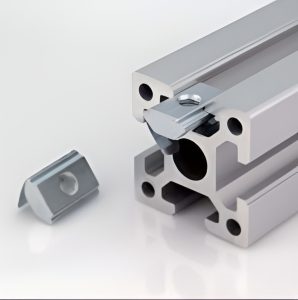 Subsequent Nut for 8 mm T-Slot Aluminium Profiles M5 M6 M8
Subsequent T-slot nut for 30 and 40 series aluminium profiles. M5, M6 and M8…
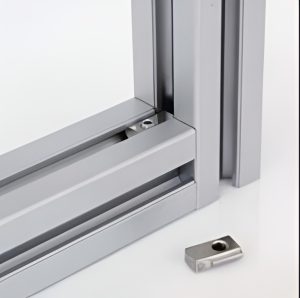 Anti-torsion Subsequent Nut for 8 mm T-Slot Aluminium Profiles
Anti-torsion subsequent T-slot nut with twin wings for 30 and 40 series aluminium profiles.…
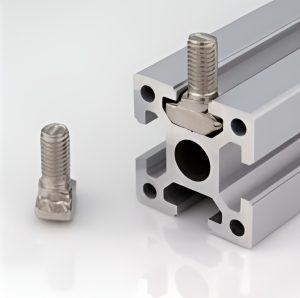 T-Bolt for 8 mm T-Slot Aluminium Profiles M6 M8 M10
T-bolt with integral T-head for 20, 30 and 40 series aluminium profiles. M5, M6,…
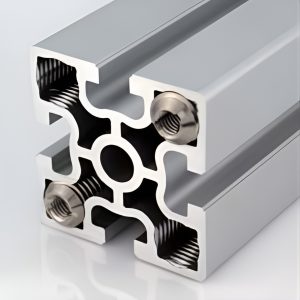 Hole Reducer Bolt for 8 mm T-Slot Aluminium Profiles
Hole reducer bolt with stepped M8 to M6 thread for 30 and 40 series…
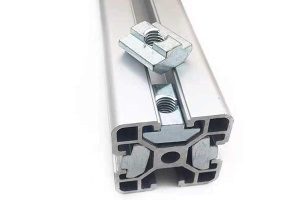 T-Nut and Bolt Set Aluminium Profile Fastener Kit M5 M6 M8 20-40 mm T-Slot Hardware
Matched T-nut, bolt and washer set for aluminium profile frames in M5, M6 and…
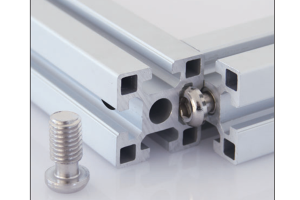 Screw Type Anchor Connector Aluminium Profile Hidden Joint Fastener 30 40 mm Series
Screw type anchor connector for aluminium profile giving a hidden joint with no visible…
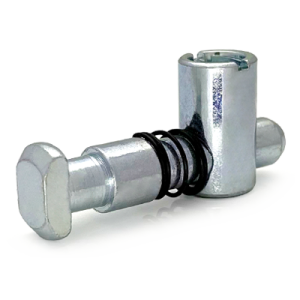 Miter Connector Model P 45 Degree Corner Joint for 30 and 40 mm Aluminium Profiles
Miter connector Model P, a hidden 45 degree corner joint for 30 and 40…
 Standard Connector Model C Aluminium Profile Corner Joint 90 Degree 30 40 mm Series
Model C standard connector for a 90 degree corner in aluminium profile with both…
