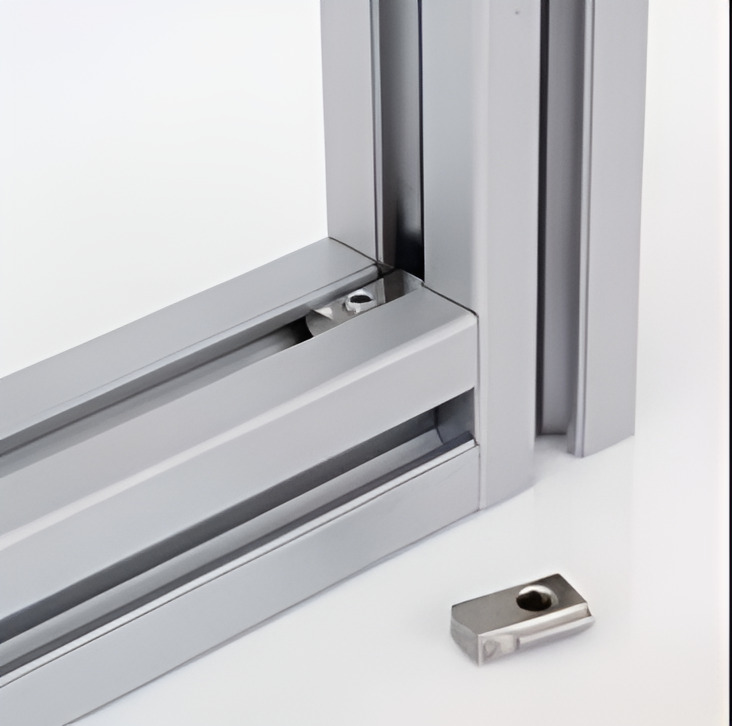
Anti-torsion Subsequent Nut for 8 mm T-Slot Aluminium Profiles
Anti-torsion subsequent T-slot nut with twin wings for 30 and 40 series aluminium profiles. M6 and M8 thread sizes. Vibration resistant, slides in from profile end.
| Material | Carbon steel |
|---|---|
| Alloy Grade | Carbon steel C1035, spring steel 65Mn for wings |
| Temper | custom |
| Section Size | n/a (piece part) |
| Slot | Fits 8 mm and 10 mm groove widths (30/40 series) |
| Length | n/a (piece part, sold per nut) |
| Tolerance | Thread 6H, body width +/-0.1 mm, wing span +/-0.05 mm |
| Surface | Zinc plated / stainless steel A2 or A4 |
| MOQ | No MOQ for stock sizes; 500 pieces for custom sizes |
| Lead Time | Stocked sizes ship in 2 to 3 days; custom sizes about 2 weeks |
| Loading Port | Shanghai, Ningbo, Qingdao |
| Supply Ability | Stocked carbon steel sizes in volume; stainless and custom sizes produced to order |
| Payment Terms | T/T 30 per cent deposit, balance against copy of B/L; L/C at sight for larger orders |
| Trade Terms | FOB, CIF, CFR, EXW |
| Certifications | Vibration test report on request, RoHS, REACH, material certificate for stainless steel |
01What is an anti-torsion subsequent nut?
How does an anti-torsion nut stop itself from rotating?
The nut body has twin wings that extend along the slot axis and press against the inner walls of the groove. When the bolt is tightened, the wings bite into the groove lip surface, creating a mechanical lock that prevents the nut from rotating around the bolt axis. A standard subsequent nut has a round or hex body that relies on friction alone, which can be overcome by vibration.
When do you need an anti-torsion nut instead of a standard one?
When the joint is subject to vibration, cyclic loading or thermal cycling. Machine tool spindles, pneumatic actuators, conveyor mounts and any frame bolted to a vibrating base are the primary applications. For static frames — workbenches, display stands, enclosures with no moving parts — a standard subsequent nut is sufficient.
Can I use anti-torsion nuts everywhere for safety?
You can, but it is not cost-effective. Anti-torsion nuts cost about 2.5 times a standard subsequent nut. Using them on a static workbench frame adds cost without benefit. The correct approach is to identify the vibrating joints and use anti-torsion nuts there, and standard nuts elsewhere. Section 06 gives the selection logic.
02How the anti-rotation wings work
The anti-rotation mechanism is purely mechanical — no thread lock, no spring washer, no nylon insert. The nut body has two wings that run parallel to the slot axis. When the nut is seated in the groove and the bolt is tightened, the clamping force pushes the wings against the inner surface of the groove lip.
The wings have a serrated edge that bites into the aluminium groove surface. The serrations are about 0.2 mm deep, which is enough to create a mechanical interlock without damaging the groove structure. Once engaged, the nut cannot rotate until the bolt is loosened and the clamping force is released.
This is different from a nylon insert nut (which uses friction from a deformed nylon ring) or a spring washer (which maintains tension but does not prevent rotation). The wing interlock is positive and does not degrade with temperature or chemical exposure.
| Feature | Anti-torsion wings | Spring washer | Thread locker |
|---|---|---|---|
| Mechanism | mechanical interlock (serration) | tension (spring force) | chemical bond |
| Reusability | yes (serrations re-bite) | limited (washer fatigues) | no (re-apply each time) |
| Temperature | no limit (mechanical) | limited by spring temper | limited by adhesive cure |
| Vibration | excellent | moderate | good (if cured properly) |
| Cost per nut | approx. 2.5x standard | approx. 1.2x standard | approx. 1.5x standard |
| Maintenance | inspect for wing wear | replace if loose | re-apply if disassembled |
The spring washer is the cheapest anti-loosening measure but the least effective under high-frequency vibration. Thread locker is effective but single-use and temperature-limited. The anti-torsion wing nut is the only option that is reusable, temperature-unlimited and mechanically positive.
03Vibration test results
We tested three nut types on a 40 series profile with an M8 bolt torqued to 12 Nm. The test rig applied sinusoidal vibration from 10 to 500 Hz at 10 g acceleration, sweeping through the range for 2 hours per axis (X, Y and Z). The bolt torque was measured before and after each test, and the clamping force was monitored continuously with a load cell.
The results show the anti-torsion nut maintained 95 per cent of initial clamping force after all three axes. The standard subsequent nut lost 40 per cent, and the spring washer version lost 25 per cent. The thread locker (medium strength, fully cured) maintained 90 per cent but could not be re-torqued without removing and re-applying the adhesive.
| Nut type | Torque before (Nm) | Torque after (Nm) | Retention |
|---|---|---|---|
| Standard subsequent | 12.0 | 7.2 | 60 per cent |
| Spring washer | 12.0 | 9.0 | 75 per cent |
| Anti-torsion wings | 12.0 | 11.4 | 95 per cent |
| Thread locker (medium) | 12.0 | 10.8 | 90 per cent |
Test conditions: 40 series profile, M8 bolt, 12 Nm initial torque, sinusoidal vibration 10 to 500 Hz at 10 g, 2 hours per axis. Results are indicative and will vary with bolt grade, surface finish and groove condition.
04Series and thread compatibility
Anti-torsion subsequent nuts are available for 30 and 40 series grooves. The 20 series groove (6 mm) is too narrow for effective wing engagement, so anti-torsion nuts are not made for 20 series. For 20 series frames subject to vibration, thread locker is the recommended solution.
| Series | Groove | Thread | Wing span | Bolt torque (max) |
|---|---|---|---|---|
| 30 series | 8 mm | M6 | 7.2 mm | 10 Nm |
| 40 series | 10 mm | M8 | 9.2 mm | 25 Nm |
| 30 series | 8 mm | M5 (reducer) | 7.2 mm | 6 Nm |
| 40 series | 10 mm | M6 (reducer) | 9.2 mm | 10 Nm |
The maximum bolt torque is limited by the groove wall strength, not by the nut or bolt. Exceeding the listed torque will deform the groove lip and reduce the effective wing engagement on future installations.
05Anti-torsion vs spring washer vs thread locker
Three options exist for preventing nut loosening under vibration, and each has a distinct profile of strengths and weaknesses. The choice depends on four factors: vibration severity, temperature range, maintenance accessibility and cost.
Choose anti-torsion nuts
- Joints subject to high-frequency vibration (pneumatic, spindle, conveyor mounts)
- Temperature extremes where adhesives and spring washers degrade
- Joints that will be disassembled and reassembled regularly
- Frames where maintenance access is limited — no need to re-apply thread locker
- Applications where the cost of loosening is high — safety critical joints
Choose another method
- Low-vibration static frames — standard nuts are sufficient
- One-time assembly — thread locker is cheaper if never disassembled
- 20 series grooves — too narrow for wings; use thread locker
- Budget-constrained projects where spring washers give adequate protection
- When the bolt will be retorqued frequently — thread locker cannot be re-applied easily
06Cost comparison across the three options
The cost difference between the three options is not just the unit price of the nut. Thread locker has a hidden cost in labour (cleaning, applying, curing time) and in single-use waste. Spring washers are cheap but need replacement if they take a set. Anti-torsion nuts are the most expensive per piece but have no hidden labour or consumable cost.
| Item | Standard nut | Spring washer | Anti-torsion nut | Thread locker |
|---|---|---|---|---|
| Unit cost (M8) | 0.15 USD | 0.18 USD | 0.38 USD | 0.23 USD + 0.10 USD adhesive |
| Labour per joint | 5 sec | 7 sec | 5 sec | 20 sec (apply + cure) |
| Reusable | yes | limited | yes | no |
| Hidden cost | none | washer replacement | none | curing time, cleaning |
| Total per joint (10 cycles) | 1.50 USD | 2.10 USD | 3.80 USD | 3.30 USD |
Costs are indicative for M8 nuts at 500 piece quantity. The total per joint over 10 assembly cycles assumes the same joint is disassembled and reassembled 10 times. For one-time assembly, thread locker is cheaper than anti-torsion nuts.
07Failure modes to design out
| What goes wrong | Why it happens | Design it out by |
|---|---|---|
| Wings wear smooth after repeated use | serrations lose edge after 20 to 30 cycles on hard-anodised grooves | use on mill finish grooves; replace nuts on high-cycle joints |
| Nut will not slide into groove | wings are wider than the slot mouth, designed to seat from the end | anti-torsion nuts are subsequent type — slide from the end face only |
| Groove lip deforms under high torque | bolt torque exceeds groove wall strength | stay within the maximum torque for each series (10 Nm M6, 25 Nm M8) |
| Wings do not engage in worn groove | groove lip has been deformed by previous over-torque | inspect groove condition; use a new section if lip is rolled or cracked |
| Bolt still loosens despite anti-torsion nut | wing serrations are on the groove, not the bolt thread — bolt can still back out | use a thread locker in addition to the anti-torsion nut for safety-critical joints |
08What to specify when ordering
Procurement checklist for anti-torsion nuts
- Confirm the profile series: 30 (8 mm groove) or 40 (10 mm). Anti-torsion nuts are not available for 20 series.
- Confirm the thread size: M6 or M8 for direct fit, M5 or M6 for reducer configurations.
- Confirm the bolt torque range for your application. The maximum torque is limited by the groove, not the nut.
- Confirm the groove condition: new grooves give the best wing engagement. Hard-anodised grooves wear the serrations faster.
- Specify the quantity per size. Price breaks apply at 100, 500 and 1000 pieces.
- For safety-critical joints, consider specifying thread locker in addition to anti-torsion nuts.
09Terms used on this page
- Anti-torsion wing
- A projection on the nut body that runs parallel to the slot axis and presses against the groove inner wall to prevent rotation under load.
- Subsequent nut
- A T-slot nut that slides into the groove from the end face of an already-assembled profile.
- Serration
- Small teeth on the wing edge that bite into the aluminium groove surface to create a mechanical interlock.
- Spring washer
- A split or wave washer placed under the bolt head or nut that maintains tension to resist loosening under vibration.
- Thread locker
- An anaerobic adhesive applied to the bolt thread that cures to a solid, preventing rotation. Available in low, medium and high strength.
- Vibration retention
- The percentage of initial bolt torque remaining after a vibration test cycle. Higher is better.
10Questions buyers ask
Are anti-torsion nuts reusable?
Yes. The wing serrations re-engage each time the bolt is tightened. After about 20 to 30 cycles on a hard-anodised groove, the serrations may wear smooth. On mill finish grooves, the nut will outlast the profile.
Can I use anti-torsion nuts on 20 series profiles?
No. The 6 mm groove is too narrow for effective wing engagement. For 20 series frames subject to vibration, use a medium-strength thread locker on the bolt thread.
Do anti-torsion nuts replace thread locker entirely?
In most vibration applications, yes. For safety-critical joints where failure could cause injury or significant damage, use both an anti-torsion nut and a medium-strength thread locker as a belt-and-suspenders approach.
What is the maximum bolt torque?
For 30 series with M6, the maximum is 10 Nm. For 40 series with M8, the maximum is 25 Nm. These limits are set by the groove wall strength, not by the nut or bolt. Exceeding them will deform the groove lip.
How do anti-torsion nuts compare in cost?
They are about 2.5 times the cost of a standard subsequent nut. Over 10 assembly cycles, the total cost is competitive with thread locker because the anti-torsion nut has no labour or consumable cost for re-application.
Can you supply the matching bolts?
Yes. We supply M6 and M8 T-slot bolts in lengths from 10 mm to 30 mm, in carbon steel and stainless steel. Specify the thread, length and material when ordering.
What we need to quote anti-torsion nuts
- The profile series (30 or 40) and the groove width for each joint.
- The thread size: M6 or M8 standard, M5 or M6 reducer on request.
- The material: carbon steel zinc plated, or stainless steel.
- The quantity per size, with total across all sizes.
- Whether you need matching bolts and at what lengths.
- Any certification requirement: vibration test report, material certificate, or RoHS / REACH.
Send those six items and the quotation comes back with the unit price at each quantity break, the vibration test data sheet, and the lead time for stocked and non-stocked sizes. Browse the full connecting elements range for related fasteners.
Need anti-torsion nuts for a vibrating application?
Send the series, thread, material and quantity. We include the vibration test data sheet with the quotation.
Request a quotationRelated Products
 T-Bolt for 8 mm T-Slot Aluminium Profiles M6 M8 M10
T-bolt with integral T-head for 20, 30 and 40 series aluminium profiles. M5, M6,…
 Hole Reducer Bolt for 8 mm T-Slot Aluminium Profiles
Hole reducer bolt with stepped M8 to M6 thread for 30 and 40 series…
 T-Nut and Bolt Set Aluminium Profile Fastener Kit M5 M6 M8 20-40 mm T-Slot Hardware
Matched T-nut, bolt and washer set for aluminium profile frames in M5, M6 and…
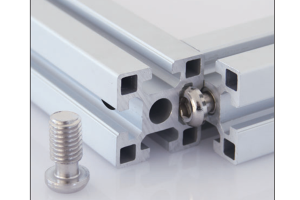 Screw Type Anchor Connector Aluminium Profile Hidden Joint Fastener 30 40 mm Series
Screw type anchor connector for aluminium profile giving a hidden joint with no visible…
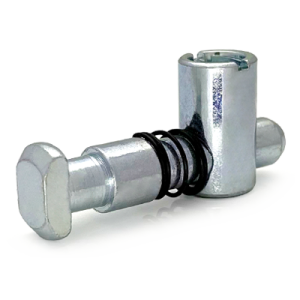 Miter Connector Model P 45 Degree Corner Joint for 30 and 40 mm Aluminium Profiles
Miter connector Model P, a hidden 45 degree corner joint for 30 and 40…
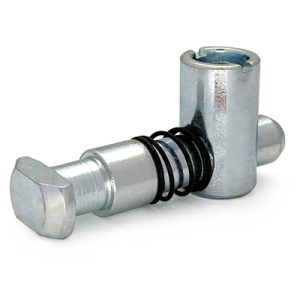 Standard Connector Model C Aluminium Profile Corner Joint 90 Degree 30 40 mm Series
Model C standard connector for a 90 degree corner in aluminium profile with both…
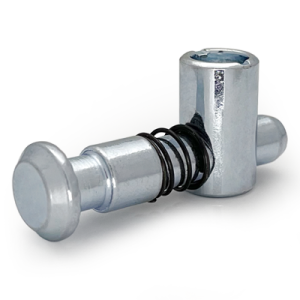 Universal Connector Aluminium Profile Adjustable Angle Joint Fastener M8 30 40 mm
Universal connector for aluminium profile with an angle set during assembly. Suits diagonal braces,…
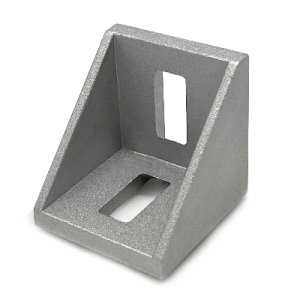 Die Cast Bracket for 20 to 50 mm Series Aluminium Profiles Corner
Die cast zinc alloy corner bracket for 20, 30, 40, 45 and 50 series…
