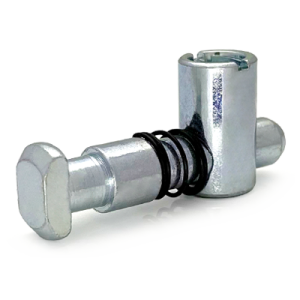
Miter Connector Model P 45 Degree Corner Joint for 30 and 40 mm Aluminium Profiles
Miter connector Model P, a hidden 45 degree corner joint for 30 and 40 series aluminium profiles, giving a clean continuous corner with no exposed bolt heads.
| Material | Zinc alloy / steel |
|---|---|
| Alloy Grade | Zinc alloy / steel |
| Temper | custom |
| Section Size | 30 series / 40 series |
| Slot | Matches the groove of the receiving section |
| Length | One-piece connector, no cutting required |
| Tolerance | Connector tolerance per series |
| Surface | Bright / zinc plated |
| MOQ | Sold in small packs; larger quantities quoted per piece |
| Lead Time | Stocked by series; larger quantities 2 to 3 weeks |
| Loading Port | Shanghai, Ningbo, Qingdao |
| Supply Ability | Die casting and plating capacity for production volumes |
| Payment Terms | T/T 30 per cent deposit, balance against copy of bill of lading |
| Trade Terms | FOB, CIF, CFR, EXW |
| Certifications | RoHS and REACH declarations |
01What is a Miter Model P connector?
What does a miter connector do?
It joins two profile members that have been cut at 45 degrees so they meet at a 90 degree corner with no gap. The connector sits inside the groove of both members, hidden from view, and is tightened with a grub screw. The result is a corner that reads as one continuous line, with no exposed bolt head.
What is the difference between Model P and Model C?
Model P is a 45 degree miter for a 90 degree corner, with the two cuts meeting on the diagonal. Model C is a 90 degree straight cut joint, where the two members butt together with the end of one against the side of the other. Model P gives a cleaner appearance because the cut line is hidden on the diagonal; Model C is quicker because the cuts are square.
Which profiles does it fit?
The 30 series and 40 series. The connector locates in the groove of the receiving section, so it matches the groove size of these two series.
02Connector data
| Item | Value | Note |
|---|---|---|
| Suits | 30 series / 40 series | matches the groove of the section |
| Angle | 45 degree miter | forms a 90 degree corner |
| Type | hidden connector | sits inside the groove |
| Tightening | grub screw | accessed through the mitre face |
| Finish | bright / zinc plated | corrosion resistant |
| Appearance | continuous corner line | no exposed bolt head |
03The appearance advantage
The reason to choose a miter connector is appearance. A normal corner bracket bolts on the outside and shows the bracket and the bolt heads. A miter connector hides inside the groove, so the only thing you see is the clean diagonal line where the two 45 degree cuts meet.
- Display and exhibition frames: the visible corner has no hardware, so the frame looks like a single piece.
- Furniture and point-of-sale: the clean corner reads as premium.
- Cabinet and enclosure fronts: no bolt heads to collect dust or snag.
The trade is that the miter corner is weaker than a bracketed joint, because the connector only carries the two members in the groove, not across a bracket. It is an appearance joint, not a load joint.
04Cut accuracy: the +/-0.5 degree problem
A miter joint only looks right if the two 45 degree cuts are accurate. If one cut is off by even a degree, the two faces do not meet and the corner shows a visible gap or a step.
| Cut error | Visible result | How to avoid |
|---|---|---|
| +/-0.5 degrees | no visible gap | CNC saw, checked mitre |
| +/-1 degree | hairline gap at the corner | re-cut or shim |
| +/-2 degrees | clear gap and misaligned faces | unacceptable, re-cut |
We cut mitres on a CNC saw to +/-0.5 degrees, which keeps the corner closed. For a frame that will be anodised, the anodising fills the hairline gap and the corner reads as a single line.
05Miter connector vs corner bracket: when it is worth it
Choose the miter connector
- The corner is visible and must look clean
- The joint is not load-bearing
- The frame is for display, furniture or a cabinet front
- No exposed hardware is acceptable to the design
- The members are cut on a CNC saw to +/-0.5 degrees
Choose a corner bracket
- The corner carries load or resists racking
- The joint must be strong and adjustable
- Speed matters more than appearance
- The frame is internal or hidden
- You need to dismantle and reuse the joint often
06Failure modes to design out
| What goes wrong | Why it happens | Design it out by |
|---|---|---|
| Corner gap appears | the mitre cut is off by more than half a degree | cut on a CNC saw and check the mitre before assembly |
| Joint opens under load | a miter connector is not a load joint | use the miter for appearance only; add a bracket if the corner carries load |
| Grub screw strips | the screw is over-tightened in the soft groove | tighten to the specified torque, do not force it |
| Connector does not seat | the connector series does not match the profile groove | match the connector to the 30 or 40 series groove |
| Members misalign at the corner | the two cut lengths differ | cut both members as a matched pair to the same length |
07What to check before you order
Procurement checklist for miter connectors
- Confirm the series: 30 series or 40 series, matching the profile groove.
- Confirm the corner angle: Model P is a 45 degree miter for a 90 degree corner.
- Confirm the cut accuracy: specify a CNC saw mitre to +/-0.5 degrees.
- Confirm the quantity of corners and whether the members are cut by us or by you.
- Confirm the finish of the connector: bright or zinc plated.
- Confirm the load: if the corner carries load, add a bracket or a gusset.
08Terms used on this page
- Miter joint
- A corner where two members are cut at 45 degrees and meet on the diagonal to form a 90 degree corner.
- Model P
- The 45 degree miter connector variant, for a clean 90 degree corner.
- Hidden connector
- A connector that sits inside the profile groove, not visible from the outside.
- Grub screw
- A headless screw that tightens the connector inside the groove, accessed through the mitre face.
- Corner bracket
- An external bracket bolted across a corner, stronger but visible.
09Questions buyers ask
What is the difference between Model P and Model C?
Model P is a 45 degree miter for a clean 90 degree corner; Model C is a 90 degree straight butt joint. Model P looks cleaner, Model C is quicker.
Which profiles does it fit?
The 30 series and 40 series, matching the groove of the receiving section.
Is it load-bearing?
No. It is an appearance joint. For a load-bearing corner, add a bracket or a gusset.
How accurate does the cut need to be?
Within +/-0.5 degrees for a closed corner. We cut mitres on a CNC saw to this accuracy.
Is the connector visible?
No, it sits inside the groove, so the finished corner shows only the diagonal line of the two cuts.
Can I get a sample?
Yes. A sample connector is available so you can confirm the fit before a full order.
What we need to quote miter connectors
- The series (30 or 40) and the corner angle.
- The quantity of corners and whether the members are cut by us.
- The cut accuracy requirement (CNC mitre to +/-0.5 degrees).
- The finish of the connector: bright or zinc plated.
- Whether the members need cutting to length as matched pairs.
- Any delivery and certification requirement.
Send those six items and the quotation comes back with the connector, cutting and finish broken out separately. Browse the full aluminium profile catalogue and the connecting elements range.
Need hidden 45 degree corners quoted for your frame?
Send the series, quantity and cut list. We quote connectors and cutting as separate lines.
Request a quotationRelated Products
 Standard Connector Model C Aluminium Profile Corner Joint 90 Degree 30 40 mm Series
Model C standard connector for a 90 degree corner in aluminium profile with both…
 Universal Connector Aluminium Profile Adjustable Angle Joint Fastener M8 30 40 mm
Universal connector for aluminium profile with an angle set during assembly. Suits diagonal braces,…
 Die Cast Bracket for 20 to 50 mm Series Aluminium Profiles Corner
Die cast zinc alloy corner bracket for 20, 30, 40, 45 and 50 series…
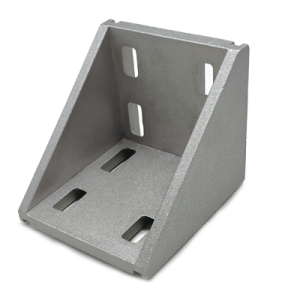 Heavy Duty Die Cast Corner Bracket for Aluminium Profile 60 80 90 100 mm Series
Heavy duty die cast corner bracket for large aluminium profile frames in 60, 80,…
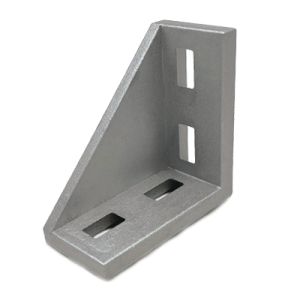 Rectangular Die Cast Corner Bracket Aluminium Profile 30×60 40×80 45×90 50×100 mm
Rectangular die cast corner bracket with unequal legs for aluminium profile frames built from…
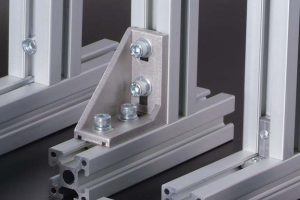 Aluminium Extrusion Connector System for 20×20 to 100×100 mm T-Slot Frames
A complete aluminium extrusion connector system covering visible brackets, hidden inner brackets, cubic corner…
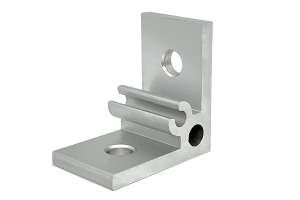 Aluminium Angle Profile Bracket 35x35x4 mm M6 Corner Brace for 20 and 30 Series Profiles
A 35 x 35 x 4 mm aluminium angle profile bracket for 20 and…
 Aluminium Inner Bracket with Top Thread M5 M6 M8 for 20 to 40 mm T-Slot Profiles
A hidden inner bracket with top thread for aluminium T-slot profiles, supplied in M5…
