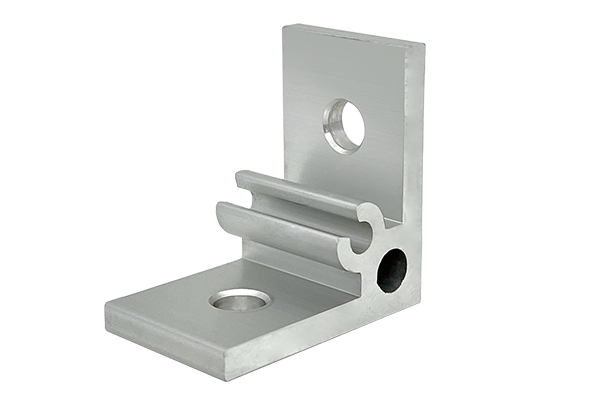
Aluminium Angle Profile Bracket 35x35x4 mm M6 Corner Brace for 20 and 30 Series Profiles
A 35 x 35 x 4 mm aluminium angle profile bracket for 20 and 30 series T-slot profiles, drilled for the slot pitch and supplied with M5 or M6 slot nuts.
| Material | Aluminium |
|---|---|
| Alloy Grade | 6063-T5 |
| Temper | T5 |
| Section Size | 35 x 35 mm legs, 4 mm thick |
| Slot | Suits 20 series 6.2 mm and 30 series 8.2 mm grooves |
| Length | 35 mm legs as standard, custom leg lengths on request |
| Tolerance | EN 755-9 / GB/T 6892, leg length +/-0.3 mm |
| Surface | Mill finish / clear anodised / black anodised |
| MOQ | 500 |
| Lead Time | 12-20 days after deposit |
| Loading Port | Shanghai / Ningbo |
| Supply Ability | 1 million pieces per month |
| Payment Terms | T/T 30% deposit + 70% before shipment | L/C at sight |
| Trade Terms | FOB | CIF | EXW |
| Certifications | ISO 9001:2015 | EN 755-9 | RoHS | REACH |
Connecting elements · Angle brackets
A 35 x 35 x 4 mm aluminium angle profile bracket is the smallest corner brace in the range: a 4 mm thick extruded angle, cut to 35 mm legs and drilled to suit the slot pitch of 20 and 30 series profiles. It pairs with M5 slot nuts in a 20 series 6.2 mm groove and M6 slot nuts in a 30 series 8.2 mm groove, and it weighs about 50 g per piece. It is supplied in mill finish, clear anodised or black anodised.
The interesting question with a bracket this small is not whether it fits — it does — but where it stops working. A 4 mm leg is in bending across the corner, and that bending is what limits the joint. The useful thing to know is that on this bracket the bracket itself is the weak link, while on the larger brackets in the family the slot becomes the weak link instead. That crossover decides whether buying a bigger bracket will help you or not.
What a 4 mm leg can carry
An angle bracket transfers a load from one member to the other by bending across its corner. The capacity is therefore the bending capacity of the leg, and for a rectangular section that is the width times the thickness squared divided by six. For a 35 mm wide, 4 mm thick leg that gives a section modulus of about 93 mm3. With 6063-T5 extruded angle at a yield strength of about 110 MPa, the corner can develop a moment of roughly 10 N m before the leg yields.
Divide that by the distance from the corner to the fixing bolt — about 25 mm on a 35 mm leg — and you get the load the joint can carry: around 0.4 kN, or 40 kg, before the bracket yields. Apply a working factor of two and the practical figure is about 0.2 kN per bracket. That is a perfectly useful number for a panel retainer or a light guard, and it is nowhere near enough for a machine frame corner.
| Bracket | Leg thickness | Section modulus | Corner moment | Load at 25 mm from the corner |
|---|---|---|---|---|
| 35 x 35 x 4 mm | 4 mm | approx. 93 mm3 | approx. 10 N m | approx. 0.4 kN |
| 50 x 50 x 9 mm | 9 mm | approx. 675 mm3 | approx. 74 N m | approx. 2.0 kN |
| 70 x 70 x 9 mm | 9 mm | approx. 945 mm3 | approx. 104 N m | approx. 2.8 kN |
| 80 x 80 x 9 mm | 9 mm | approx. 1,080 mm3 | approx. 119 N m | approx. 3.2 kN |
| 100 x 100 x 15 mm | 15 mm | approx. 3,750 mm3 | approx. 413 N m | approx. 11.1 kN |
The crossover is the point of this table. Look at what limits each row. On the 35 x 35 x 4 mm bracket the leg yields at 0.4 kN. On the 50 x 50 x 9 mm bracket the leg would take 2.0 kN — but an M8 slot nut in a 40 series groove pulls out at about 1.5 to 2.2 kN, so the slot is now the limit, not the bracket. Going bigger than that buys you nothing at all.
The bracket stops being the limit above 50 x 50 mm
This is the single most useful thing to understand about the whole bracket family. Two different things can limit a bolted corner joint: the bracket bending, and the slot letting go. On the small brackets the bracket governs; on the large ones the slot governs. That means:
- Up to about 35 x 35 x 4 mm, a bigger bracket makes the joint stronger, because the bracket is still the limiting item.
- From about 50 x 50 x 9 mm upwards, a bigger bracket makes no measurable difference to the joint capacity, because the slot pull-out has taken over as the limit.
- Above that point the only way to make the joint stronger is to stop loading the slot — that is, to switch to an end face connector, an anchor connector or a cubic corner block, all of which put the load into the section itself.
People buy the 100 x 100 x 15 mm bracket expecting a five-times-stronger corner and are disappointed, because the bracket was never what was going to fail. The large brackets exist for their reach and their bolt pattern, not for their bending capacity.
Matching the holes to the slot pitch
The bracket has to be drilled for the pitch of the series it is being used with, and the two series this bracket serves have different geometry. Getting the match wrong is the usual reason a small bracket will not sit flat.
| Series | Groove | Slot mouth | Slot pitch | Nut and bolt |
|---|---|---|---|---|
| 20 series | 6.2 mm | 6 mm | 20 mm | M5 slot nut |
| 30 series | 8.2 mm | 6 mm | 30 mm | M6 slot nut |
| 40 series | 10.2 mm | 8 mm | 40 mm | M8 slot nut |
The 35 mm leg is sized so that it reaches across the slot pitch of both series with the bolt clearing the profile edge. Note that the mouth of the groove is narrower than the groove itself on both series — 6 mm mouth against a 6.2 mm groove on the 20 series, and 6 mm against 8.2 mm on the 30 series. That undercut is what a T-slot nut engages with, and it is also why a nut cannot simply be pushed into a closed frame from the side.
Using it well
- Use two bolts per leg wherever the joint carries load Two bolts spread the load along the slot and stop the bracket rotating about a single fixing. The bracket has the holes; use them.
- Keep the bolt close to the corner The moment on the leg is the load times the distance from the corner to the bolt. Moving the fixing 5 mm closer to the corner adds about 20 per cent to the capacity for free.
- Do not ream the holes out to suit a bigger bolt Enlarging the hole removes material from exactly the section that is in bending, and a 4 mm leg does not have material to spare. Use the correct M5 or M6 bolt.
- Add a gusset rather than a bigger bracket Where you need more capacity on a small frame, bolt a triangular gusset behind the bracket or fit a diagonal stay. That removes the bending from the leg altogether and is cheaper than stepping up a bracket size.
- Check the anodised surface at the joint Anodising is a dielectric. On an earthed frame, add a separate earth connection rather than relying on the bracket to carry it.
Frequently asked questions
What is the difference between this and a 35 x 35 x 4 mm angle profile?
An angle profile is sold by the metre and used as a structural or trim member. This is a bracket: a short piece of the same angle, cut to 35 mm legs and drilled to the slot pitch, used as a corner brace. The bracket weighs about 50 g per piece.
Which bolt and nut do I need?
M5 slot nuts for a 20 series profile and M6 slot nuts for a 30 series profile. Torque them to about 8 N m for M5 and about 12 N m for M6 — the ceiling is set by the slot, not by the bolt.
Can I use it on a 40 series profile?
It will bolt on, but the 35 mm leg is short for a 40 mm slot pitch and the M6 bolt is undersized for the 8 mm mouth. Use the 50 x 50 x 9 mm bracket for 40 series work.
How many brackets do I need per corner?
One bracket per corner face for a light frame. For a frame carrying load, use two brackets per corner on adjacent faces, or switch to an end face connector.
Do you supply them drilled to my pattern?
Yes. Send the drawing with the hole positions and the series, and we will drill, deburr and finish the brackets to suit. Standard patterns are available from stock.
Send the corner load and the profile series
Tell us the load at the corner, the series and the hole pattern you need. We will confirm whether this bracket is adequate, drill to your drawing and quote with the slot nuts.
Request a QuoteRelated Products
 Aluminium Inner Bracket with Top Thread M5 M6 M8 for 20 to 40 mm T-Slot Profiles
A hidden inner bracket with top thread for aluminium T-slot profiles, supplied in M5…
 Aluminium Cubic Connector 2020 20×20 mm Three-Way Corner Joint with ABS Cap
A 20 x 20 x 20 mm three-way cubic corner connector for 20 series…
 Cubic Connector 4545 45x45x45 mm Three-Way Aluminium Corner Joint Block for 45 Series
A 45 x 45 x 45 mm three-way cubic corner connector for 45 series…
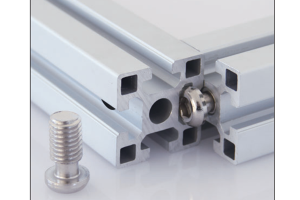 Self-Tapping Screw Connector for Aluminium Profile M6 M8 M10 to 50 mm Series
A self-tapping screw connector for aluminium profiles in M6, M8 and M10. Forms its…
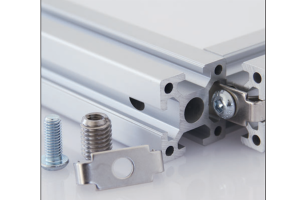 End Face Connector for Aluminium Profile M8 M10 up to 50 mm Series with Spring Clip
An end face connector for aluminium profiles in M8 and M10 with a spring…
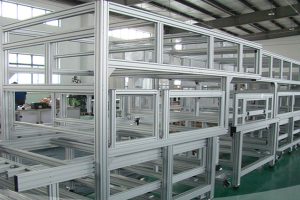 Aluminium Profile Shelf System 40×40 mm T-Slot Uprights for Workshop Racking
A bolted aluminium profile shelf system in 40 x 40 mm T-slot uprights and…
Aluminium Framing Extrusion Kit 40×40 mm 40 Series Cut List for Machine Frames
A cut-to-length aluminium framing extrusion kit in the 40 series: profile cut to a…
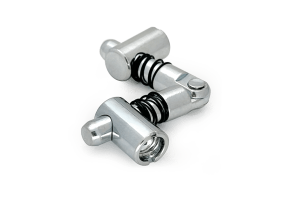 Miter Connector Model C 90 Degree Corner Joint for 40 mm Aluminium Profiles
Miter connector Model C for 90-degree corner joints on aluminium T-slot profiles. Internal tie…
