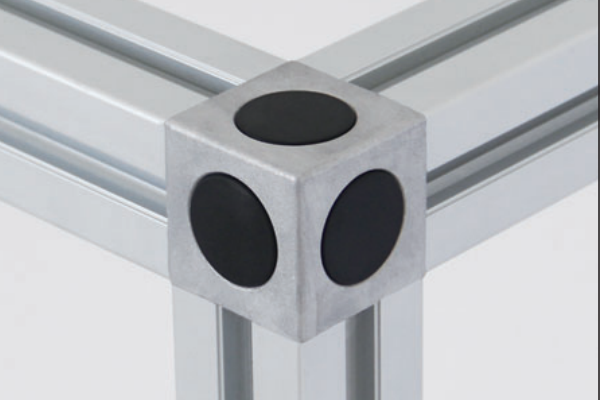
Cubic Connector 4545 45x45x45 mm Three-Way Aluminium Corner Joint Block for 45 Series
A 45 x 45 x 45 mm three-way cubic corner connector for 45 series aluminium profiles, with a 26 mm counterbore and a 14.5 mm through bore on each face and a clip-on cap.
| Material | Aluminium or zinc alloy with ABS cap |
|---|---|
| Alloy Grade | 6061-T6 or Zamak 3 body, ABS cap, 304 stainless inserts |
| Temper | custom |
| Section Size | 45 x 45 x 45 mm cube, suits 45 mm profile faces |
| Slot | Suits 45 series 10 mm groove profiles |
| Length | Stocked, no cutting required |
| Tolerance | ISO 8062 die casting or ISO 2768-m machining |
| Surface | Natural finish, anodised on request |
| MOQ | 200 |
| Lead Time | 18-28 days after deposit |
| Loading Port | Shanghai / Ningbo |
| Supply Ability | 300,000 pieces per month |
| Payment Terms | T/T 30% deposit + 70% before shipment | L/C at sight |
| Trade Terms | FOB | CIF | EXW |
| Certifications | ISO 9001:2015 | RoHS | REACH |
Connecting elements · Cubic corner joints
A cubic connector 4545 is a 45 x 45 x 45 mm three-way corner block for 45 series aluminium profiles. Each of the three faces is counterbored 26 mm with a 14.5 mm through bore concentric with it, and the counterbore is closed by a clip-on cap. The 45 mm cube matches the 45 mm face of the profile exactly, so the corner comes out flush on all three axes, and one block replaces three brackets and twelve bolts at a three-way node.
The interesting part of this connector is not the block, it is the bolt arithmetic. The cube’s 14.5 mm through bore will pass an M14 shank, and the 45 series profile has a 12 mm core bore tapped M14 — so the two match directly. But most customers do not use an M14 bolt. They screw a hole reducer into the profile and use an M8 or M6 bolt through the cube, which is cheaper and easier to torque accurately. Choosing between those options is what this page is about.
The bore geometry, read off the drawing
Two diameters are marked on the 4545 drawing. The 26 mm is a counterbore: a recess that gives the bolt head and its washer a flat seat and provides the lip that the cap clips onto. The 14.5 mm is the through bore, concentric with it, and it is what the bolt shank passes through. On a 45 mm cube the 26 mm counterbore leaves about 9.5 mm of wall on each side, which is where the stiffness of the block comes from.
The important thing to notice is that the through bore is 14.5 mm, not 10 mm or 12 mm. That is deliberate: it is sized so that an M14 bolt passes through with clearance, which means the cube can be used with the largest fixing the 45 series core bore will take, without any adapter at all.
| Feature | Dimension | What it is for |
|---|---|---|
| Cube body | 45 x 45 x 45 mm | Matches the 45 series profile face, so the corner is flush |
| Counterbore | 26 mm on each of three faces | Seats the bolt head and washer, and gives the cap its clip lip |
| Through bore | 14.5 mm | Clears an M14 shank with no adapter needed |
| Wall at the bore | approx. 9.5 mm each side | Where the block gets its stiffness |
| Cap | Clip-on ABS | Closes the counterbore after tightening |
Three ways to fix it, and why most people choose the third
The 45 series profile has a 12 mm core bore tapped M14. The cube’s through bore is 14.5 mm. Those two facts give you three fixing options, and they trade cost against torque control.
| Fixing option | Receiving thread | Bolt used | When it is the right choice |
|---|---|---|---|
| Direct | M14 in the profile core bore | M14 | Maximum capacity, fewest parts |
| Reducer | M14 in the profile, M8 in the reducer | M8 | The general-purpose choice for 45 series frames |
| Reducer | M12 in the profile, M6 in the reducer | M6 | Light frames and small node loads |
The thread is in aluminium, so the torque is lower than you expect. An M8 bolt into a steel thread can be taken to about 25 N m. Into an aluminium thread it should be limited to roughly 18 to 22 N m, because the receiving thread — not the bolt — is what strips. This is the opposite of the T-slot case, where the bolt is much stronger than the slot it sits in.
Pairing the cube with larger sections
The cube is 45 mm because the 45 series face is 45 mm. That is fine on a 45 x 45 mm profile, and it is fine on the 45 mm face of a 45 x 90 mm section. It is not a match for a 90 x 90 mm section, whose face is 90 mm — the cube will bolt on and the core bore threads will line up, but the block will sit as a 45 mm island in the middle of a 90 mm face with a 22.5 mm step all round.
That step is not a structural problem; the load path is unchanged and the joint is just as strong. It is a visual and a cleaning problem. On a frame where the corner is visible, or in a wash-down area where a recess will hold product, use a joining plate or a purpose-made corner for the large section instead. The joining plates range covers the 45 series in 45 x 45 mm, and the large section corners are better handled by a plate than by a cube.
Assembling a 4545 three-way corner
- Face and tap all three profile ends first The cube fixes into the end of each member, so each end needs a square face and a tapped core bore. Do this before assembly, not after.
- Decide the reducer before you tap If you are using a hole reducer, the profile is tapped M14 as normal and the reducer screws in afterwards. If you are going direct with M14, tap to the full depth the bolt needs — an M14 bolt needs considerably more engagement than an M8.
- Fit the cube to the first member and leave it loose Bring the cube onto the first arm and tighten only enough to hold it. The corner self-aligns while the joint is loose.
- Add the second and third members, then check flush The cube face and the profile face are both 45 mm, so they should be exactly flush. A step means the end face is not square, not that the cube is wrong.
- Torque in two passes and fit the caps last Bring all three bolts up to about half torque, then finish them. Fitting the caps last means you can still see the bolt heads if you need to re-check.
Frequently asked questions
What is the difference between the 4545 cube and the 2020 cube?
Size and series only. The 2020 is a 20 x 20 x 20 mm cube for 20 series profiles; the 4545 is a 45 x 45 x 45 mm cube for 45 series. The construction is the same: a counterbore on each of three faces with a through bore and a clip-on cap.
Do I need a hole reducer?
Only if you want to use a bolt smaller than M14. The cube will take an M14 bolt straight into the profile’s M14 core bore. Most customers use an M14 to M8 reducer because an M8 bolt is cheaper and easier to torque.
Can the cube be used on a 90 x 90 mm profile?
It can be bolted on and the threads line up, but the 45 mm cube leaves a step on a 90 mm face. Use a joining plate or a purpose-made corner where the corner is visible or where a recess would trap product.
Is the cube stronger than three brackets?
The node is far stiffer, because the load goes through the block in compression rather than through a bracket in bending. It also uses a quarter of the parts. The capacity is set by the thread in the profile end, not by the cube.
Do you supply the bolts and reducers?
Yes. Tell us the series and whether you want the direct M14 fixing or a reducer, and we will supply the cubes, caps, bolts and reducers bagged as a kit per corner.
Send the node count and the fixing preference
Tell us how many three-way corners the frame has and whether you want the direct M14 fixing or a reducer to M8 or M6. We will confirm the tapping depth and quote the cubes, caps and hardware as a kit.
Request a QuoteRelated Products
 Self-Tapping Screw Connector for Aluminium Profile M6 M8 M10 to 50 mm Series
A self-tapping screw connector for aluminium profiles in M6, M8 and M10. Forms its…
 End Face Connector for Aluminium Profile M8 M10 up to 50 mm Series with Spring Clip
An end face connector for aluminium profiles in M8 and M10 with a spring…
 PG45 90×90 mm Eight Slot Aluminium Strut Profile M10 Column Section
A 90 x 90 mm eight slot PG45 aluminium strut profile with 8 x…
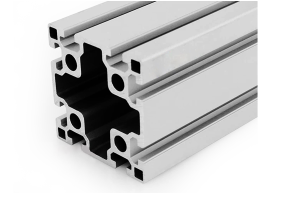 PG45 90×90 mm Eight Slot Heavy Aluminium Strut Profile for Heavy Machinery Frames
A 90 x 90 mm eight slot heavy PG45 aluminium strut profile with thicker…
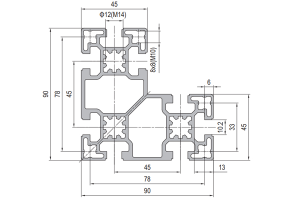 PG45 90×90 mm L-Shape Eight Slot Aluminium Strut Profile Corner Column for Frames
A 90 x 90 mm L-shaped eight slot PG45 aluminium strut profile with two…
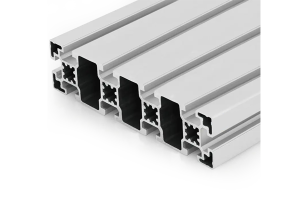 PG45 180 x 45 mm Ten Slot Aluminium Strut Profile Wide Gantry Beam
A 180 x 45 mm ten slot PG45 aluminium strut profile at about 6.20…
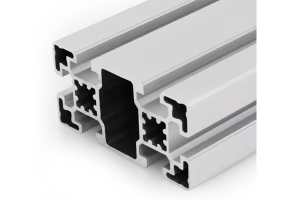 PG45 90×45 mm Six Slot Aluminium Strut Profile Rectangular Machine Beam
A 90 x 45 mm six slot PG45 aluminium strut profile for machine frames…
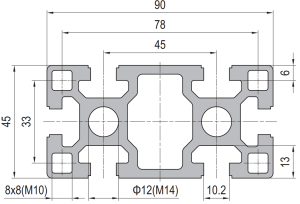 PG45 90 x 45 mm Six Slot Aluminium Strut Profile Heavy Rectangular Beam
90 x 45 mm six-slot heavy aluminium strut profile with 10.2 mm grooves and…
