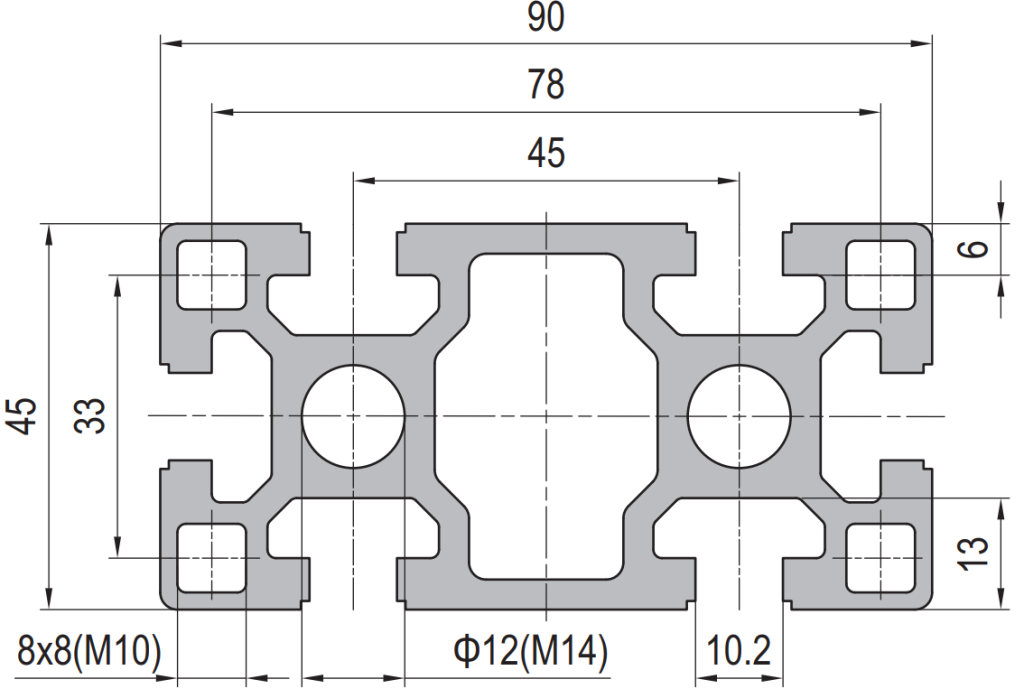
PG45 90 x 45 mm Six Slot Aluminium Strut Profile Heavy Rectangular Beam
90 x 45 mm six-slot heavy aluminium strut profile with 10.2 mm grooves and a 10 mm mouth for M10 accessories. Heavy rectangular load beam for machine frames and gantries.
| Material | Aluminium |
|---|---|
| Alloy Grade | 6063-T5 |
| Temper | T5 |
| Section Size | 90 x 45 mm |
| Slot | 6 x 10.2 mm groove, 10 mm mouth, 45 mm pitch, 2 per 90 mm face and 1 per 45 mm face, M10 |
| Length | 6 m stock, cut to drawing to +/-0.5 mm |
| Tolerance | EN 755-9 / GB/T 6892, wall +/-0.15 mm |
| Surface | Mill finish / clear anodised / black anodised |
| MOQ | Made to order; small trial lengths available from stock offcuts |
| Lead Time | Typically 2 to 3 weeks for mill finish, about a week longer for anodising |
| Loading Port | Shanghai, Ningbo, Qingdao |
| Supply Ability | Extrusion capacity for standard and custom dies, with in-house cutting, machining and anodising |
| Payment Terms | T/T 30 per cent deposit, balance against copy of bill of lading; L/C at sight for larger orders |
| Trade Terms | FOB, CIF, CFR, EXW |
| Certifications | Mill certificate to EN 10204 3.1 on request, RoHS and REACH declarations |
01What is the 90 x 45 mm six slot heavy profile?
What makes it a heavy beam?
The 90 mm depth and the heavy wall. When the 90 mm face is vertical (the strong axis), the second moment of area is around 52 cm4, which is about six times the 45 x 45 mm section. That lets it span much further under a given load, which is why it is used as the load beam in machine frames and gantries.
Why does orientation matter so much?
Because bending stiffness scales with the cube of the depth. With the 90 mm face vertical, the section is 52 cm4; with it horizontal, the depth is only 45 mm and the stiffness drops to about 14 cm4, a factor of 3.7. Using the beam the wrong way round throws away most of its strength.
How does the 45 series differ from the 40 series for this beam?
The 45 series has a 10 mm mouth and M10 accessories, against the 40 series 8 mm mouth and M8. For a heavy beam, the larger M10 fasteners give higher per-slot pull-out, which matters when the beam carries a heavy head or a loaded carriage.
02Section data
| Item | Value | Note |
|---|---|---|
| Envelope | 90 x 45 mm rectangular | depth 90 mm, width 45 mm |
| Slots | 6 | 10.2 mm groove, 10 mm mouth |
| Slot layout | 2 per 90 mm face, 1 per 45 mm face | 45 mm pitch |
| Fasteners | M10 | larger than the 40 series M8 |
| Strong-axis I | approx. 52 cm4 | 90 mm face vertical |
| Weak-axis I | approx. 14 cm4 | 90 mm face horizontal |
| Weight | approx. 4.85 kg/m | from published specification |
| Alloy | 6063-T5 | EN AW-6063 |
| Standard | EN 755-9 / GB/T 6892 | wall tolerance +/-0.15 mm |
| Length | 6 m stock | cut to drawing to +/-0.5 mm |
03Strong axis vs weak axis: the numbers
The 90 x 45 mm section is strongly directional. The stiffness depends on which way the depth points, and the difference is close to a factor of four.
| Orientation | Depth (mm) | I (cm4) | Deflection at 500 N, 1 m span |
|---|---|---|---|
| 90 mm face vertical (strong) | 90 | approx. 52 | 0.32 mm |
| 90 mm face horizontal (weak) | 45 | approx. 14 | 1.2 mm |
That is why the beam is almost always used with the 90 mm face vertical, as a load beam spanning between columns. The 45 mm width is then the flange, and the two slots on each 90 mm face carry the fixings along the top and bottom edges.
04Three jobs and their limits
The same section is used three ways, and the limits are different for each.
| Use | Orientation | Typical span | Typical load |
|---|---|---|---|
| Column (vertical member) | either | up to 3 m | compression, up to 25 kN |
| Load beam (horizontal) | 90 mm face vertical | up to 2 m | 500 N to 2 kN centre |
| Diagonal brace | either | bay diagonal | tension or compression, up to 15 kN |
As a column, the beam is limited by buckling, not bending, so orientation matters less. As a beam, it must be oriented with the 90 mm face vertical. As a brace, it carries axial load and both orientations are acceptable, though the strong axis is still preferred where a moment may develop.
05Joining the 90 x 45 to the rest of the frame
The 90 x 45 beam is usually joined to a 45 x 45 or 90 x 45 column with a corner bracket or a machined end plate. Because the beam carries moment, a plain slot nut joint at the corner is not enough; the joint needs a bracket that spreads the load across the full depth of the beam.
- Corner brackets: a heavy bracket bolted into the slots of both members, tying the beam to the column across the full 90 mm depth.
- Machined end plates: a plate bolted to the beam end and to the column face, used where the beam sits between two columns.
- Through-bolts: a long bolt through the beam and column centre bores for a high-tension joint at the corners.
For a gantry, the beam is often tapped at both ends and bolted directly to the uprights with an end plate, which gives the stiffest joint.
06Choosing the 90 x 45 vs the 45 x 45
Choose the 90 x 45
- The member spans between supports and carries bending load
- The span is over 1 m and deflection must stay low
- The beam carries a loaded head, carriage or gantry
- You need M10 fasteners for high per-slot pull-out
- The frame is a load-bearing machine frame, not a light guard
Choose the 45 x 45
- The member is a column or a short link, not a beam
- The span is under 1 m and the load is light
- You need four faces of fixings on a square section
- Weight per metre matters and the 45 x 45 is half the weight
- The frame is a perimeter or guard, not a load path
07Failure modes to design out
| What goes wrong | Why it happens | Design it out by |
|---|---|---|
| Beam is installed on the weak axis | the 90 mm face is horizontal, so depth is only 45 mm | orient the 90 mm face vertical for any spanning member |
| Beam deflects under a moving load | the span is too long for the 52 cm4 stiffness | add an intermediate column, or step up to a 90 x 90 section |
| Corner joint opens under moment | a plain slot nut joint cannot carry the beam end moment | use a heavy corner bracket or a machined end plate across the full depth |
| Nut pulls out at the loaded head | the M10 nut is overloaded at a single point | use multiple nuts along the slot, and a through-bolt at the load point |
| Beam twists under an off-centre load | the rectangular section has low torsional stiffness | keep the load centred, or add a torsional brace across the section |
08What to check before you order
Procurement checklist for the 90 x 45 heavy beam
- Confirm the orientation: the 90 mm face must be vertical for any spanning member. Mark it on the drawing.
- Confirm the span and load. If the span is over 2 m under a centre load, check whether a 90 x 90 section is needed.
- Confirm the joint type: corner bracket or machined end plate, not a plain slot nut joint.
- Confirm the end preparation: square cut, tapped ends, or machined end plate.
- Confirm the finish: mill for hidden use, anodised for exposed service.
- Confirm the quantity in metres. A 6 m bar yields three 1.9 m beams.
09Terms used on this page
- Strong axis
- The bending orientation with the highest second moment of area. For the 90 x 45, it is with the 90 mm face vertical.
- Weak axis
- The bending orientation with the lowest second moment of area. For the 90 x 45, it is with the 90 mm face horizontal.
- Second moment of area
- A geometric property, in cm4, that determines bending stiffness. It scales with the cube of the depth.
- End plate
- A machined plate bolted to the beam end and the column face, giving a stiff corner joint.
- Buckling
- The sudden sideways failure of a column under compression, before the material itself yields.
10Questions buyers ask
What is the strong-axis stiffness?
Around 52 cm4 with the 90 mm face vertical. With the 90 mm face horizontal, it drops to about 14 cm4, so orientation is critical.
What fasteners fit?
M10 slot nuts, T-bolts and cover strips from the 45 series range. The 10 mm mouth is larger than the 40 series 8 mm mouth.
Can it be used as a column?
Yes. As a column it is limited by buckling, and both orientations are acceptable. It carries compression up to about 25 kN over a 3 m height.
How is it joined to the frame?
With a heavy corner bracket or a machined end plate across the full 90 mm depth. A plain slot nut joint is not stiff enough at the beam end.
What is the weight per metre?
Approximately 4.85 kg/m, from the published product specification.
Can it be anodised?
Yes. Clear, black, champagne and bronze at 10 to 15 micron.
What we need to quote this section
- The section drawing or the profile reference GP-SP-4590H-6S.
- The cut length for each beam and the number of beams.
- The end preparation: square cut, tapped ends, or machined end plate.
- The finish: mill, clear anodised, or a specified colour.
- The annual or per-order quantity, in metres or pieces.
- Any certification requirement: mill certificate to EN 10204 3.1.
Send those six items and the quotation comes back with the extrusion price, the cutting and machining charge, the finish surcharge and the lead time broken out separately. Browse the full aluminium profile catalogue and the 45 series aluminium profiles range.
Need this heavy beam quoted for your load frame?
Send the section, the cut list, the end preparation and the finish. We quote extrusion, cutting and machining as separate lines.
Request a quotationRelated Products
 PG45 45 x 45 mm Two Slot Type B Aluminium Strut Profile Opposite Rail
45 x 45 mm two-slot Type B aluminium strut profile with slots on opposite…
 PG40 120 x 80 mm Ten Slot Aluminium Strut Profile Wide Heavy Beam
120 x 80 mm ten-slot aluminium strut profile with six slots on the two…
 PG40 80×40 mm Six Slot Aluminium Strut Profile Standard Wall Beam
An 80 x 40 mm six slot standard wall PG40 aluminium strut profile. Two…
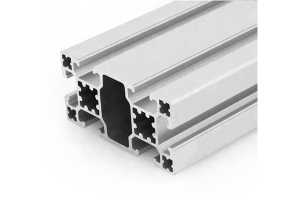 PG40 80×40 mm Six Slot Light Aluminium Strut Profile for Panel Frames
An 80 x 40 mm six slot light wall PG40 aluminium strut profile for…
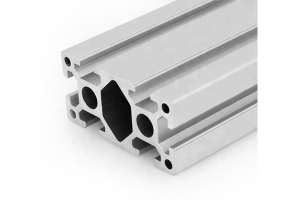 PG40 80 x 40 mm Six Slot Aluminium Strut Profile Heavy Rectangular Beam
80 x 40 mm heavy-wall six-slot aluminium strut profile with four slots on the…
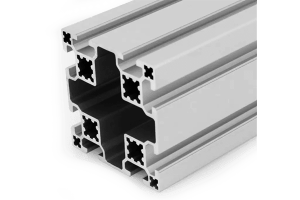 PG40 80×80 mm Eight Slot Aluminium Strut Profile Square Column
An 80 x 80 mm eight slot standard wall PG40 aluminium strut profile square…
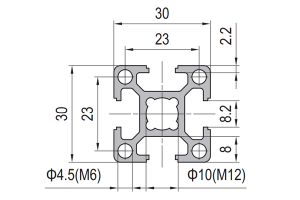 PG30 30×30 mm Four Slot Aluminium Strut Profile Standard Wall Column
A 30 x 30 mm four slot standard wall PG30 aluminium strut profile square…
 PG20 20 x 20 mm Four Slot Aluminium Strut Profile Miniature Frame
20 x 20 mm four-slot aluminium strut profile with 6.2 mm grooves and 6…
