PG40 120 x 80 mm Ten Slot Aluminium Strut Profile Wide Heavy Beam
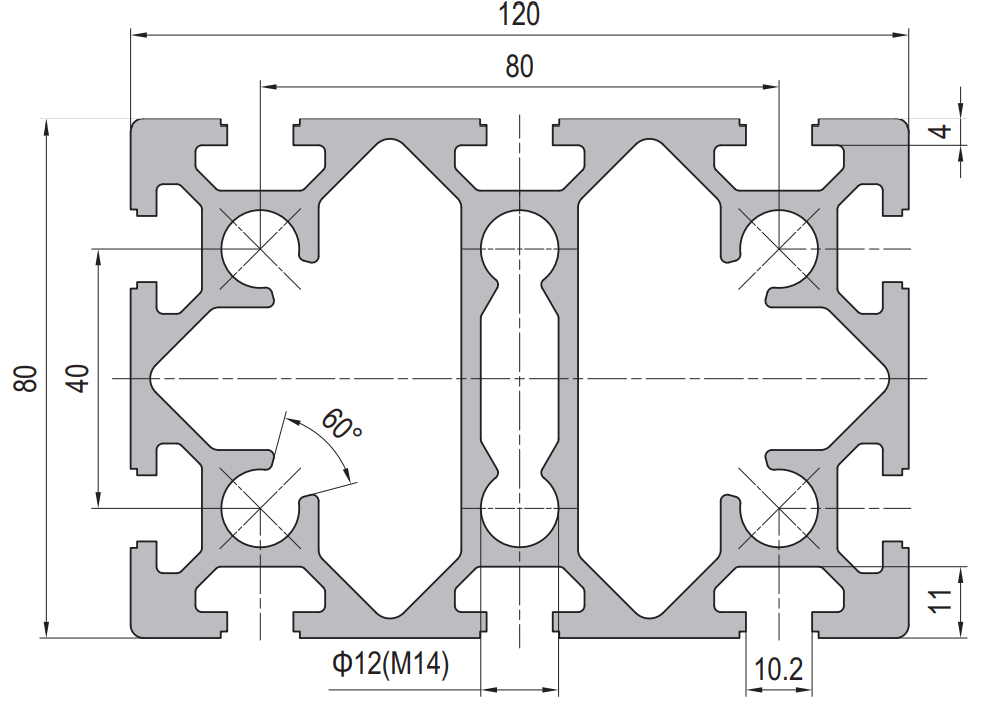
120 x 80 mm ten-slot aluminium strut profile with six slots on the two 120 mm faces and four on the 80 mm faces. Wide heavy beam for large-scale structural frames using M8 fasteners.
| Material | Aluminium |
|---|---|
| Alloy Grade | 6063-T5 |
| Temper | T5 |
| Section Size | 120 x 80 mm rectangular, ten slots, heavy-wall, all faces slotted |
| Slot | 10 x 10.2 mm groove, 8 mm mouth, 3 per 120 mm face + 2 per 80 mm face, 40 mm pitch, M8 |
| Length | 6 m stock, cut to drawing to +/-0.5 mm |
| Tolerance | EN 755-9 / GB/T 6892, wall +/-0.15 mm |
| Surface | Mill finish / clear anodised / black anodised |
| MOQ | Made to order; minimum extrusion run applies for this section size; small trial lengths from stock on request |
| Lead Time | Typically 3 to 4 weeks for mill finish, plus 1 week for machining, plus 1 week for anodising; large section may require a dedicated extrusion run |
| Loading Port | Shanghai, Ningbo, Qingdao |
| Supply Ability | Extrusion capacity for large-section wide beam profiles, with in-house anodising, machining and centre bore tapping |
| Payment Terms | T/T 30 per cent deposit, balance against copy of bill of lading; L/C at sight for larger orders |
| Trade Terms | FOB, CIF, CFR, EXW |
| Certifications | Mill certificate to EN 10204 3.1 on request, RoHS and REACH declarations |
01What is the 120 x 80 mm ten-slot wide beam?
Why would you need a section this large?
Because some frames need maximum stiffness in a single profile. The 120 x 80 ten-slot has a second moment of area of about 28 cm4 on the strong axis — roughly 5 times stiffer than the 40 x 40 four-slot at 5.8 cm4, and about 2.5 times stiffer than the 80 x 40 heavy six-slot at 11 cm4. It is the stiffest standard section in the 40 series range, designed for large machine bases and long-span structural members.
What is it used for?
Large CNC machine bases, multi-station assembly platforms, heavy conveyor support frames, portal frame uprights and crossbeams, and any application where a single beam must span 2 metres or more and carry significant weight. The 10 slots give fixing positions on every face for brackets, panels, sensors, cable chains and accessories.
How many slots and where?
Ten slots in total: three on each 120 mm long face and two on each 80 mm short face. This gives 10 fixing tracks across all four sides of the profile, with a slot pitch of 40 mm between centres. All slots use the standard 40 series 10.2 mm groove and 8 mm mouth for M8 fasteners.
How does it compare to bolted-together sections?
A common alternative is to bolt two 80 x 40 beams back-to-back to make a 80 x 80 section. That assembly weighs 7.2 kg/m and has I about 16 cm4. The single 120 x 80 ten-slot weighs 6.0 kg/m and has I about 28 cm4 on the strong axis. The single section is lighter and stiffer than the bolted assembly, and eliminates the alignment and bolting work.
02Section data
| Item | Value | Note |
|---|---|---|
| Envelope | 120 x 80 mm rectangular | 1.5:1 aspect ratio |
| Slots | 10 | 10.2 mm groove, 8 mm mouth |
| Slot layout | 3+3+2+2 | 3 per long face, 2 per short face |
| Slot pitch | 40 mm | centre-to-centre on all faces |
| Centre bore | Phi18 mm typically | for through-bolts or location |
| Wall | approx. 3.5 mm | heavy-wall standard for this size |
| Weight | approx. 6.00 kg/m | heaviest standard 40 series section |
| I strong axis | approx. 28.0 cm4 | bending about the 80 mm width |
| I weak axis | approx. 11.0 cm4 | bending about the 120 mm width |
| Alloy | 6063-T5 | EN AW-6063 |
| Standard | EN 755-9 / GB/T 6892 | wall tolerance +/-0.15 mm |
| Length | 6 m stock | cut to drawing to +/-0.5 mm |
The strong-axis stiffness of 28 cm4 is about 5 times that of the 40 x 40 four-slot. This makes the 120 x 80 the section of choice for long-span beams where deflection must be kept under 0.5 mm per metre at full load.
03Stiffness comparison across the 40 series range
The 120 x 80 ten-slot sits at the top of the 40 series stiffness range. Here is how it compares to the other standard sections, all on the strong axis:
| Section | Weight (kg/m) | I strong (cm4) | Stiffness ratio |
|---|---|---|---|
| 40 x 40 four-slot | 1.49 | 5.8 | 1.0x |
| 80 x 40 six-slot heavy | 3.60 | 11.0 | 1.9x |
| 120 x 80 ten-slot | 6.00 | 28.0 | 4.8x |
The stiffness ratio of 4.8 means that for the same span and load, the 120 x 80 beam deflects about 5 times less than the 40 x 40 beam. This is why large machine frames use the 120 x 80 for the main structural members and the 40 x 40 for secondary bracing and accessories.
04Ten-slot layout for multi-station platforms
The 10 slots are distributed across all four faces, giving fixing positions on every side of the profile. This is particularly useful for multi-station assembly platforms where tools, fixtures, sensors and cable chains must be mounted from different directions.
| Face | Slots | Typical use on a platform beam |
|---|---|---|
| Top (120 mm) | 3 slots | fixture stations, tool mounts, jigs |
| Bottom (120 mm) | 3 slots | feet, levelling mounts, support brackets |
| Front (80 mm) | 2 slots | cable chains, pneumatic lines, sensors |
| Back (80 mm) | 2 slots | return cables, secondary mounting, panels |
On a 6 metre platform beam, the three top slots give fixing positions every 40 mm along the full length. For a station spacing of 600 mm, each station has 15 fixing positions in the top face alone. The two front slots carry the cable chain and the sensor track, and the two back slots carry the return cables.
05Span design and deflection control
For a simply supported beam with a uniformly distributed load, the midspan deflection is proportional to the load, the span cubed, and the inverse of the second moment of area. With I = 28 cm4 on the strong axis, the deflection of a 2 metre span under a 500 N load is about 0.24 mm. For a 3 metre span under the same load, it is about 0.81 mm.
| Span (mm) | Load (N) | Deflection strong axis (mm) | Deflection weak axis (mm) |
|---|---|---|---|
| 1000 | 500 | 0.03 | 0.08 |
| 2000 | 500 | 0.24 | 0.61 |
| 3000 | 500 | 0.81 | 2.06 |
| 4000 | 500 | 1.92 | 4.88 |
These are elastic deflection estimates for a simply supported beam with a uniformly distributed load. Real frames with fixed ends and multiple supports will deflect less. Use these numbers for section comparison, not for final design.
06When to choose the 120 x 80 ten-slot
Choose the 120 x 80 ten-slot
- You need maximum stiffness in a single profile
- The beam must span 2 metres or more with controlled deflection
- You are building a large machine base or multi-station platform
- You need fixing positions on all four faces
- A single section is preferred over bolted-together assemblies
Choose bolted-together smaller sections
- The frame is modular and may need reconfiguration
- Transport is a constraint: 120 x 80 at 6 m is 36 kg per bar
- You need different stiffness in different directions
- Cost per metre is the primary driver
- The frame is light-duty and does not need the extra stiffness
The 120 x 80 is the top of the range for single-profile stiffness in the 40 series. For even larger frames, consider welded steel or bolted-together aluminium assemblies. For medium-duty frames, the 80 x 40 heavy six-slot is usually sufficient.
07Failure modes to design out
| What goes wrong | Why it happens | Design it out by |
|---|---|---|
| Beam installed in weak-axis orientation | the 120 mm dimension is horizontal instead of vertical | mark the strong axis on the drawing and on the bar before installation |
| Excessive deflection on long spans | the span exceeds 3 metres without intermediate support | add a support post or use a bolted truss above the beam |
| Bolts loosen under vibration on heavy frame | M8 slot nuts can back out under cyclic loading | use spring-loaded slot nuts or thread-lock on all critical bolts |
| Profile is too heavy to handle safely | a 6 m bar weighs 36 kg and is awkward to move | cut to shorter lengths on receipt, or specify factory cut-to-size |
| Die line or surface defect on visible faces | the extrusion die is worn after a long production run | specify anodised finish to conceal minor surface defects |
08What to check before you order
Procurement checklist for the 120 x 80 ten-slot beam
- Confirm the section orientation: the 120 mm dimension is vertical for strong-axis bending. Mark it on the drawing.
- Confirm the slot count: 10 slots total, 3 per 120 mm face and 2 per 80 mm face. All M8, 40 series.
- Confirm the wall thickness: about 3.5 mm is standard for this section size.
- Confirm the finish: mill for hidden structural use, anodised for exposed service. Anodising adds 10 to 15 micron.
- Confirm the cut length and quantity. A 6 m bar weighs 36 kg; plan handling and storage accordingly.
- Confirm the deflection requirement: specify the maximum allowable deflection at full load and the span.
- Confirm the machining requirement: drilling, tapping, slot end milling for joints.
- Any certification requirement: mill certificate to EN 10204 3.1.
09Terms used on this page
- Wide beam
- A rectangular section where the height is significantly larger than the width, giving high strong-axis stiffness. The 120 x 80 is the widest standard 40 series section.
- Multi-station platform
- A structural frame with multiple workstation positions along its length, each with independent fixing positions for tools and fixtures.
- Portal frame
- A structural frame with two uprights and a horizontal crossbeam. The 120 x 80 is used for both uprights and the crossbeam on large portals.
- Stiffness ratio
- The ratio of strong-axis to weak-axis second moment of area. For the 120 x 80, the ratio is about 2.5:1.
- Through-bolt
- A bolt that passes through the centre bore of the profile to connect two members end-to-end or to anchor the profile to a base.
10Questions buyers ask
What is the 120 x 80 ten-slot used for?
Large CNC machine bases, multi-station assembly platforms, heavy conveyor support frames, and portal frame crossbeams where maximum stiffness and fixing positions on all faces are needed.
How does it compare to two 80 x 40 beams bolted together?
The single 120 x 80 weighs 6.0 kg/m vs 7.2 kg/m for two 80 x 40 heavy beams, and has I of 28 cm4 vs about 16 cm4. The single section is lighter, stiffer, and eliminates alignment work.
What is the maximum recommended span?
For a 500 N uniformly distributed load with deflection under 1 mm, the strong-axis span can be up to about 3 metres. Add intermediate supports for longer spans.
Can I use standard 40 series accessories?
Yes. All 10 slots use the 10.2 mm groove and 8 mm mouth, so M8 slot nuts, T-bolts, cover strips and all 40 series accessories fit every slot.
What is the weight per metre?
Approximately 6.00 kg/m. A 6 m stock bar weighs about 36 kg; plan handling and storage accordingly.
Can it be anodised?
Yes. Clear, black, champagne and bronze at 10 to 15 micron. Recommended for exposed surfaces in machine frames.
What is the lead time?
Typically three to four weeks for mill finish, as this is a large section that may require a dedicated extrusion run. Cutting and drilling adds one week. Anodising adds one week.
What we need to quote this section
- The section drawing or the profile reference GP-SP-80120-10S.
- The cut length for each beam and the number of beams.
- The orientation: confirm the 120 mm dimension is vertical for strong-axis bending.
- The machining requirement: drilling, tapping, slot end milling.
- The finish: mill, clear anodised, or a specified colour.
- The deflection requirement: maximum allowable deflection at full load and the span.
- The annual or per-order quantity, in metres or pieces.
- Any certification requirement: mill certificate to EN 10204 3.1.
Send those eight items and the quotation comes back with the extrusion price, the machining charge, the finish surcharge and the lead time broken out separately. Browse the full aluminium profile catalogue and the 40 series aluminium profiles range for related sections.
Need this wide heavy beam quoted for your large-scale frame?
Send the section, the orientation, the machining requirement and the finish. We quote extrusion, machining and anodising as separate lines.
Request a quotationRelated Products
 PG40 80×40 mm Six Slot Aluminium Strut Profile Standard Wall Beam
An 80 x 40 mm six slot standard wall PG40 aluminium strut profile. Two…
 PG40 80×40 mm Six Slot Light Aluminium Strut Profile for Panel Frames
An 80 x 40 mm six slot light wall PG40 aluminium strut profile for…
 PG40 80 x 40 mm Six Slot Aluminium Strut Profile Heavy Rectangular Beam
80 x 40 mm heavy-wall six-slot aluminium strut profile with four slots on the…
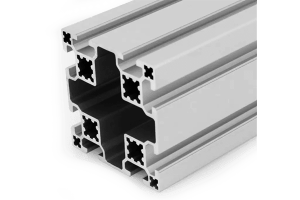 PG40 80×80 mm Eight Slot Aluminium Strut Profile Square Column
An 80 x 80 mm eight slot standard wall PG40 aluminium strut profile square…
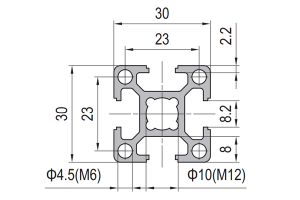 PG30 30×30 mm Four Slot Aluminium Strut Profile Standard Wall Column
A 30 x 30 mm four slot standard wall PG30 aluminium strut profile square…
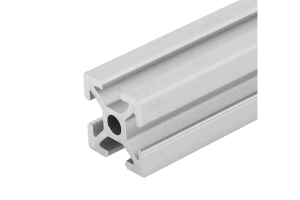 PG20 20 x 20 mm Four Slot Aluminium Strut Profile Miniature Frame
20 x 20 mm four-slot aluminium strut profile with 6.2 mm grooves and 6…
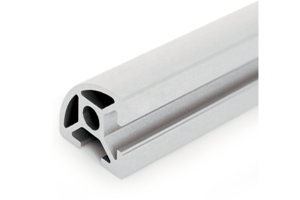 PG20 20 x 20 mm R90 Two Slot Aluminium Strut Profile Rounded Corner
20 x 20 mm quarter-round aluminium strut profile with a swept R90 outer corner…
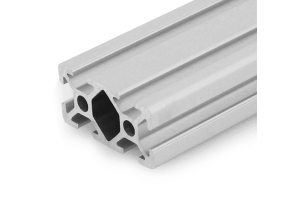 PG20 40 x 20 mm Six Slot Aluminium Strut Profile Rectangular Flat Beam
40 x 20 mm six-slot aluminium strut profile with 6.2 mm grooves on a…
