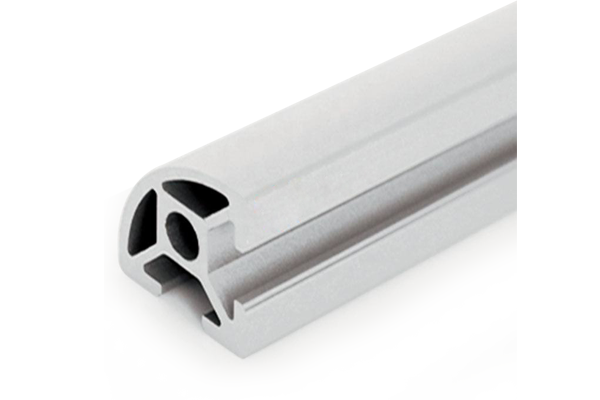
PG20 20 x 20 mm R90 Two Slot Aluminium Strut Profile Rounded Corner
20 x 20 mm quarter-round aluminium strut profile with a swept R90 outer corner and two 6.2 mm T-slots on the straight faces. For visible frame edges where a sharp arris is not acceptable.
| Material | Aluminium |
|---|---|
| Alloy Grade | 6063-T5 |
| Temper | T5 |
| Section Size | 20 x 20 mm quarter round, 20 mm outer radius |
| Slot | 2 x 6.2 mm groove, 6 mm mouth, 20 mm pitch, one per straight face, M5 and M6 |
| Length | 6 m stock, cut to drawing to +/-0.5 mm |
| Tolerance | EN 755-9 / GB/T 6892, wall +/-0.15 mm |
| Surface | Mill finish / clear anodised / black anodised |
| MOQ | Made to order; small trial lengths available from stock offcuts |
| Lead Time | Typically 2 to 3 weeks for mill finish, about a week longer for anodising |
| Loading Port | Shanghai, Ningbo, Qingdao |
| Supply Ability | Extrusion capacity for standard and custom dies, with in-house cutting, machining and anodising |
| Payment Terms | T/T 30 per cent deposit, balance against copy of bill of lading; L/C at sight for larger orders |
| Trade Terms | FOB, CIF, CFR, EXW |
| Certifications | Mill certificate to EN 10204 3.1 on request, RoHS and REACH declarations |
01What is the 20 x 20 mm R90 two slot profile?
How is the R90 different from the standard 20 x 20 four-slot?
The standard 20 x 20 is a square section with four slots, one on each face. The R90 is a quarter-round: the outer corner is swept to a 90 mm radius, replacing the sharp arris with a smooth arc. Only the two straight faces carry T-slots, so it has two slots instead of four. The rounded face has no slot and is meant to be the visible edge of a frame.
Why would you choose the R90 over the standard four-slot?
When the profile is on a visible or touched edge of a frame, a sharp arris is a catch point, a cleaning difficulty and an aesthetic issue. The R90 gives you a smooth corner without adding a separate plastic or aluminium cover cap. It is used on display frames, equipment enclosures and safety guards where the outer edge has to be safe to touch and easy to wipe down.
What fasteners fit the 6.2 mm groove?
The two slots use the same 6.2 mm groove and 6 mm mouth as the standard 20 series, so M5 and M6 slot nuts, hammer head bolts and cover strips all fit. The slot pitch is 20 mm between centres, matching the standard 20 series.
02Section data
| Item | Value | Note |
|---|---|---|
| Envelope | 20 x 20 mm quarter round | 90 mm outer radius on the corner |
| Slots | 2 | 6.2 mm groove, 6 mm mouth, on the straight faces only |
| Slot pitch | 20 mm between centres | matches standard 20 series |
| Outer radius | R90 | swept corner, no sharp arris |
| Wall | approx. 2.8 mm effective | thinner at the radius transition |
| Weight | approx. 0.38 kg/m | lighter than the 0.62 kg/m four-slot |
| Alloy | 6063-T5 | EN AW-6063 |
| Standard | EN 755-9 / GB/T 6892 | wall tolerance +/-0.15 mm |
| Length | 6 m stock | cut to drawing to +/-0.5 mm |
The weight figure is from the published product specification. The effective wall thickness at the radius transition is thinner than the flat faces, which is why the R90 weighs about 40 per cent less than the standard four-slot despite sharing the 20 x 20 envelope.
03Where the R90 earns its place
The R90 is a finish profile, not a load-bearing one. Its job is to replace the standard 20 x 20 on the visible edges of a frame where a sharp corner would be a problem. Three applications cover most of what it does:
- Display and exhibition frames: the rounded edge looks finished without a cover cap, and the frame can be handled without gloves.
- Equipment enclosures in clean rooms and labs: the radius eliminates the groove where dust accumulates at the corner, and the surface wipes down without catching a cloth on the arris.
- Safety guards on small machines: the edge that an operator might brush against is smooth, reducing the risk of a cut or a snag.
On all three, the frame’s structural members are still the standard 20 x 20 four-slot. The R90 is used only on the perimeter edges, where it does not need to carry bending load and the rounded face is the reason it was chosen.
04How the slots are arranged and what fits them
The two T-slots are on the two straight faces of the quarter-round section. The radius face has no slot. The slots use the standard 6.2 mm groove and 6 mm mouth of the 20 series, with 20 mm pitch between centres.
| Slot | Face | Typical use |
|---|---|---|
| Slot 1 | straight face A | bracket or panel fixing |
| Slot 2 | straight face B | bracket or panel fixing, perpendicular to A |
| Radius face | no slot | visible, finished edge |
The radius face accepts no fastener. If you need to fix something to it, use an adhesive or a clamp that wraps around the section. For most applications, the radius face is left bare or finished with a clear anodised coating.
05What you give up: slot count and bending stiffness
The R90 has half the slots of the standard four-slot and less material in the wall, so two things are lower.
First, the bending stiffness is lower. The quarter-round section has less material away from the neutral axis than the square section, because the radius face removes the corner that would be there on the four-slot. For a 1 m span under a 50 N centre load, the R90 deflects roughly 20 per cent more than the four-slot.
Second, the fixing count per face is halved. The four-slot gives you one slot per face on all four faces; the R90 gives you two slots on two faces and nothing on the radius face. If the frame design needs a fixing on the radius face, the R90 cannot do it.
| Property | Standard 4-slot | R90 2-slot | Change |
|---|---|---|---|
| Slots | 4 | 2 | -50 per cent |
| Weight (kg/m) | approx. 0.62 | approx. 0.38 | -39 per cent |
| Deflection at 50 N, 1 m | reference | approx. +20 per cent | higher |
| Faces with slots | 4 | 2 | radius face bare |
| Outer corner | sharp arris | R90 swept | safe to touch |
The comparison values are derived from the published section data for the 20 x 20 standard four-slot, available on the 20 series profiles page. The R90 deflection estimate is approximate because the quarter-round geometry makes the neutral axis offset non-trivial.
06Choosing between the R90 and the standard four-slot
Choose the R90
- The profile is on a visible or touched edge of a frame
- You want to eliminate a decorative cover cap from the design
- The frame is in a clean room or lab where sharp corners trap dust
- Safety: operators might brush against the edge
- The R90 face does not need a fastener attached to it
Choose the standard four-slot
- The profile spans between supports and carries bending load
- You need four fixing faces, not two
- The frame is internal or hidden, and appearance does not matter
- Weight per metre is a driver (four-slot is heavier but only 0.62 kg/m)
- You need the full range of 20 series accessories on all four faces
07Failure modes to design out
| What goes wrong | Why it happens | Design it out by |
|---|---|---|
| Bracket cannot attach to radius face | the radius face has no slot | use the two straight-face slots; for the radius face, use an adhesive or wraparound clamp |
| Frame deflects more than the four-slot | the quarter-round section has less material at the corner | use the R90 only on perimeter edges, not on spanning members |
| Anodising colour mismatch on radius vs flat | the radius face anodises at a different rate than flat faces | specify the same batch and a single anodising run for the whole frame |
| Cover strip does not follow the radius | the standard 20 series cover strip is straight | use a flexible PVC cover strip, or leave the radius face bare |
| Slot nut pulls out at lower force | the effective wall is thinner at the radius transition | use M5 nuts and keep the torque under 3 Nm; do not use the slots for tension |
08What to check before you order
Procurement checklist for the R90 profile
- Confirm the corner orientation: left-hand or right-hand radius. The R90 is asymmetric, so the drawing must show which corner is rounded.
- Confirm the cut length and tolerance. Standard cut is +/-0.5 mm on a CNC saw.
- Confirm the finish: mill, clear anodised, or black anodised. The radius face is the visible one, so specify the finish that will be seen.
- Confirm the quantity in metres, not pieces. A 6 m bar yields six 950 mm members with 300 mm of offcut.
- Confirm the fastener plan: which slots carry brackets and what happens at the radius face. If a fixing is needed there, the design has to change.
- If the frame has structural members, specify the standard four-slot for those and the R90 only for the perimeter edges.
09Terms used on this page
- Quarter-round
- A section whose outer corner is swept to a radius, in this case 90 mm, replacing the sharp arris with a smooth arc.
- Arris
- The sharp edge where two flat faces of a profile meet at a corner. On the R90, the arris is replaced by the radius.
- Effective wall
- The wall thickness that actually carries load at a given point. At the radius transition it is thinner than on the flat faces.
- Slot pitch
- The distance between slot centres. On the R90 it is 20 mm, matching the standard 20 series.
- Cover cap
- A separate plastic or aluminium cap that clips onto a sharp corner to make it safe. The R90 eliminates the need for one.
10Questions buyers ask
Can I use standard 20 series slot nuts in the R90?
Yes. The two slots use the same 6.2 mm groove and 6 mm mouth as the standard 20 series, so M5 and M6 slot nuts, hammer head bolts and cover strips all fit.
What is the difference between this and the standard 20 x 20 four-slot?
The R90 has two slots instead of four, a quarter-round outer corner instead of a sharp arris, and weighs about 0.38 kg/m vs 0.62 kg/m. It is used on visible frame edges; the four-slot is the structural section.
Can I attach something to the radius face?
Not with a slot nut. The radius face has no slot. Use an adhesive, a wraparound clamp, or redesign so the fixing goes on one of the two straight-face slots.
Is the R90 available in left-hand and right-hand versions?
The extrusion is symmetric in the sense that rotating it 180 degrees swaps the handedness. But on a cut member, the radius has to be on the correct side for the frame. Specify the orientation on the drawing.
What is the minimum order quantity?
Extrusion is made to order. Small trial lengths are available from stock offcuts; production runs are quoted by the metre. Send the drawing and annual volume for a quotation.
Can it be supplied anodised?
Yes. Clear, black, champagne and bronze are standard anodised colours at 10 to 15 micron. The radius face is the visible one, so the anodising quality on it matters more than on the flat faces.
What we need to quote this section
- The section drawing or the profile reference, with the radius orientation called out.
- The cut length for each member and the number of members.
- The finish: mill, clear anodised, or a specified colour.
- The annual or per-order quantity, in metres or pieces.
- Whether the centre bore is needed (the R90 does not always have one).
- Any certification requirement: mill certificate to EN 10204 3.1.
Send those six items and the quotation comes back with the extrusion price, the cutting charge, the finish surcharge and the lead time broken out separately. Browse the full aluminium profile catalogue and the 20 series aluminium profiles range for related sections.
Need this profile quoted for your frame edges?
Send the section, the cut list and the finish. We quote extrusion, cutting and anodising as separate lines so the cost of each step is visible.
Request a quotationRelated Products
 PG20 40 x 20 mm Six Slot Aluminium Strut Profile Rectangular Flat Beam
40 x 20 mm six-slot aluminium strut profile with 6.2 mm grooves on a…
 PG15 30 x 15 mm Three Slot Aluminium Strut Profile Light Panel Frame
30 x 15 mm three-slot aluminium strut profile with 6 mm grooves on a…
 PG30 60×60 mm L-Shape Eight Slot Aluminium Strut Profile Corner Column
A 60 x 60 mm L-shape eight slot PG30 aluminium strut profile corner column…
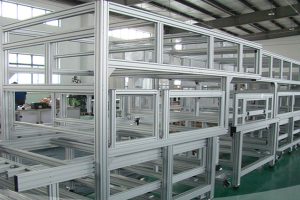 Aluminium Profile Shelf System 40×40 mm T-Slot Uprights for Workshop Racking
A bolted aluminium profile shelf system in 40 x 40 mm T-slot uprights and…
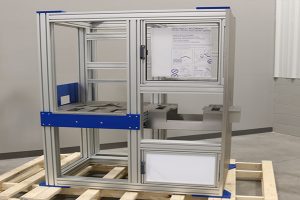 Aluminium Extrusion Table Frame 20×20 40 mm Workbench Base
20 series aluminium extrusion table frame with 40x40 mm four-slot legs and 40x80 mm…
Aluminium Framing Extrusion Kit 40×40 mm 40 Series Cut List for Machine Frames
A cut-to-length aluminium framing extrusion kit in the 40 series: profile cut to a…
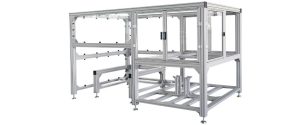 Aluminium Profile Machine Guard Frame 40 x 40 mm Safety Enclosure
40 x 40 mm T-slot aluminium machine guard frame for safety fences and enclosures,…
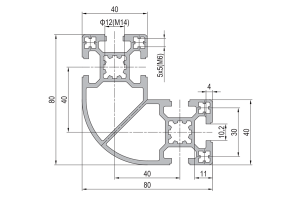 PG40 80×80 mm R90 Six Slot Aluminium Strut Profile Rounded Corner Column
80 x 80 mm L section aluminium corner column with a swept R90 outer…
