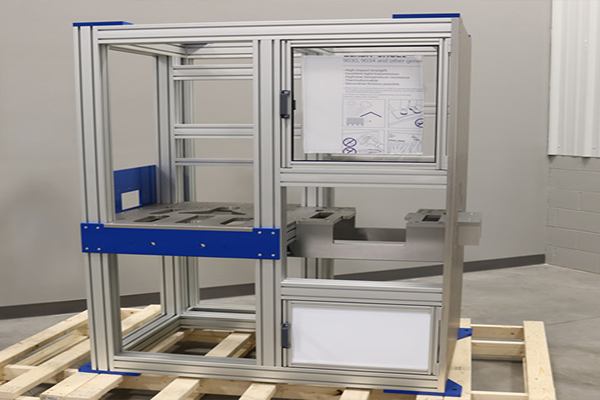
Aluminium Extrusion Table Frame 20×20 40 mm Workbench Base
20 series aluminium extrusion table frame with 40x40 mm four-slot legs and 40x80 mm six-slot apron rails. 8 mm groove, M6 fasteners. For light-duty workbenches up to 50 kg distributed load.
| Material | Aluminium |
|---|---|
| Alloy Grade | 6063-T5 |
| Temper | T5 |
| Section Size | Leg 40x40 mm 4-slot, apron 40x80 mm 6-slot |
| Slot | 8 mm groove, M6 fasteners, 30 mm slot centres, 4 faces on leg |
| Length | Legs cut to frame height, aprons cut to span, tolerance +/-0.5 mm |
| Tolerance | EN 755-9, cut length +/-0.5 mm, squareness 0.5 degrees |
| Surface | Mill finish / clear anodised / black anodised |
| MOQ | 1 frame set; fittings and hardware have no MOQ |
| Lead Time | 3 to 5 days for standard sizes, 2 weeks for custom or anodised |
| Loading Port | Shanghai, Ningbo, Qingdao |
| Supply Ability | Extrusion, cutting, machining and assembly in-house; stocked profiles and fittings for rapid assembly |
| Payment Terms | T/T 30 per cent deposit, balance against copy of B/L; L/C at sight for larger orders |
| Trade Terms | FOB, CIF, CFR, EXW |
| Certifications | Mill certificate to EN 10204 3.1 on request, RoHS and REACH declarations |
01What is a 20 series aluminium extrusion table frame?
What profiles are used in this table frame?
The legs are 40 x 40 mm four-slot profiles with an 8 mm groove, and the apron rails (the cross-members under the desktop) are 40 x 80 mm six-slot profiles. Both are in the 20 series T-slot system, so all fasteners are M6. The legs use four slots — one on each face — to accept castors or levelling feet at the bottom, cross rails on two faces, and accessories or cable clips on the remaining faces.
How much weight can this frame hold?
The frame is rated for up to 50 kg of distributed load on the desktop. That is sufficient for a packing bench, a light assembly station, a computer workstation or a display table. For heavier loads — machine bases, assembly jigs for automotive parts, or anything over 50 kg — use 30 or 40 series profiles instead.
Why use 20 series and not 30 or 40 series?
Because the load is light and the frame needs to be light and mobile. A 20 series frame weighs about 8 to 12 kg for a 1200 x 800 mm table, versus 15 to 20 kg for a 30 series frame of the same size. If the table needs to be moved frequently or fitted with castors, the lighter frame is easier to handle and puts less load on the castors.
02Frame anatomy: legs, aprons, fasteners
The table frame consists of four legs and four apron rails assembled into a rectangular base. The legs are 40 x 40 mm four-slot profiles, and the apron rails are 40 x 80 mm six-slot profiles. The rails connect to the legs using corner brackets bolted into the T-slots — no drilling, tapping or welding is required.
The desktop sits on top of the apron rails and is fastened with brackets that clip into the T-slot. The legs have a levelling foot or a castor at the bottom, depending on whether the table is stationary or mobile. Both are bolted into the bottom end of the leg T-slot.
| Component | Profile | Slots | Weight | Function |
|---|---|---|---|---|
| Leg | 40 x 40 mm | 4 | 1.30-2.35 kg/m | vertical support, accepts foot/castor |
| Apron rail (long) | 40 x 80 mm | 6 | 2.9 kg/m | desktop support, cross-member |
| Apron rail (short) | 40 x 80 mm | 6 | 2.9 kg/m | desktop support, cross-member |
| Corner bracket | die-cast | n/a | approx. 80 g | connects leg to apron |
| Desktop bracket | stamped steel | n/a | approx. 15 g | fastens desktop to apron |
| Levelling foot | M6 or M8 | n/a | approx. 100 g | adjusts table height, levels on uneven floor |
| Castor | M6 or M8 stem | n/a | approx. 200 g | mobility for light-duty tables |
The leg weight range of 1.30 to 2.35 kg/m reflects the standard wall and heavy wall variants of the 40 x 40 four-slot profile. The heavy wall is recommended for table legs because the slot pull-out is higher and the foot or castor places a concentrated load on the bottom end of the slot.
03Desktop size to frame span to deflection
The frame span — the distance between the two apron rails — determines how much the rails deflect under the desktop load. The deflection limit for a workbench is typically 2 mm at full load, because more than 2 mm is visible to the eye and feels unstable when leaning on the table.
The table below shows the maximum frame span for common desktop sizes at a 50 kg distributed load, assuming a 40 x 80 mm apron rail in standard wall (2.9 kg/m) and a 2 mm deflection limit.
| Desktop size (mm) | Frame span (mm) | Deflection at 50 kg (mm) | Status |
|---|---|---|---|
| 600 x 400 | 500 | 0.3 | OK — well within limit |
| 800 x 500 | 700 | 0.6 | OK — standard small bench |
| 1000 x 600 | 900 | 1.2 | OK — medium bench |
| 1200 x 800 | 1100 | 1.9 | marginal — use heavy wall apron |
| 1500 x 800 | 1400 | 3.1 | exceeds 2 mm — use 30 series |
| 1800 x 800 | 1700 | 4.5 | exceeds 2 mm — use 30 series |
The deflection figures are calculated for a simply supported 40 x 80 mm apron rail in 6063-T5 aluminium, standard wall (2.9 kg/m), with the 50 kg load distributed evenly across the desktop. In practice, a person leaning on one edge creates a higher point load — add a safety factor of 1.5 to the deflection figures.
04The four-slot leg: why every face has a groove
The 40 x 40 mm leg profile has four T-slots, one on each face. This is not accidental — it is the design that makes the 20 series table frame so versatile. Each face of the leg serves a different function:
| Face | Direction | Typical fitting | Slot function |
|---|---|---|---|
| Front face | towards user | cable clip or tool holder | accessory mounting |
| Rear face | away from user | back panel or power strip | service mounting |
| Left face | towards long rail | corner bracket | structural connection |
| Right face | towards long rail | corner bracket | structural connection |
| Bottom end | downward | levelling foot or castor | height adjustment / mobility |
The left and right faces both connect to apron rails via corner brackets. On a four-leg table, each leg has two structural connections (one to the long rail, one to the short rail), leaving the front and rear faces free for accessories.
05Levelling feet vs castors: the mobility decision
The choice between levelling feet and castors determines whether the table is stationary or mobile. The 20 series frame is light enough that both options are common, but the choice has structural implications.
Choose levelling feet
- The table must be stable — no wobble, no rolling
- Height adjustment is needed to level on an uneven floor
- The table supports precision work — assembly, inspection, electronics
- The table is stationary and does not need to move
- Vibration-sensitive equipment is on the desktop
Choose castors
- The table needs to be moved frequently — between workstations or rooms
- Mobility is the primary requirement — stockroom, lab, demonstration
- The table carries light loads (under 30 kg) so stability is less critical
- The floor is smooth and level — no height adjustment needed
- You want the option to lock in place with brake castors
06Load capacity and the 50 kg limit
The 50 kg load rating is for a distributed load on the desktop — meaning the weight is spread evenly across the surface. A person leaning on one edge, or a heavy item placed near the centre of the span, creates a higher point load that can cause more deflection than the distributed load rating suggests.
The table below shows the frame behaviour under different load conditions for a 1200 x 800 mm table with a 1100 mm span.
| Load condition | Total load (kg) | Max deflection (mm) | Safety factor |
|---|---|---|---|
| Distributed (even) | 50 | 1.9 | 1.0x rated |
| Point load, centre | 25 | 1.6 | 1.2x distributed |
| Edge load (leaning) | 15 | 2.4 | exceeds 2 mm limit |
| Corner load | 10 | 1.2 | OK |
| Dynamic (impact) | 20 | 3.5 | temporary, recoverable |
The edge load (leaning) condition exceeds the 2 mm deflection limit. This is acceptable for short durations — the table will not fail — but it means the frame is not suitable as a work surface that people lean on heavily. For such applications, use 30 series profiles.
07What to check before ordering a table frame
Procurement checklist for the 20 series table frame
- Confirm the desktop size and the required frame span. Check the deflection table in Section 03 to confirm the span is within the 2 mm limit.
- Confirm the leg profile: standard wall (1.30 kg/m) or heavy wall (2.35 kg/m). Heavy wall is recommended for legs because of the concentrated foot load.
- Confirm the apron profile: 40 x 80 mm standard wall (2.9 kg/m) is the default. For spans over 1100 mm, consider 40 x 80 heavy wall or switch to 30 series.
- Confirm feet or castors: M6 or M8 stem, levelling foot or castor with or without brake. The stem thread must match the leg bore or slot.
- Confirm the corner bracket type: die-cast 3-way bracket for rigid joints, or angle bracket for adjustable frames.
- Confirm the desktop material: MDF, plywood, acrylic or steel plate. The desktop brackets clip into the T-slot.
08Failure modes to design out
| What goes wrong | Why it happens | Design it out by |
|---|---|---|
| Frame wobbles after assembly | corner brackets not fully tightened or leg-to-rail gap | tighten all bracket bolts to 8 Nm; check for square with a try square |
| Desktop deflects more than 2 mm | frame span exceeds 1100 mm with standard wall apron | reduce span or use heavy wall apron; or switch to 30 series |
| Castor stem bends under load | M6 stem is too thin for a 50 kg table with dynamic load | use M8 stem castors; or reduce load to 30 kg for M6 stems |
| Levelling foot sinks into soft floor | small foot pad on vinyl or carpet | use a larger pad diameter (50 mm or more) for soft floors |
| Frame is not square | corner brackets allow adjustment but do not self-align | assemble on a flat reference surface; check diagonals are equal |
09Terms used on this page
- Table frame
- A structural base built from aluminium extrusion that supports a desktop or work surface. Consists of legs, apron rails and fasteners.
- Apron rail
- The cross-member profile that runs between the legs under the desktop. Supports the desktop and provides the structural span.
- Levelling foot
- An adjustable foot screwed into the bottom of the leg, used to level the table on an uneven floor. Typically M6 or M8 stem.
- Castor
- A wheel assembly that replaces the levelling foot, providing mobility. Available with a brake for locking in place.
- Corner bracket
- A die-cast or stamped fitting that connects two or three profiles at a corner. Bolts into the T-slot without drilling.
- Deflection limit
- The maximum allowable bending of the apron rail under load. For workbenches, typically 2 mm at full distributed load.
10Questions buyers ask
What is the maximum desktop size for this frame?
1200 x 800 mm at 50 kg distributed load with a 2 mm deflection limit on the apron rail. Larger sizes (1500 x 800 and 1800 x 800) exceed the deflection limit and require 30 series profiles instead.
Can I use this frame for a heavy workbench?
No. The 20 series frame is rated for 50 kg distributed load. For heavy workbenches — machine bases, engine assembly, anything over 50 kg — use 30 or 40 series profiles. The 20 series frame is designed for light-duty applications.
What is included in the frame kit?
The frame kit includes four 40 x 40 mm legs, four 40 x 80 mm apron rails, corner brackets, fasteners and assembly hardware. Levelling feet or castors and the desktop are ordered separately.
Can I add a shelf below the desktop?
Yes. The four-slot legs allow a shelf bracket to be bolted into any face at any height. The shelf load should be limited to 20 kg for a 20 series frame — the shelf brackets bear on the slot, not the centre bore.
Can the frame be disassembled and reassembled?
Yes. All connections are bolted into T-slots. The frame can be disassembled by removing the corner bracket bolts. This is useful for shipping or moving the table through narrow doorways.
What is the lead time?
Frame kits are assembled to order from stocked profiles and fittings. Lead time is typically 3 to 5 days for standard sizes and 2 weeks for custom sizes or finishes.
What we need to quote a 20 series table frame
- The desktop dimensions (length x width) and the required frame height.
- The leg and apron profile: standard 40×40 / 40×80, or heavy wall for longer spans.
- The foot type: levelling foot (M6 or M8) or castor (with or without brake).
- The desktop material: MDF, plywood, acrylic or steel plate, and whether you need it supplied or will provide your own.
- The finish: mill finish, clear anodised, or black anodised.
- The quantity and whether you need assembly or just the cut-and-machined kit.
Send those six items and the quotation comes back with the frame price, the fitting and hardware kit, and the optional desktop and castors as separate lines. Browse the full aluminium profile catalogue and the 20 series profiles range for related sections.
Need a 20 series table frame quoted?
Send the desktop size, frame height, leg and apron profile, foot type and finish. We quote the frame, fittings and hardware as separate lines.
Request a quotationRelated Products
 Aluminium Framing Extrusion Kit 40×40 mm 40 Series Cut List for Machine Frames
A cut-to-length aluminium framing extrusion kit in the 40 series: profile cut to a…
 Aluminium Profile Machine Guard Frame 40 x 40 mm Safety Enclosure
40 x 40 mm T-slot aluminium machine guard frame for safety fences and enclosures,…
 PG40 80×80 mm R90 Six Slot Aluminium Strut Profile Rounded Corner Column
80 x 80 mm L section aluminium corner column with a swept R90 outer…
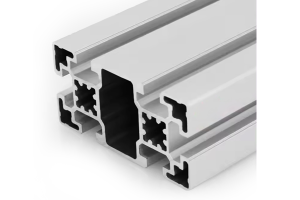 PG40 40 x 40 mm Eight Slot Aluminium Strut Profile High Density Frame
40 x 40 mm eight-slot aluminium strut profile with two T-slots on each face…
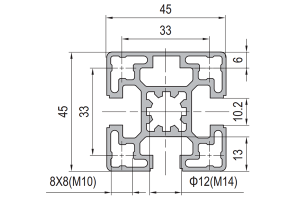 PG45 45 x 45 mm Three Slot Aluminium Strut Profile Asymmetric Rail
45 x 45 mm three-slot aluminium strut profile with one solid flat face for…
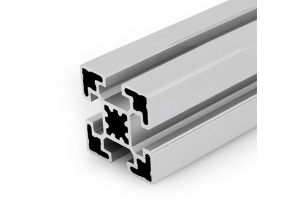 PG45 45 x 45 mm Four Slot Aluminium Strut Profile Standard Frame
45 x 45 mm four-slot aluminium strut profile with 10.2 mm grooves, M8 slot…
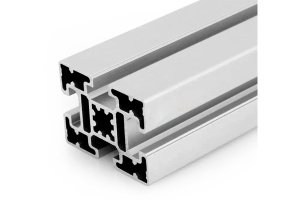 PG45 45 x 60 mm Four Slot Aluminium Strut Profile Rectangular Beam
45 x 60 mm four-slot rectangular aluminium strut profile with directional bending stiffness. Strong…
 Aluminium Pipe 28 mm OD Round Tube Profile for Lean Pipe Systems
28 mm OD round aluminium tube for lean pipe systems, conveyor rollers and rotating…
