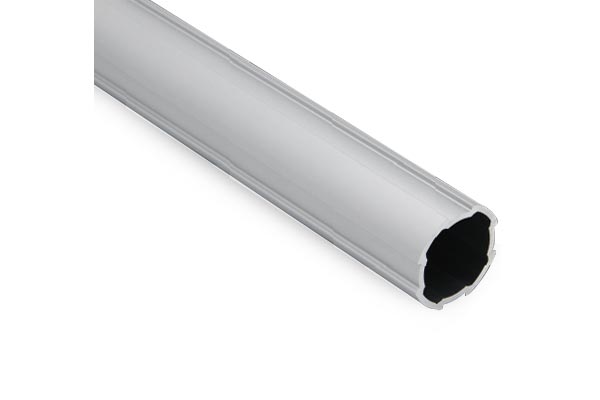
Lean pipe profiles are round steel tubes with a bonded plastic coating, supplied in 28 mm and 43 mm outside diameters and cut to length on site. They are the material of a pipe and joint system: tube is cut with a pipe cutter, cast joints are clamped on with a hex key, and the structure is finished without welding or painting. Coatings include polyethylene, ABS and conductive ESD grades.
Below: how the diameters differ, what each coating is for, and the cutting detail that decides whether the coating survives assembly.
Why the tube is coated steel rather than aluminium
The choice of material is deliberate. Steel gives the tube the strength and stiffness it needs at a small diameter, and the coating provides everything else.
- No painting. A coated tube arrives finished. An uncoated tube structure would have to be painted, and a painted tube chips at every joint.
- No sharp edges. Round, coated tube is safe to handle and does not snag clothing or cable. This matters on a cart that an operator pushes all day.
- Quieter in use. A plastic coating damps the ring of a steel tube, and it stops parts rattling against the structure.
- Protected from the environment. The coating keeps moisture away from the steel in normal workshop conditions, and it resists most common workshop fluids.
- Colour coding. Coating colour can identify a line, a product family or a safety function, which is useful in a plant with many similar racks.
Diameter: 28 mm or 43 mm
| Diameter | Character | Typical use |
|---|
| 28 mm | Light, easy to handle, widest range of joints and accessories | Carts, small flow racks, supermarket racks, tube workstations, presentation stands |
| 43 mm | Stiffer and stronger, fewer but heavier joints | Larger racks, heavier loads, structures that have to span further or take impact |
28 mm is the default for most applications, and the accessory range is much deeper in it. Moving to 43 mm is normally driven by load or by span rather than by preference, and it is worth checking joint availability before standardising on it.
Coatings and what each is for
| Coating | Character | Use it when |
|---|
| Polyethylene (PE) | Tough, flexible, good impact resistance; the common general-purpose coating | General workshop carts and racks |
| ABS | Harder and glossier surface; better chemical resistance | Cleaner environments and where appearance matters |
| PVC | Soft and grippy; less abrasion resistant | Where a soft contact surface is wanted |
| ESD / conductive | Formulated to dissipate static charge | Electronics assembly and any area with static-sensitive components |
| Anti-static and heat-resistant grades | Speciality formulations | Specific process environments; confirm the requirement with us |
ESD tube is worth a note because it is often specified incorrectly. A conductive coating provides a path to earth only if the whole structure is electrically continuous and bonded to earth, and only if the joints do not isolate the tube from each other. Confirm that the joints are compatible with the ESD requirement before ordering tube, because a standard joint with a painted or coated surface can break the continuity.
Cutting: the one mistake that ruins a tube
Coated tube is cut with a pipe cutter, and the cutting wheel deforms the coating as it cuts. Two consequences follow.
- The coating can crack or lift at the cut. A blunt wheel, too much clamping pressure or a fast cut all promote cracking, and a crack propagates along the tube in service.
- The coating must be removed from the joint area. The joint clamps onto the tube wall; if the coating is left under the clamp, the joint is held by the coating rather than by the tube, and it will slip.
The correct procedure is to cut with a sharp wheel at a moderate feed, deburr the tube end, and strip the coating back to bare metal over the length that the joint socket covers. Where the joint socket length is not obvious, mark the tube before cutting so the stripped length matches. Stripping too much leaves bare steel visible; stripping too little leaves coating inside the joint.
Practical point: cut the tube slightly long and trim to fit rather than cutting to a nominal length. Joint sockets take up a defined length of tube, so the finished dimension of a frame is not simply the sum of the cut lengths — it is the sum of the cut lengths minus the socket engagement at each end.
Accessories that go with the tube
End capsClose the open tube end. A bare steel tube end is sharp and will collect dirt; a cap costs very little.
Pipe holders and clipsHold a tube against a wall or a machine, or hold a cable to the tube.
Castor platesProvide a wheel at the base of a leg, for carts and mobile racks. See floor elements.
Levelling feetSet the structure level and take the load off castors in use. See levelling feet.
Rollers and slidesTurn a rack into a gravity flow lane, with the lane angle set by an adjustable joint.
Labels and sign holdersClip onto the tube so a rack can be re-labelled without tools.
Where lean pipe is used
Material handling cartsThe classic application: a coated, edge-free cart that can be re-configured as the part mix changes.
Gravity flow racksInclined lanes with rollers, where the angle is set by trial using adjustable joints.
Supermarket and presentation racksPoint-of-use storage holding a defined quantity, re-arranged whenever the mix changes.
Tube workstationsBench surrounds, tool rails and document holders built from the same system.
Electronics assembly areasESD-rated tube and joints, provided the structure is properly earthed.
Specifying lean pipe
Give us the diameter, the coating type, the colour, the total length or the cut list, and the accessories required. Tell us if the structure has to be ESD-rated, because that changes both the tube and the joints. Where you are building a structure rather than simply replacing tube, send the layout and we will list the tube, joints and accessories together — that is usually cheaper and far more reliable than ordering piece by piece. Standard tube is quoted within one working day. Related ranges: pipe and joint systems, floor elements, levelling feet, profile accessories and strut profiles.