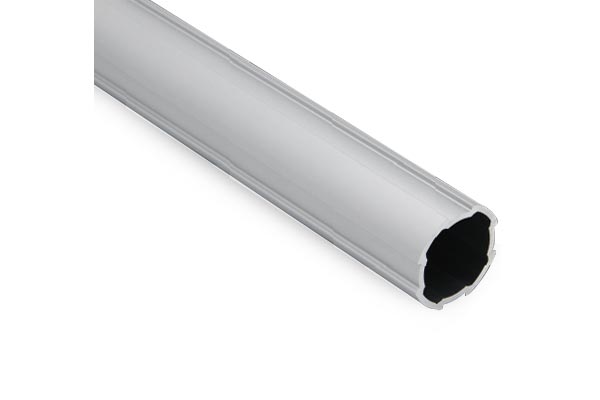
A pipe and joint system, also called a lean tube or pipe rack system, builds structures from plastic-coated round steel tube and cast metal joints. Tube is cut to length with a pipe cutter, joints are bolted on with a hex key, and the structure is complete without welding. It is used mainly for carts, flow racks, gravity conveyors, supermarket racks and tube-based workstations.
Below: how the system is assembled, what the round tube does better than a slot profile, and where a profile frame is still the right answer.
How the system is assembled
Three components do all the work: coated tube, cast metal joints, and the fasteners that clamp the joint to the tube.
- The tube is a coated steel pipe, normally 28 mm or 43 mm outside diameter. The coating is what makes it usable without painting, and it is also what needs care when cutting.
- The joints are castings with a socket for each tube and a set screw or a bolt that clamps onto the tube wall. A fixed joint sets one angle; an adjustable joint allows the angle to be set and locked.
- Nothing is welded. Every connection can be loosened and re-set, which is why the system is associated with lean manufacturing: a rack can be re-configured as the process changes.
Assembly is quick, and the reason is that the joint wraps the tube rather than needing a hole or a slot. There is no drilling, no tapping, and no need to plan the fixing positions before cutting — which is exactly the opposite of a concealed profile joint.
Where round tube beats a slot profile
| Criterion | Pipe and joint | Slot profile |
|---|
| Assembly speed | Very fast; cut, clamp, done | Fast for brackets; slower where concealed joints need machining |
| Re-configuration | Loosen and re-set at any time | Possible, but joints are more positional |
| Edges | Round and coated; no sharp edges, nothing to snag | Slots and square ends; covers and caps are needed |
| Stiffness | Lower; the joints are the weak point | Higher; a deep rectangular section is far stiffer |
| Mounting panels and devices | Harder; needs adaptors or clips | Easy; the slot takes hardware anywhere along its length |
| Precision | Moderate; joints have some play | Higher; brackets locate positively |
| Cost per metre | Lower | Higher, though not dramatically once joints are counted |
The pattern is consistent: tube wins where the structure is a rack or a cart, moved around, loaded by hand, and re-configured often. Profile wins where the structure is a machine frame, has to hold a position, and has to carry panels, guards or equipment.
Carts, flow racks and supermarket racks
These three applications are where the system is at its best, and they share a common requirement: the structure has to be reconfigured as the process changes, and it has to be safe to handle by hand.
Carts and trolleys
A cart is a mobile rack, so the design has to consider the same things as any mobile structure: castors concentrate the load, the structure has to resist being pushed, and the load arrives with momentum. Round tube is a good fit because it does not present edges to the operator, and because a cart is rarely required to hold a tight position.
Gravity flow racks
A flow rack is a rack with inclined lanes and rollers or slides, so parts move forward under gravity. The angle of the lane is set by the load and the friction of the lane, and it is normally made adjustable, because the correct angle is found by trial. An adjustable pipe joint is ideal for this and a bolted profile frame is not, because changing the angle of a profile lane means re-drilling or re-positioning brackets.
Supermarket racks
A supermarket rack holds presentation stock at the point of use, in defined quantities. It is usually built in two levels with a defined pick face, and it is re-arranged whenever the part mix changes. Again, adjustability is the dominant requirement rather than stiffness.
Where a profile frame is still the right answer
Pipe and joint systems are often proposed for structures that should be built from profile, and the result is a frame that is never quite rigid enough. Four cases point clearly to profile.
- Anything carrying a machine. A motor, a spindle or a driven load needs a stiff frame. Round tube joints have play and the tube has a modest section, so the structure will move.
- Anything that has to hold a position. A fixture, a gauge or a sensor rail has to be located accurately and stay there. The slot gives a positive fixing; a clamped joint gives a frictional one.
- Anything that has to carry panels or guarding. Retaining a panel in a tube structure needs adaptors and clips; the profile slot takes a gasket or a retainer directly.
- Anything that has to be levelled or anchored precisely. Profile bases take base plates and levelling feet directly; a tube structure needs a purpose-made adaptor.
Practical point: the two systems can be combined, and often should be. A profile frame carrying the machine, with a tube rack bolted to its side for presentation stock, gets the stiffness where it is needed and the adjustability where it is wanted.
Joint types
| Joint | Function | Notes |
|---|
| Fixed joint | Sets one angle between two tubes | Rigid and the cheapest option; no adjustment once fitted |
| Adjustable joint | Allows the angle to be set and locked | Used for flow rack lanes and re-configurable structures |
| Multi-way joint | Joins three or more tubes at one node | Keeps the node compact; watch the load at the node |
| Base and castor joints | Provides a foot or a wheel at the bottom of a leg | Use with a levelling foot where the structure must sit solidly |
| Hinge and swivel joints | Allows movement, such as a folding shelf | Introduces a mechanism; design for the load path |
Specifying a pipe and joint structure
Give us the structure type (cart, flow rack, supermarket rack, workstation), the load it has to carry, the overall envelope, whether it has to be mobile, and whether it will be used in an electronics area that requires an ESD-rated system. From that we can specify the tube diameter, the joint types and the accessories. If the structure has to carry a machine or hold a position, tell us — that is the point at which we would recommend a profile frame instead. Standard parts are quoted within one working day. Related ranges: lean pipe profiles, strut profiles, floor elements, levelling feet and connecting elements.