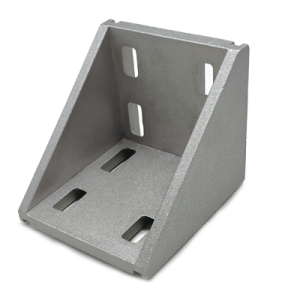
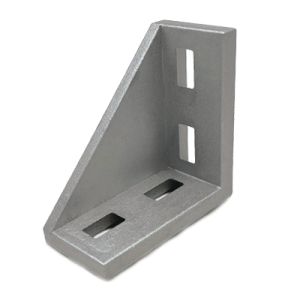
A die-cast bracket is a cast corner piece shaped to fit into the T-slot of two profiles at a joint. It is fixed with two or three bolts and needs no machining of the profiles, which makes it the fastest and most forgiving way to build a bolted aluminium frame. It is available in sizes matched to each series, in die-cast zinc or die-cast aluminium, and in internal and external forms.
Below: how the casting behaves compared with a machined bracket, where the design limit sits, and how to use brackets so that a frame is stiff rather than merely assembled.
How a die-cast bracket works
The bracket is an L or a triangular gusset with a ribbed profile. It drops into the slot of each member, and bolts through the bracket into T-nuts in the slot draw it tight. The ribs are what make the casting work: they carry the bending load from one leg to the other without the bracket needing to be solid.
Two features separate a good bracket from a poor one, and neither is visible in a photograph.
- Slot engagement. The bracket should sit in the slot with enough depth that the bolts load the slot lip properly rather than just clamping the flat face. A shallow bracket relies on friction and slips under load.
- Bolt position relative to the corner. The further the bolts sit from the corner, the longer the lever arm resisting the moment. Brackets with bolts close together look compact and are measurably weaker.
Die-cast zinc or die-cast aluminium?
| Material | Strength | Weight | Finish | Use it when |
|---|
| Die-cast zinc | Higher | Heavier | Bright or coated; different colour from the frame | General structural corners at standard loads |
| Die-cast aluminium | Moderate | Light | Can be anodised to match the frame | Appearance matters and the load is moderate |
| Machined or extruded aluminium | Higher in the extrusion direction | Light to moderate | Matches the frame | Heavier duty and visible joints |
| Zinc-plated steel | Highest | Heaviest | Plated; distinct colour | High-load joints where appearance is secondary |
When the casting becomes the limit
Cast brackets are deliberately the weakest part of a bolted joint, and that is not a defect. A bracket that fails before the slot lip is crushed protects the profiles, and profiles cost far more than brackets. But it does mean the bracket sets the ceiling on the joint.
Three signs that a die-cast bracket is at its limit:
- The bracket deforms rather than the joint loosening. A bent or cracked bracket means the joint is carrying more than the casting can take. Step up to a machined bracket, or add a joining plate.
- The corner moves under a load you can apply by hand. If you can see the corner deflect, the joint is not adequate. Add a second load path before anything breaks.
- Bolts keep coming loose. A joint that will not stay tight is usually a joint that is being worked by a load it was not designed for.
Practical point: on a heavy frame, use a die-cast bracket for assembly and alignment, and add a joining plate for strength. The bracket pulls the corner square quickly; the plate carries the load. This combination costs very little more than two brackets and performs far better.
Internal and external brackets
| Type | Where it sits | Advantage | Watch out for |
|---|
| Internal corner bracket | Inside the corner, in the slot | Invisible in service on most frames | Occupies the inside of the corner; can clash with a panel or a drawer |
| External bracket | On the outside faces | Nothing inside the frame; easy access to the bolts | Visible, and it uses the outer slot that a panel may need |
| Tee bracket | At a member end meeting a through member | Simple way to build a mid-span joint | Loads the through member's slot across its width; add a plate where load is high |
| Angled bracket | Inside a corner, at a set angle | Allows frames that are not rectangular | Usually a bespoke casting; check availability for your series |
Using brackets well rather than often
A frame with a bracket at every corner is not automatically a good frame. Four habits separate a well-built structure from one that merely assembles.
- Brace the bay, not the corner. Racking is resisted by diagonals. One diagonal across a bay does more than doubling the brackets at every corner.
- Put two load paths where load is high. A bracket plus a plate at a base corner, or two brackets separated along the profile, spreads load into more of the slot.
- Check the diagonal, not the angle. A frame is square when its diagonals are equal. Checking the corners with a square is slower and less reliable.
- Torque to a figure. Tightening by feel is the most common cause of a crushed slot lip. Use the fastener maker's torque figure.
Bolts and T-nuts
Brackets are only half the joint. The T-nut, the bolt length and the washer matter just as much, and all three are series-specific. A bolt that is too long bottoms out in the slot before the bracket is tight; a bolt that is too short engages too few threads and strips under load. Where a bracket is fitted into a slot that already carries other hardware, check that the T-nut positions do not compete — two items cannot occupy the same point in a slot. The full hardware range is described under fastening elements.
Specifying a die-cast bracket order
Give us the profile series, the joint type, whether the bracket is internal or external, the material and the quantity. If the joint carries a machine or a cantilevered load, say so — that is the point at which we would recommend a machined bracket or a plate instead of a standard casting. Standard brackets are quoted within one working day. Related ranges: connecting elements, anchor connectors, angle profile brackets, joining plates and fastening elements.