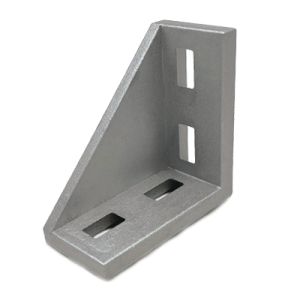
Rectangular Die Cast Corner Bracket Aluminium Profile 30×60 40×80 45×90 50×100 mm
Rectangular die cast corner bracket with unequal legs for aluminium profile frames built from 30x60, 40x80, 45x90 or 50x100 sections. Each leg reaches the groove in the face it fixes to.
| Material | Zinc alloy |
|---|---|
| Alloy Grade | Zinc alloy, die cast |
| Temper | custom |
| Section Size | 30x60 / 40x80 / 45x90 / 50x100 mm |
| Slot | M6 (30x60) / M8 (40x80, 45x90, 50x100) |
| Length | Legs 30x60 / 40x80 / 45x90 / 50x100 mm |
| Tolerance | Cast to ISO 8062 general tolerances |
| Surface | As cast / anodised / powder coated |
| MOQ | 2000 |
| Lead Time | 15-25 days after deposit |
| Loading Port | Shanghai / Ningbo |
| Supply Ability | 2,000,000 pieces per month |
| Payment Terms | T/T 30% deposit + 70% before shipment | L/C at sight |
| Trade Terms | FOB | CIF | EXW |
| Certifications | ISO 9001:2015 | RoHS | REACH |
Connecting · Unequal bracket
An unequal-sided die-cast bracket is a right-angle bracket whose two legs are different lengths, made to suit frames built from rectangular sections such as 30 x 60, 40 x 80, 45 x 90 and 50 x 100. Each leg is sized to land on the face it fixes to and to reach the groove in that face, which is what makes it different from an equal-sided bracket.
The need for it comes from where the groove sits. On a rectangular section the groove in the wide face runs down the centre, so on a 60 mm wide face it is 30 mm from the edge. A 30 mm bracket leg only reaches 30 mm from the corner, and its slot sits at about 15 mm from the edge. The bolt has no groove to go into. The unequal bracket solves this by making that leg long enough to put the bolt over the groove, while the other leg stays short to match the narrow member.
Why an equal-sided bracket does not work
A bracket is only useful if its bolts land over the groove of the profile face. That is not a matter of convenience: the T-nut or the tapped hole has to be in the groove, and the flange has to sit flat on the face with the slot over it. If the slot misses the groove, the bolt either cannot be fitted at all or it bears on the solid face beside the groove, which does not hold and crushes the profile.
On a square section an equal-sided bracket puts the slot over the groove because both are at the centre. On a rectangular section the two faces have their grooves at different distances from the corner, so a single leg length cannot serve both. That is the whole reason unequal brackets exist.
| Frame section | Wide face groove from the edge | Bracket leg on that face |
|---|---|---|
| 30 x 60 mm | About 30 mm | 60 mm leg |
| 40 x 80 mm | About 40 mm | 80 mm leg |
| 45 x 90 mm | About 45 mm | 90 mm leg |
| 50 x 100 mm | About 50 mm | 100 mm leg |
What an equal-sided bracket actually does
Fitting a 30 x 30 bracket to a 30 x 60 corner is a common mistake and it fails in a predictable way. The flange covers only the first 30 mm of the 60 mm face, so the slot sits at roughly 15 mm from the corner while the groove is at 30 mm. The bolt has no groove under it.
In practice the assembler either leaves that bolt out, which halves the joint, or forces it against the solid face, which strips the thread or dents the profile and leaves a joint that looks tight and is not. Either way the corner has about half the capacity it was designed for, and nothing on the outside shows it.
Checking a mixed-size joint
The capacity of an unequal bracket joint is set by the smaller leg, not by the average. That is the first thing to establish, because it is the number that decides whether the corner is adequate.
The second thing is the moment arm. On a rectangular corner the two faces are different distances from the corner, so the load path into the two flanges is not symmetrical. The long leg sees a larger bending moment than the short one for the same corner rotation, and the long leg is also the one with the wider bolt spacing, so the two effects partly cancel. Work through the smaller leg first, then confirm the long leg has the bolt spacing to carry what the short leg can take.
| Check | What to establish | Why it decides the joint |
|---|---|---|
| Smaller leg capacity | Bolts and spacing on the short leg | Sets the ceiling for the whole corner |
| Bolt over the groove | Groove position on each face | A bolt off the groove carries almost nothing |
| Long leg bolt spacing | Distance between the two slots | Sets the couple arm on the wide face |
| Flange overhang | Leg length against face width | Overhang means the bracket sits on one edge |
| Brace requirement | Free height against section width | A brace may be needed regardless of the bracket |
Fitting an unequal bracket
- Identify which leg goes on which face The long leg goes on the wide face and the short leg on the narrow face. Getting this the wrong way round is not obvious until the bolts are started, and on a rectangular section it usually means the long leg overhangs the narrow face.
- Check the slot sits over the groove before loading nuts Offer the bracket dry and look into the slot. If the groove is not visible through the slot on both legs, the bracket is the wrong size for the section and no amount of adjustment will fix it.
- Load the nuts into both grooves Load the nuts while the members are on the bench. On a mixed corner the two grooves are at different heights, so doing this after the frame is standing is awkward.
- Square the frame and tighten in stages Set the diagonals using the slots, then tighten in two stages, half torque then full torque, working diagonally across the four bolts. A rectangular corner bows more easily than a square one because the flange stiffness is not symmetrical.
Unequal bracket or a packer? Some assemblers try to make an equal-sided bracket work on a mixed corner by adding a spacer under one flange. That moves the bracket off the face and puts the load through the spacer rather than through the flange, which is worse than the original problem. Use the unequal bracket, which is the same price and is made for the job.
Frequently asked questions
What is a rectangular die-cast bracket for?
Making a 90 degree corner where the two members are different sizes, such as a 30 x 60, 40 x 80, 45 x 90 or 50 x 100 frame. Each leg is sized so its bolts land over the groove in the face it fixes to.
Why can I not use an equal-sided bracket?
Because the groove in the wide face is further from the corner than the bracket leg reaches. On a 30 x 60 corner the groove is about 30 mm from the edge while a 30 mm leg puts the slot at about 15 mm, so the bolt has no groove to go into.
What happens if I fit an equal-sided bracket anyway?
The joint ends up with about half its intended capacity. The bolt either is left out or is forced against the solid face beside the groove, and neither is visible once the frame is assembled. The corner then moves under load later.
How do I check the joint is adequate?
Work through the smaller leg first, because it sets the ceiling for the corner. Then confirm the long leg has enough bolt spacing to carry what the short leg can take, and check whether the free height of the frame needs a diagonal brace as well.
Do you make unequal brackets to other leg combinations?
Yes. Standard combinations are 30 x 60, 40 x 80, 45 x 90 and 50 x 100, and other combinations can be cast from 10,000 pieces. Send the two sections you are joining and we will confirm the leg lengths.
Tell us the two sections you are joining
Send the rectangular sections and the corner you are making. We will confirm the correct leg combination, quote the bulk price and supply samples for a trial frame.
Request a QuoteRelated Products
 Aluminium Extrusion Connector System for 20×20 to 100×100 mm T-Slot Frames
A complete aluminium extrusion connector system covering visible brackets, hidden inner brackets, cubic corner…
 Aluminium Angle Profile Bracket 35x35x4 mm M6 Corner Brace for 20 and 30 Series Profiles
A 35 x 35 x 4 mm aluminium angle profile bracket for 20 and…
 Aluminium Inner Bracket with Top Thread M5 M6 M8 for 20 to 40 mm T-Slot Profiles
A hidden inner bracket with top thread for aluminium T-slot profiles, supplied in M5…
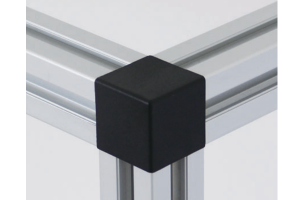 Aluminium Cubic Connector 2020 20×20 mm Three-Way Corner Joint with ABS Cap
A 20 x 20 x 20 mm three-way cubic corner connector for 20 series…
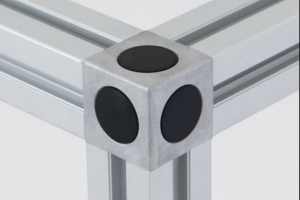 Cubic Connector 4545 45x45x45 mm Three-Way Aluminium Corner Joint Block for 45 Series
A 45 x 45 x 45 mm three-way cubic corner connector for 45 series…
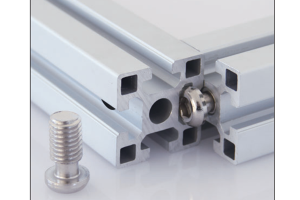 Self-Tapping Screw Connector for Aluminium Profile M6 M8 M10 to 50 mm Series
A self-tapping screw connector for aluminium profiles in M6, M8 and M10. Forms its…
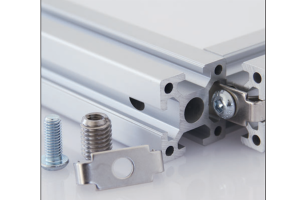 End Face Connector for Aluminium Profile M8 M10 up to 50 mm Series with Spring Clip
An end face connector for aluminium profiles in M8 and M10 with a spring…
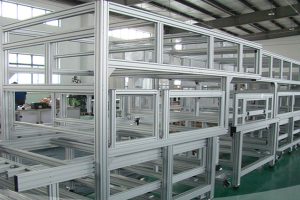 Aluminium Profile Shelf System 40×40 mm T-Slot Uprights for Workshop Racking
A bolted aluminium profile shelf system in 40 x 40 mm T-slot uprights and…
