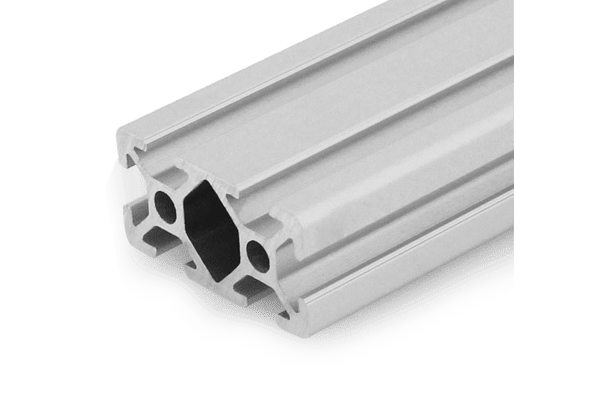
PG20 40 x 20 mm Six Slot Aluminium Strut Profile Rectangular Flat Beam
40 x 20 mm six-slot aluminium strut profile with 6.2 mm grooves on a 20 mm pitch. Rectangular flat beam with strong and weak axes for directional frame members using M5 fasteners.
| Material | Aluminium |
|---|---|
| Alloy Grade | 6063-T5 |
| Temper | T5 |
| Section Size | 40 x 20 mm rectangular, six slots |
| Slot | 6 x 6.2 mm groove, 6 mm mouth, 20 mm pitch, 2 per 40 mm face and 1 per 20 mm face, M5 |
| Length | 6 m stock, cut to drawing to +/-0.5 mm |
| Tolerance | EN 755-9 / GB/T 6892, wall +/-0.15 mm |
| Surface | Mill finish / clear anodised / black anodised |
| MOQ | Made to order; small trial lengths available from stock offcuts |
| Lead Time | Typically 2 to 3 weeks for mill finish, about a week longer for anodising |
| Loading Port | Shanghai, Ningbo, Qingdao |
| Supply Ability | Extrusion capacity for standard and custom dies, with in-house cutting, machining and anodising |
| Payment Terms | T/T 30 per cent deposit, balance against copy of bill of lading; L/C at sight for larger orders |
| Trade Terms | FOB, CIF, CFR, EXW |
| Certifications | Mill certificate to EN 10204 3.1 on request, RoHS and REACH declarations |
01What is the 40 x 20 mm six slot profile?
Why would you need six slots on a 20 series profile?
Because the 40 mm wide face gives room for two slots side by side, and the two 20 mm faces each carry one more. That gives six slots total on a section that is still only 20 mm thick. The point is not just density of fixing positions, but also the directional bending stiffness that the 40 mm width provides. When the profile stands on its 20 mm edge, it is four times stiffer than when it lies flat. That makes it useful as a beam, not just as a multi-slot rail.
Is it stronger than the 20 x 20 four-slot?
In one direction, yes. The 40 mm width gives a second moment of area of about 0.8 cm4 on the strong axis, versus 0.2 cm4 for the 20 x 20. On the weak axis, it is the same 0.2 cm4. So the answer depends entirely on which way you orient it. Used as a beam with the 40 mm face horizontal, it is four times stiffer. Used with the 20 mm face horizontal, it is the same as the 20 x 20.
What fasteners fit the 6.2 mm groove?
The full 20 series M5 range: slot nuts, hammer head T-bolts, cover strips and hinges. The groove and mouth dimensions are the same as the standard 20 series, so all 20 series accessories fit without an adapter.
02Section data
| Item | Value | Note |
|---|---|---|
| Envelope | 40 x 20 mm rectangular | width 40 mm, thickness 20 mm |
| Slots | 6 | 6.2 mm groove, 6 mm mouth, 20 mm pitch |
| Slot layout | 2 per 40 mm face, 1 per 20 mm face | balanced layout |
| Central bore | approx. Phi4 mm | for through-bolts or location |
| Wall | approx. 1.5 mm at slot lip | same as standard 20 series |
| Weight | approx. 0.80 kg/m | from published specification |
| Alloy | 6063-T5 | EN AW-6063 |
| Standard | EN 755-9 / GB/T 6892 | wall tolerance +/-0.15 mm |
| Length | 6 m stock | cut to drawing to +/-0.5 mm |
The weight figure is from the published product specification. The wall at the slot lip is the same 1.5 mm as the standard 20 series, so per-slot pull-out is unchanged at about 0.5 kN for an M5 nut.
03The strong axis and the weak axis: why orientation matters
The 40 x 20 section is directional. When the 40 mm face is horizontal (standing on the 20 mm edge), the second moment of area is about 0.8 cm4 — four times the 20 x 20. When the 20 mm face is horizontal (lying flat), it drops to about 0.2 cm4, the same as the 20 x 20 square.
That means the profile has a strong axis and a weak axis, and the choice of orientation has more effect on stiffness than the choice of section itself. Getting it wrong is not a small error — it is a factor of four.
| Orientation | I (cm4) | Deflection at 50 N, 1 m span | Stiffness ratio |
|---|---|---|---|
| 40 mm face horizontal (strong) | approx. 0.8 | 0.20 mm | 4x |
| 20 mm face horizontal (weak) | approx. 0.2 | 0.80 mm | 1x |
The rule is simple: always orient the 40 mm face as the loaded face in bending. If you use it the other way, you are carrying the weight of a 40 mm section with the stiffness of a 20 mm one, which defeats the point of choosing a rectangular profile.
04Span selection: standing vs lying
The orientation determines the allowable span before deflection becomes a problem. The table below shows the maximum span for a 0.5 mm deflection limit under a 50 N centre load, in both orientations.
| Orientation | Max span at 50 N load (0.5 mm limit) | Max span at 100 N load |
|---|---|---|
| Strong axis (40 mm face horizontal) | approx. 750 mm | approx. 550 mm |
| Weak axis (20 mm face horizontal) | approx. 400 mm | approx. 300 mm |
On the strong axis, the 40 x 20 can span about 750 mm under a modest load. On the weak axis, only 400 mm. For comparison, the 20 x 20 square has a maximum span of about 500 mm in the same conditions. So the 40 x 20 standing up is 50 per cent better than the 20 x 20, but lying flat it is 20 per cent worse, because the extra slots remove material without adding stiffness in that direction.
05Slot layout and what fits in each lane
The six slots are distributed as two per 40 mm face and one per 20 mm face. The two slots on each wide face are spaced 20 mm apart on centres, which is enough for two M5 nut bodies to sit side by side without overlapping.
| Slot | Face | Typical assignment |
|---|---|---|
| Slot 1 | 40 mm face, outer left | panel fixing |
| Slot 2 | 40 mm face, inner left | cable channel or bracket |
| Slot 3 | 40 mm face, inner right | sensor or actuator clip |
| Slot 4 | 40 mm face, outer right | structural tie |
| Slot 5 | 20 mm face A | perpendicular bracket or hinge |
| Slot 6 | 20 mm face B | perpendicular bracket or hinge |
With this assignment, one 40 x 20 rail can carry a panel, a cable channel, a sensor and a structural tie on the wide face, plus two perpendicular brackets on the narrow faces. That is the multi-function advantage of a six-slot rectangular profile over a four-slot square.
06Choosing between the 40×20 six-slot and the 20×20 four-slot
Choose the 40 x 20 six-slot
- The member is a beam that spans between supports
- You need two fixing lanes on one face for cable and bracket
- The frame needs a wide flat mounting surface for panels
- Strong-axis stiffness matters more than four equal faces
- You want to eliminate a second profile from the frame design
Choose the 20 x 20 four-slot
- The member is a post or column, not a beam
- You need four equal faces with one fixing each
- The frame is symmetric and directional orientation is confusing
- Weight matters: the 0.80 kg/m is heavier than 0.62 kg/m
- You need the simplest standard section with the widest accessory range
07Failure modes to design out
| What goes wrong | Why it happens | Design it out by |
|---|---|---|
| Beam deflects too much | the profile was installed on the weak axis | always orient the 40 mm face as the loaded face; mark the orientation on the drawing |
| Slot nut pulls out under load | the 1.5 mm wall at the lip limits pull-out to 0.5 kN | use the central bore with a through-bolt for structural tension |
| Cable and bracket interfere in adjacent slots | the 20 mm pitch is tight for two M5 fittings side by side | stagger fittings along the length, or use the narrow-face slots |
| Rail twists under torsion | the thin walls and wide section have low torsional constant | add cross-bracing, or use the rail only in bending, not torsion |
| Frame racks because the beam is only strong in one direction | the weak axis does not resist lateral load | add a diagonal brace or use square sections for the posts |
08What to check before you order
Procurement checklist for the 40 x 20 six-slot
- Confirm the orientation: the 40 mm face must be the loaded face in bending. If the frame uses it flat, redesign.
- Confirm the span: on the strong axis, 750 mm is the practical limit at 50 N. Beyond that, add a support.
- Confirm the slot assignment: which slots carry cable, panel, sensor and structural tie. Put it on the drawing.
- Confirm the finish: mill for hidden frames, anodised for exposed service.
- Confirm the quantity in metres. A 6 m bar yields eight 720 mm members with 240 mm of offcut.
- If the rail carries torsion, add cross-bracing. The wide thin section twists easily.
09Terms used on this page
- Strong axis
- The bending orientation that gives the higher second moment of area. On the 40 x 20, it is with the 40 mm face horizontal.
- Weak axis
- The bending orientation with the lower second moment of area. On the 40 x 20, it is with the 20 mm face horizontal.
- Second moment of area
- A geometric property of the section, in cm4, that determines bending stiffness. The 40 x 20 has 0.8 cm4 strong, 0.2 cm4 weak.
- Directional profile
- A profile whose bending stiffness depends on orientation. The 40 x 20 is four times stiffer on the strong axis than the weak.
- Slot pitch
- The distance between slot centres on a face with more than one slot. On this profile, 20 mm between the two slots on the 40 mm face.
10Questions buyers ask
Can I use standard 20 series accessories in the six-slot rail?
Yes. All six slots use the same 6.2 mm groove and 6 mm mouth as the standard 20 series, so M5 slot nuts, T-bolts, cover strips and hinges all fit.
What is the difference between the strong and weak axes?
The strong axis (40 mm face horizontal) gives I of about 0.8 cm4. The weak axis (20 mm face horizontal) gives only 0.2 cm4. Always orient the 40 mm face as the loaded face in bending.
How does it compare to the 20 x 20 four-slot?
Same groove and mouth. The 40 x 20 has six slots instead of four, a 40 mm wide face, weighs 0.80 kg/m vs 0.62 kg/m, and is four times stiffer on the strong axis. It is a beam, not just a post.
What is the maximum span?
About 750 mm on the strong axis under a 50 N centre load with 0.5 mm deflection. On the weak axis, only 400 mm. For longer spans, add a support or move to a thicker section.
What is the weight per metre?
Approximately 0.80 kg/m, from the published product specification.
Can it be supplied anodised?
Yes. Clear, black, champagne and bronze at 10 to 15 micron. Mill finish is available for hidden frames.
What we need to quote this section
- The section drawing or the profile reference GP-SP-4020-6S.
- The cut length for each member and the number of members.
- The orientation (which face is the loaded face) if the frame design matters.
- The finish: mill, clear anodised, or a specified colour.
- The annual or per-order quantity, in metres or pieces.
- Any certification requirement: mill certificate to EN 10204 3.1.
Send those six items and the quotation comes back with the extrusion price, the cutting charge, the finish surcharge and the lead time broken out separately. Browse the full aluminium profile catalogue and the 20 series aluminium profiles range for related sections.
Need this rectangular beam quoted for your frame?
Send the section, the cut list, the orientation and the finish. We quote extrusion, cutting and anodising as separate lines.
Request a quotationRelated Products
 PG15 30 x 15 mm Three Slot Aluminium Strut Profile Light Panel Frame
30 x 15 mm three-slot aluminium strut profile with 6 mm grooves on a…
 PG30 60×60 mm L-Shape Eight Slot Aluminium Strut Profile Corner Column
A 60 x 60 mm L-shape eight slot PG30 aluminium strut profile corner column…
 Aluminium Profile Shelf System 40×40 mm T-Slot Uprights for Workshop Racking
A bolted aluminium profile shelf system in 40 x 40 mm T-slot uprights and…
 Aluminium Extrusion Table Frame 20×20 40 mm Workbench Base
20 series aluminium extrusion table frame with 40x40 mm four-slot legs and 40x80 mm…
Aluminium Framing Extrusion Kit 40×40 mm 40 Series Cut List for Machine Frames
A cut-to-length aluminium framing extrusion kit in the 40 series: profile cut to a…
 Aluminium Profile Machine Guard Frame 40 x 40 mm Safety Enclosure
40 x 40 mm T-slot aluminium machine guard frame for safety fences and enclosures,…
 PG40 80×80 mm R90 Six Slot Aluminium Strut Profile Rounded Corner Column
80 x 80 mm L section aluminium corner column with a swept R90 outer…
 PG40 40 x 40 mm Eight Slot Aluminium Strut Profile High Density Frame
40 x 40 mm eight-slot aluminium strut profile with two T-slots on each face…
