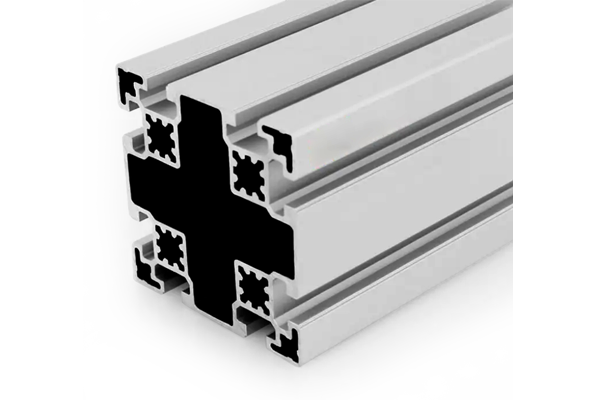
PG45 90×90 mm Eight Slot Aluminium Strut Profile M10 Column Section
A 90 x 90 mm eight slot PG45 aluminium strut profile with 8 x 8 mm corner holes tapped M10 and a 10 mm slot mouth. For frames where the bolted joints, not the members, set the limit.
| Material | Aluminium |
|---|---|
| Alloy Grade | 6063-T5 |
| Temper | T5 |
| Section Size | 90 x 90 mm |
| Slot | 8 x 10.2 mm groove, 10 mm mouth, 45 mm pitch, outer pair 45 mm apart |
| Length | 6 m stock, cut to drawing to +/-0.5 mm |
| Tolerance | EN 755-9 / GB/T 6892, wall +/-0.15 mm |
| Surface | Mill finish / clear anodised / black anodised |
| MOQ | 150 |
| Lead Time | 22-32 days after deposit for mill finish |
| Loading Port | Shanghai / Ningbo |
| Supply Ability | 200 t per month |
| Payment Terms | T/T 30% deposit + 70% before shipment | L/C at sight |
| Trade Terms | FOB | CIF | EXW |
| Certifications | ISO 9001:2015 | EN 755-9 | RoHS | REACH |
Structural framing · PG45 column section
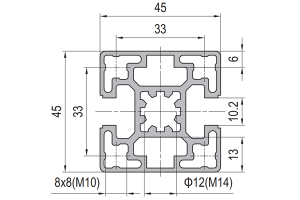
A PG45 90 x 90 mm eight slot aluminium strut profile is a square column on a 45 mm slot pitch with a 10.2 mm groove and a 10 mm slot mouth. The corner holes are 8 x 8 mm tapped M10, the centre bore is Ø12 mm tapped M14, the flange is 6 mm and the web 13 mm, the outer slots are 45 mm apart, and the section weighs about 7.6 kg/m. It is supplied in 6063-T5, cut and machined to order.
The 45 series exists because of one thing: the bolt. Going from a 40 series M8 to a 45 series M10 is a single size step, but it changes the joint by more than people expect. The bolt gets about 58 per cent more shear area, the slot takes roughly double the tightening torque, and the clamping force the joint can develop goes up by about 60 per cent. On a frame where the connections are the weak point rather than the members, that is the whole argument.
M8 against M10, in three numbers
It is easy to treat a bolt size step as a small change. It is not, and the arithmetic is simple enough to do properly. Three quantities matter on a structural joint: the shear area of the bolt, the torque the receiving slot will take, and the clamping force that torque produces.
| Quantity | M8 | M10 | Ratio |
|---|---|---|---|
| Tensile stress area | 36.6 mm2 | 58.0 mm2 | 1.58 times |
| Shear capacity of the bolt | Reference | 58 per cent more | 1.58 times |
| Torque ceiling in the slot | approx. 15 N m | approx. 30 N m | 2.0 times |
| Clamping force at that torque | approx. 9.4 kN | approx. 15.0 kN | 1.60 times |
| Friction the joint can carry | Reference | 60 per cent more | 1.60 times |
The clamping force figure is the one that matters most on a bolted frame, because a bolted joint does not fail by the bolt shearing — it fails by the clamped faces slipping. The friction between those faces is proportional to the clamping force, and the clamping force is proportional to the torque. Doubling the torque therefore roughly doubles the slip resistance of the joint, which is why the M10 corner hole is worth more than the 58 per cent bolt strength increase suggests.
The slot mouth is wider as well. The 45 series has a 10 mm slot mouth against the 8 mm mouth of the 40 series, with the same 10.2 mm groove. The wider mouth means a bigger nut body with more bearing area on the lip, so the pull-out is higher as well as the torque. Both effects point the same way.
Is the extra 5 mm of pitch worth it?
The honest comparison is between the biggest standard column in each series. Here is how the 45 series 90 x 90 mm section stands against the 40 series 80 x 80 mm heavy section.
| 40 series 80 x 80 mm heavy | 45 series 90 x 90 mm | |
|---|---|---|
| Envelope | 80 x 80 mm | 90 x 90 mm |
| Slot pitch | 40 mm | 45 mm |
| Slot mouth | 8 mm | 10 mm |
| Corner hole | 5 mm round, tapped M6 | 8 x 8 mm, tapped M10 |
| Centre bore | Ø12 mm, tapped M14 | Ø12 mm, tapped M14 |
| Wall | 4 mm flange / 11 mm web | 6 mm flange / 13 mm web |
| Weight | approx. 6.80 kg/m | approx. 7.60 kg/m |
| Second moment of area | approx. 150 cm4 | approx. 230 cm4 |
| Slot torque ceiling | approx. 15 N m for M8 | approx. 30 N m for M10 |
The 45 series wins on every line, and it wins by a margin that is larger than the 12 per cent weight difference suggests. About half again the stiffness and double the torque ceiling for 12 per cent more weight is a straightforward improvement — which is why the 45 series exists at all, and why the question is not whether to use it but when.
Specifying a 45 series frame
- Start from the joint, not the member The reason to be in the 45 series is the joint capacity, so size the connections first and let the member follow. If the joints are fine in M8, you do not need this series.
- Use the 8 x 8 mm corner holes for the structural connections They are tapped M10 and they are the strongest fixing in the section. Keep the slots for adjustable items and brackets.
- Torque to about 30 N m, not more The M10 slot ceiling is about 30 N m. The bolt could take more in steel, but the receiving slot is aluminium and it is what deforms.
- Remember the pitch is 45 mm, not 40 A 45 series bracket will not fit a 40 series profile and vice versa. Keep one series per frame, or use a transition plate where two series meet.
- Check the weight before you commit At 7.6 kg/m a long 45 series column is a two-person lift. On a frame built on site that is worth planning for.
Frequently asked questions
How much stronger is an M10 joint than an M8 joint?
About 58 per cent more shear area in the bolt and about 60 per cent more clamping force, but roughly double the tightening torque. The clamping force is the figure that decides how much load the joint can carry before it slips.
Will 45 series brackets fit a 40 series profile?
No. The pitch and the slot mouth differ, so the brackets are not interchangeable. Keep one series per frame.
What is the difference between this and the heavy version?
Internal wall thickness. The standard 45 series already has a 6 mm flange and a 13 mm web, so the heavy version is a second, smaller increment on top of that.
Can I use this as a machine base?
Yes, and the M10 corner holes are well suited to it. For a base that is anchored and tapped, the higher torque ceiling of the M10 joint is a real advantage over a 40 series section.
Do you machine the corner holes?
Yes. We cut to length, face and square the ends, drill and tap the 8 x 8 mm corner holes to M10 and the centre bore to M14, and supply end plates. Send DWG, DXF, STEP or PDF.
Send the joint load and the bolt size you want
Tell us the load at each joint, whether the frame vibrates and how often it comes apart. We will confirm whether the M10 joint is needed and quote cut lengths, tapping and hardware.
Request a QuoteRelated Products
 PG45 90×90 mm Eight Slot Heavy Aluminium Strut Profile for Heavy Machinery Frames
A 90 x 90 mm eight slot heavy PG45 aluminium strut profile with thicker…
 PG45 90×90 mm L-Shape Eight Slot Aluminium Strut Profile Corner Column for Frames
A 90 x 90 mm L-shaped eight slot PG45 aluminium strut profile with two…
 PG45 180 x 45 mm Ten Slot Aluminium Strut Profile Wide Gantry Beam
A 180 x 45 mm ten slot PG45 aluminium strut profile at about 6.20…
 PG50 100×100 mm Eight Slot Aluminium Strut Profile for Heavy Machine Columns
A 100 x 100 mm eight slot PG50 aluminium strut profile with two slots…
 PG50 100×50 mm Six Slot Aluminium Strut Profile Rectangular Machine Beam
A 100 x 50 mm six slot PG50 aluminium strut profile with slots on…
 PG45 90×45 mm Six Slot Aluminium Strut Profile Rectangular Machine Beam
A 90 x 45 mm six slot PG45 aluminium strut profile for machine frames…
 PG45 90 x 45 mm Six Slot Aluminium Strut Profile Heavy Rectangular Beam
90 x 45 mm six-slot heavy aluminium strut profile with 10.2 mm grooves and…
 PG45 45 x 45 mm Two Slot Type B Aluminium Strut Profile Opposite Rail
45 x 45 mm two-slot Type B aluminium strut profile with slots on opposite…
