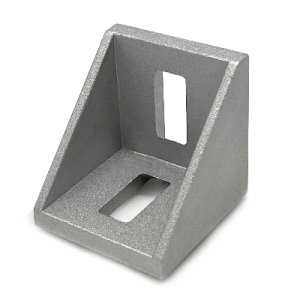
Die Cast Bracket for 20 to 50 mm Series Aluminium Profiles Corner
Die cast zinc alloy corner bracket for 20, 30, 40, 45 and 50 series aluminium profiles, with M5, M6 and M8 fixings. A one-piece corner gusset stronger than a cut angle.
| Material | Zinc alloy |
|---|---|
| Alloy Grade | Die cast zinc alloy |
| Temper | custom |
| Section Size | 20 / 30 / 40 / 45 / 50 series |
| Slot | M5 (20 series) / M6 (30 series) / M8 (40, 45, 50 series) |
| Length | One-piece bracket, no cutting required |
| Tolerance | Cast tolerance per series |
| Surface | Bright / black painted |
| MOQ | Sold in small packs; larger quantities quoted per piece |
| Lead Time | Stocked by series; larger quantities 2 to 3 weeks |
| Loading Port | Shanghai, Ningbo, Qingdao |
| Supply Ability | Die casting and finishing capacity for production volumes |
| Payment Terms | T/T 30 per cent deposit, balance against copy of bill of lading |
| Trade Terms | FOB, CIF, CFR, EXW |
| Certifications | RoHS and REACH declarations |
01What is a die cast corner bracket?
What does die cast mean?
The bracket is cast in a steel die from molten zinc alloy, so it comes out as a single finished shape with the holes and the gusset rib already formed. There is no cutting or machining, which keeps the piece cost low and the shape consistent from bracket to bracket.
Why is it stronger than a cut angle?
Because the die can form a web or rib across the inside of the corner, which a simple cut angle does not have. The rib puts material where the bending moment is highest, so a die cast bracket is roughly 30 per cent stronger than a flat angle of the same footprint, at the cost of being slightly heavier and bulkier.
Which series does it fit?
The full range from 20 to 50 series, with the fixing size matched to the series: M5 for the 20 series, M6 for the 30 series, and M8 for the 40, 45 and 50 series. One bracket design per series, so you buy the one that matches your profile.
02Bracket data by series
| Series | Fixing | Bracket size | Typical use |
|---|---|---|---|
| 20 series | M5 | small | instrument frames, light guards |
| 30 series | M6 | small-medium | light machine frames |
| 40 series | M8 | medium | standard machine frames |
| 45 series | M8 | medium-large | heavy frames and gantries |
| 50 series | M8 | large | large frames and load paths |
The bracket size rises with the series, because the profile section grows and the corner moment it must carry grows with it. Always match the bracket to the series of the profile.
03Die cast bracket vs cut angle
For a corner joint, you have two main options: a cut angle (flat L-section bolted on) or a die cast bracket (formed with a rib). The choice is strength and speed versus flexibility.
| Factor | Die cast bracket | Cut angle |
|---|---|---|
| Strength | approx. 30% higher | reference |
| Weight | slightly higher | lower |
| Fit speed | fast, self-aligning holes | slower, holes to drill |
| Customisability | fixed shape | fully customisable |
| Appearance | bulkier, has a rib | flatter, lower profile |
| Cost | low at volume | low for one-off |
If you are building many identical frames, the die cast bracket wins on speed and consistency. If you need a specific hole pattern or a low-profile joint, the cut angle wins on flexibility.
04Fitting and alignment
The die cast bracket bolts into the slot of the two adjoining profiles. The slot nuts sit inside the groove, and the bracket’s holes line up with them. The bracket is self-aligning because the hole positions are fixed by the die, so the two profiles pull square as the bolts are tightened.
- Slot nuts first: slide the slot nuts into both profiles before offering the bracket up.
- Tighten evenly: snug both bolts, then torque them alternately so the corner pulls square.
- Match the fixing: use the correct nut size for the series, or the bracket will not seat properly.
Because the bracket is a one-piece cast, the two holes are always at the correct angle to each other, which is what keeps the frame square without shimming.
05Choosing the right corner connection
Choose a die cast bracket
- You are building many identical frames
- Speed and consistency matter more than a custom hole pattern
- The corner carries a medium moment and needs the rib
- You want a self-aligning joint that pulls square
- The bracket’s bulk is acceptable for the application
Choose a cut angle
- You need a custom hole pattern or edge distance
- The joint must be low profile
- The quantity is low and a fixed shape is not worth tooling
- Weight per corner matters
- You need a longer brace, not just a corner gusset
06Failure modes to design out
| What goes wrong | Why it happens | Design it out by |
|---|---|---|
| Bracket cracks at the rib | the joint is overloaded or over-tightened | match the bracket to the series, and torque to the slot nut limit |
| Profiles do not pull square | the bolts are tightened one at a time | tighten alternately and evenly |
| Wrong fixing size | an M8 bracket used on a 30 series profile | match the bracket to the series: M5/M6/M8 |
| Bracket loosens under vibration | zinc alloy relaxes under a plain joint | use a spring washer or thread locker, and retorque |
| Corrosion at the zinc-to-aluminium contact | dissimilar metals in a wet environment | use an isolating washer or a painted bracket for outdoor use |
07What to check before you order
Procurement checklist for die cast brackets
- Confirm the series of your profile: 20, 30, 40, 45 or 50.
- Confirm the fixing size: M5, M6 or M8, matched to the series.
- Confirm the quantity of corners and whether you need slot nuts and bolts too.
- Confirm the finish: bright or black painted.
- Confirm the environment: for outdoor or wet use, specify a painted or isolated bracket.
- Confirm the load: for a heavy corner, the die cast bracket may need a second bracket or a gusset plate.
08Terms used on this page
- Die cast
- A part cast under pressure in a steel die, giving a consistent finished shape with the holes and ribs formed.
- Zinc alloy
- The casting material, chosen for its low melting point and good dimensional accuracy.
- Gusset rib
- A web cast across the inside of the bracket that puts material where the bending moment is highest.
- Slot nut
- A nut that slides into the T-slot groove and receives the bracket bolt.
- Series
- The profile size family (20, 30, 40, 45, 50) that sets the slot and fixing size.
09Questions buyers ask
Which series does the bracket fit?
All five: 20, 30, 40, 45 and 50 series, with a bracket per series. The fixing is M5 for 20 series, M6 for 30 series, and M8 for 40, 45 and 50 series.
Is it stronger than a cut angle?
Roughly 30 per cent stronger for the same footprint, because the cast rib puts material where the corner moment is highest.
Does it need drilling?
No. The holes are formed in the die, so the bracket is ready to bolt straight into the slot with a slot nut.
Is it weatherproof?
Bright zinc alloy is fine indoors. For outdoor or wet use, specify a painted bracket and an isolating washer to prevent galvanic corrosion.
What is the minimum order quantity?
Brackets are stocked by series and sold in small packs. Larger quantities are quoted at a lower per-piece price.
Can I get a sample?
Yes. A sample pack across the series is available so you can confirm the fit before a full order.
What we need to quote die cast brackets
- The series of your profile and the fixing size.
- The quantity of corners, and whether slot nuts and bolts are needed.
- The finish: bright or black painted.
- The environment (indoor, outdoor or wet).
- Any customisation: a specific hole pattern or a painted colour.
- The delivery requirement and any certification.
Send those six items and the quotation comes back with the bracket, fastener and finish broken out separately. Browse the full aluminium profile catalogue and the connecting elements range.
Need corner brackets quoted for your frame series?
Send the series, quantity and finish. We quote brackets and fasteners as separate lines.
Request a quotationRelated Products
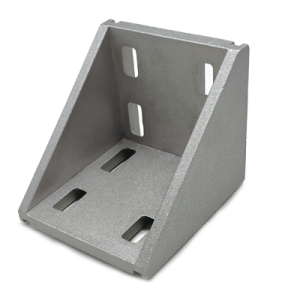 Heavy Duty Die Cast Corner Bracket for Aluminium Profile 60 80 90 100 mm Series
Heavy duty die cast corner bracket for large aluminium profile frames in 60, 80,…
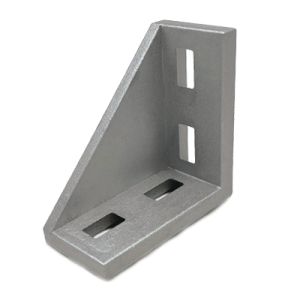 Rectangular Die Cast Corner Bracket Aluminium Profile 30×60 40×80 45×90 50×100 mm
Rectangular die cast corner bracket with unequal legs for aluminium profile frames built from…
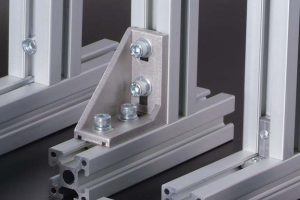 Aluminium Extrusion Connector System for 20×20 to 100×100 mm T-Slot Frames
A complete aluminium extrusion connector system covering visible brackets, hidden inner brackets, cubic corner…
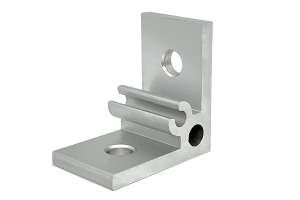 Aluminium Angle Profile Bracket 35x35x4 mm M6 Corner Brace for 20 and 30 Series Profiles
A 35 x 35 x 4 mm aluminium angle profile bracket for 20 and…
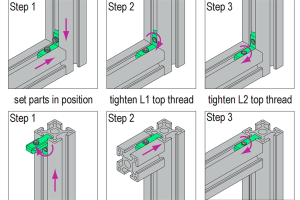 Aluminium Inner Bracket with Top Thread M5 M6 M8 for 20 to 40 mm T-Slot Profiles
A hidden inner bracket with top thread for aluminium T-slot profiles, supplied in M5…
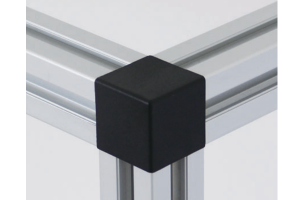 Aluminium Cubic Connector 2020 20×20 mm Three-Way Corner Joint with ABS Cap
A 20 x 20 x 20 mm three-way cubic corner connector for 20 series…
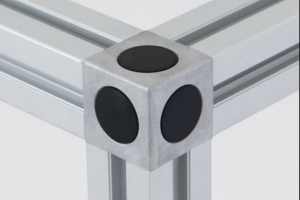 Cubic Connector 4545 45x45x45 mm Three-Way Aluminium Corner Joint Block for 45 Series
A 45 x 45 x 45 mm three-way cubic corner connector for 45 series…
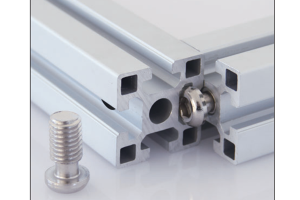 Self-Tapping Screw Connector for Aluminium Profile M6 M8 M10 to 50 mm Series
A self-tapping screw connector for aluminium profiles in M6, M8 and M10. Forms its…
