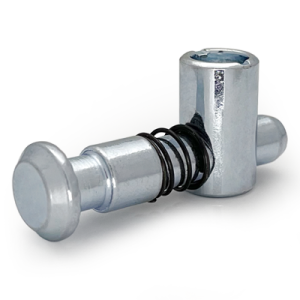
Universal Connector Aluminium Profile Adjustable Angle Joint Fastener M8 30 40 mm
Universal connector for aluminium profile with an angle set during assembly. Suits diagonal braces, ribs and non-orthogonal frames in 30 and 40 series from one part number, M8.
| Material | Steel |
|---|---|
| Alloy Grade | Carbon steel |
| Temper | custom |
| Section Size | 30 series / 40 series |
| Slot | M8, matches the groove of the receiving section |
| Length | By series, to drawing |
| Tolerance | Sleeve outside diameter within 0.05 mm |
| Surface | Zinc plated |
| MOQ | 2000 |
| Lead Time | 18-28 days after deposit |
| Loading Port | Shanghai / Ningbo |
| Supply Ability | 1,000,000 pieces per month |
| Payment Terms | T/T 30% deposit + 70% before shipment | L/C at sight |
| Trade Terms | FOB | CIF | EXW |
| Certifications | ISO 9001:2015 | RoHS | REACH |
Connecting · Universal connector
A universal connector joins two profiles at an angle that is set during assembly rather than fixed by the shape of the connector. The joint can be set anywhere in the connector’s working range and then locked, so a frame corner does not have to be a right angle. It is the part that makes diagonal braces, reinforcing ribs and non-orthogonal frames possible without a bespoke connector for every angle.
The reason it matters is stock and lead time. A fixed 90 degree connector is one part number and a mitre connector is another, and between them they cover two angles. A frame with a 60 degree corner, a 75 degree sloped cover and a 135 degree octagon joint needs three more. A universal connector covers all of them with one part, which is worth more than the price difference on any project with more than one non-standard angle in it.
Why a fixed-angle connector cannot do a diagonal
Every fixed connector carries its angle in its geometry. A standard connector is machined so that when it seats in the end face and expands in the groove, the two members end up at exactly 90 degrees. A mitre connector does the same for a joint where both members are cut at 45 degrees. Change the required angle and the connector no longer fits, because the faces it pulls together are no longer parallel to the direction it pulls in.
A universal connector avoids this by not carrying the angle at all. Its sleeve expands in the groove and its bolt pulls along the axis of the incoming member, and the angle between the members is whatever it is when the bolt is tightened. The connector holds the members in position rather than defining the position, which is the difference between an angle-specific part and an adjustable one.
How the angle is set and locked
The connector is fitted into the end face of one member in the usual way, then the second member is offered up at the required angle. With the bolt only finger tight, the joint can still be moved, so the angle is set by holding the members in the correct relationship and then tightening. The sleeve expands against the groove and locks the joint at whatever angle it was holding.
That means the angle has to be set by something other than the connector. On a one-off frame it can be set from a drawing with a protractor or an angle finder. On a production frame the members should be set in a jig, because a hand-held setting will vary by a degree or more between assemblies and the frame will not be square to itself.
| Joint | Fixed-angle part needed | Universal connector |
|---|---|---|
| 90 degree corner | Standard connector, Model C | Yes, in range |
| Mitred 90 degree corner | Mitre connector, Model P | Not for a mitred face |
| 60 degree corner | Bespoke connector | Yes, in range |
| 75 degree sloped cover | Bespoke connector | Yes, in range |
| 135 degree octagon joint | Bespoke connector | Yes, in range |
| 45 degree diagonal brace | Bespoke or a mitred bracket | Yes, in range |
| Part numbers to stock for the above | Six | One |
One universal connector instead of a brace cut to angle
A diagonal brace in a rectangular frame is normally a member cut to a fixed length with both ends cut to a compound angle, because it has to land squarely on the two members it braces. Get the length wrong by a millimetre and the brace does not fit, and the angle at each end is set by the aspect ratio of the frame, so a brace cut for one frame will not fit another.
With a universal connector at one end, the brace can be a plain square-cut strut. The connector takes up the angle, and the brace is cut to length rather than to length and angle. That removes the compound cut, which is the operation most likely to be scrapped, and it means one stock length of strut covers every brace on the frame regardless of the angle it has to make.
| Brace approach | Cuts required | Reusable on another frame | Setting accuracy |
|---|---|---|---|
| Fixed brace, compound cut both ends | Two compound mitres | No, length and angle specific | Set by the cut |
| Fixed brace with a bracket each end | Two square cuts | Only at the same angle | Set by the bracket |
| Strut with a universal connector | One square cut | Yes, any angle in range | Set during assembly |
Setting a universal joint correctly
- Prepare the end face before assembly The connector goes into a hole in the end face of one member, so that hole is drilled and tapped before the frame goes together. It has to be on the groove centre line, because the sleeve expands against both flanks of the groove.
- Fit the connector and leave it finger tight Slide the sleeve into the groove of the receiving member and turn the bolt only until it takes up the slack. The joint has to stay movable while the angle is set, so it must not be tightened at this stage.
- Set the angle from a jig or a reference, not by eye Hold the members in the required relationship against a jig, a square or a protractor, and check the diagonal measurement across the frame rather than the angle itself. Diagonal measurement catches errors in both members at once.
- Tighten to the specified torque and re-check the diagonal Tighten to the figure for the section and then measure the diagonals again. If they have moved, the joint was not held during tightening and the angle has to be reset.
- Add a second connector or a pin on a loaded joint A universal joint is locked by friction in one plane, so it resists rotation less well than a fixed connector. On a joint that carries load or is subject to vibration, use two connectors or add a pin through the members to stop the angle moving.
Universal connector or a fixed one? Where the angle is 90 degrees and the members are square cut, use a standard connector: it is cheaper and it holds the angle rigidly. Use the universal connector where the angle is not 90 degrees, where it has to be set on assembly, or where the same part has to cover several different angles on the same project.
Frequently asked questions
What is a universal connector used for?
Joining two profiles at an angle that is set during assembly instead of being fixed by the connector. It is used for diagonal braces, reinforcing ribs, sloped covers and any frame corner that is not 90 degrees.
What angle range does it cover?
It covers the working range of the connector for your section, and the exact limits depend on the groove and the member sizes. Tell us the sections and the angle you need and we will confirm whether the universal connector covers it.
How is the angle held once it is set?
The sleeve expands against the inside of the groove when the bolt is tightened, and friction between the sleeve and the groove holds the angle. It is a friction lock in one plane, so a joint that carries load or sees vibration should have a second connector or a pin.
Can I use it to replace a mitred brace?
Yes, and it usually saves money. The brace becomes a plain square-cut strut instead of one with two compound mitres, and one stock length covers every brace on the frame regardless of the angle each one has to make.
Do I still need to drill and tap the end face?
Yes. The connector seats in a hole in the end face of the incoming member, and that hole has to be drilled and tapped before assembly on the groove centre line. The angle is adjustable, the hole is not.
Tell us the angles your frame has to make
Send the sections you are joining and the angles you need to cover. We will confirm whether one universal connector covers them all, quote the bulk price and supply samples for a trial joint.
Request a QuoteRelated Products
 Die Cast Bracket for 20 to 50 mm Series Aluminium Profiles Corner
Die cast zinc alloy corner bracket for 20, 30, 40, 45 and 50 series…
 Heavy Duty Die Cast Corner Bracket for Aluminium Profile 60 80 90 100 mm Series
Heavy duty die cast corner bracket for large aluminium profile frames in 60, 80,…
 Rectangular Die Cast Corner Bracket Aluminium Profile 30×60 40×80 45×90 50×100 mm
Rectangular die cast corner bracket with unequal legs for aluminium profile frames built from…
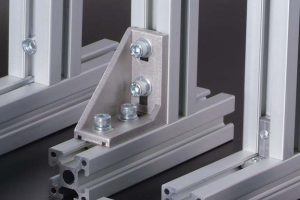 Aluminium Extrusion Connector System for 20×20 to 100×100 mm T-Slot Frames
A complete aluminium extrusion connector system covering visible brackets, hidden inner brackets, cubic corner…
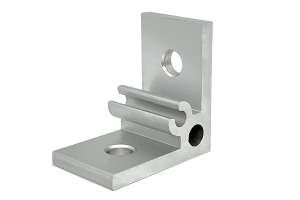 Aluminium Angle Profile Bracket 35x35x4 mm M6 Corner Brace for 20 and 30 Series Profiles
A 35 x 35 x 4 mm aluminium angle profile bracket for 20 and…
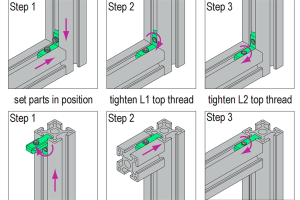 Aluminium Inner Bracket with Top Thread M5 M6 M8 for 20 to 40 mm T-Slot Profiles
A hidden inner bracket with top thread for aluminium T-slot profiles, supplied in M5…
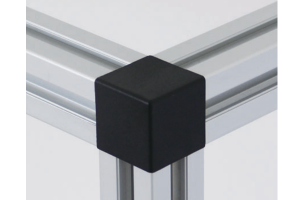 Aluminium Cubic Connector 2020 20×20 mm Three-Way Corner Joint with ABS Cap
A 20 x 20 x 20 mm three-way cubic corner connector for 20 series…
 Cubic Connector 4545 45x45x45 mm Three-Way Aluminium Corner Joint Block for 45 Series
A 45 x 45 x 45 mm three-way cubic corner connector for 45 series…
