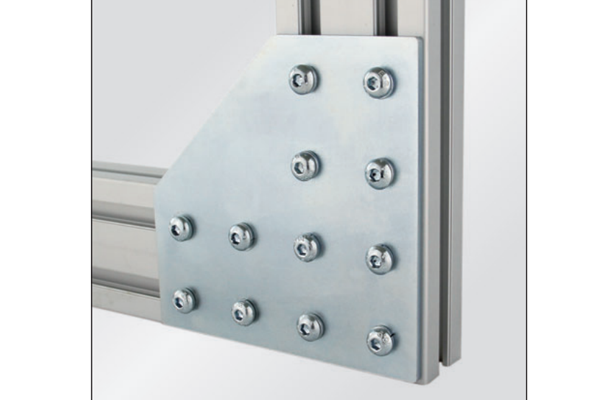
Joining Plate PG40-8080
Heavy joining plate for two 80 mm profiles at 90°, a structural corner joint for machine bases, gantries and heavy frames where the joint carries the load.
| Material | Machined aluminium 6063-T5 or steel |
|---|---|
| Alloy Grade | 6063-T5 or S355 steel |
| Temper | custom |
| Section Size | 80 x 80 mm profiles at 90 degrees |
| Slot | 8 mm slot; 4 + 4 M8 or M10 T-nuts |
| Length | Plate 160 x 160 x 40 mm |
| Tolerance | ±0.25 mm on bolt slot positions |
| Surface | Anodised, powder coated or zinc plated |
| MOQ | 100 |
| Lead Time | 20-30 days after deposit |
| Loading Port | Shanghai / Ningbo |
| Supply Ability | 20,000 pcs per month |
| Payment Terms | T/T 30% deposit + 70% before shipment | L/C at sight |
| Trade Terms | FOB | CIF | EXW |
| Certifications | ISO 9001:2015 | ISO 14001 | RoHS | REACH |
Joining plates · Heavy structure
This plate joins two 80 mm profiles at 90° on a frame where the joint is a structural element rather than a locator. On a light frame a corner plate holds two members in position and the members carry the load. On a heavy frame — a machine base, a gantry, a press frame — the joint itself is in the load path and has to transmit the full bending moment and shear of the connection.
The design of the joint changes at that point. A single plate is no longer enough, the bolt count matters, and the question of whether to bolt or weld the joint becomes real. The 8080 plate is the bolted answer to a joint that would once have been welded: it keeps the frame demountable and transportable while giving the joint enough capacity to be trusted.
When a joint stops being a locator and becomes structure
| Frame | Joint role | Typical plate | Bolt count |
|---|---|---|---|
| Light enclosure | Locates the members | Standard L | 2 + 2 |
| Machine frame | Carries member weight | Heavy L | 3 + 3 |
| Machine base | Carries the machine and a moment | 8080 heavy | 4 + 4 |
| Gantry leg | Carries a bending moment | 8080 heavy + brace | 4 + 4 |
| Press or forming frame | Carries the process force | Welded or 8080 heavy | 4 + 4 or welded |
The change is not gradual. Up to a machine frame, the corner is mostly locating and the member is doing the work. On a machine base or a gantry, the corner carries a bending moment that the members alone cannot resolve, and the joint has to transmit it. That is the point at which the plate becomes a structural component and the joint should be designed rather than assumed.
Bolted or welded
- Bolt slip is the failure mode of a bolted heavy joint. A friction joint holds until the load exceeds the friction, then it slips and the frame moves. On a heavy joint the bolts are specified so the friction capacity exceeds the working load with a margin, and the bolts are torqued to the full figure.
- Two plates minimum, four on a heavy corner. On an 80 mm corner the plates go on both visible faces, and on a loaded corner they are doubled or a brace is added. The plate area is what resists the rotation.
- The members have to be up to it. A heavy plate on a light member just transfers the problem: the member deflects or the slot deforms. On a structural joint, the member section and the plate are designed together.
- Establish the joint load The bending moment and the shear at the joint, from the frame analysis. On a machine base or a gantry this is a real number, not a rule of thumb.
- Check the member section Confirm the 80 mm member can carry the moment. A heavy plate cannot compensate for a member that is too light for the span.
- Size the plate and the bolt count The plate area resists the rotation; the bolts resist the shear. On a heavy corner the usual figure is four bolts per leg and a plate on each face.
- Torque to the full figure A friction joint depends entirely on the torque. Use a calibrated wrench and record the figures — on a structural joint this is a quality record, not a formality.
- Re-check after first load Bolted heavy joints bed in under the first full load. Re-torque after the frame has carried its working load for a shift, then at the first service interval.
Practical point: on a frame where the corner moment is significant, send us the load case and we will check the joint — plate size, bolt count, torque and whether a brace is needed. It is a short calculation and it is much cheaper than discovering a slipping joint on a commissioned machine.
Frequently asked questions
Is a bolted joint as stiff as a welded one?
Not quite — a welded joint is stiffer for the same material. But a bolted joint with a heavy plate pair and a brace comes close, and it keeps the frame demountable, which matters for transport and for machines that are modified in service.
How many bolts does a heavy 80 mm corner need?
Four per leg is the usual figure for a loaded corner, with a plate on each visible face. The count is set by the shear at the joint, not by the plate.
What torque should the bolts be?
Around 40 Nm for an M8 T-nut in an 80 series slot, but confirm against the profile supplier’s data. A friction joint is only as good as its torque, so use a calibrated wrench.
Can the joint slip?
It can if it is under-torqued or overloaded. A friction joint holds until the load exceeds the friction, so the bolts are specified with a margin and torqued fully.
Can the plate be welded instead?
Aluminium 6063 can be welded, but welding a heat-treatable alloy reduces its strength in the heat-affected zone. On a structural joint that has to be welded, the design should account for the reduced properties near the weld.
Send the load case and we will check the joint
Tell us the frame, the load on the corner and the span. We will check the plate, the bolt count, the torque and whether a brace is needed, and return FOB pricing within one working day.
Request a QuoteRelated Products
 Joining Plate PG45-4545
Joining plate for two 45 × 45 mm profiles at 90°, sized to the…
 Butt Connector
Connector that joins two profiles end to end in a straight line, transmitting bending…
 Aluminium Profile Castors
Castors for aluminium profile frames in seven configurations — plate fixed, swivel, braked and…
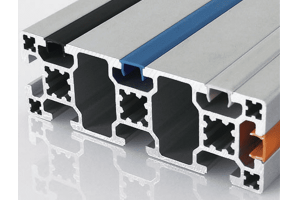 T-Slot Cover Profile
Snap-in T-slot cover strip that closes the open slot on aluminium framing profiles, giving…
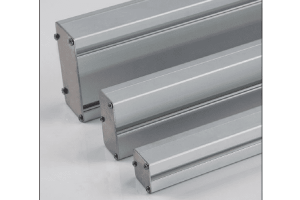 Aluminium Conduit End Cap
Snap-fit or screw-fixed end caps for aluminium conduit profiles from 40x40 to 80x200 mm,…
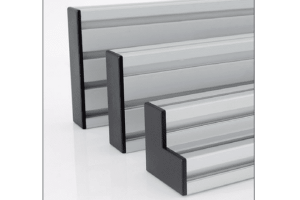 Aluminium Profile End Cap
Push-fit end caps for T-slot framing profiles from 15 to 60 series, sized to…
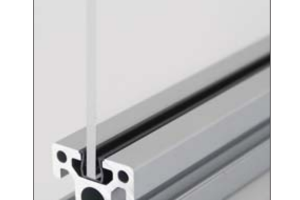 T-Slot Reducing Profile
Reducing insert that narrows a wide T-slot to accept standard nuts and accessories from…
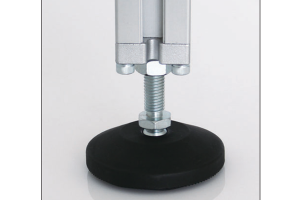 Swivel Ball Foot
Self-aligning levelling foot with a ball-and-socket joint between stem and pad, keeping the pad…
