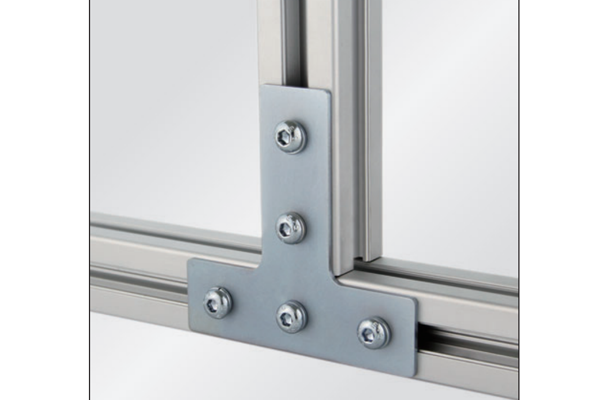
Joining Plate PG30 (3030)
L-shaped joining plate that bolts into the 30 series T-slot to make a 90° corner joint on light frames, enclosures and guards, with no machining of the profile ends.
| Material | Die-cast aluminium ADC12 or machined 6063-T5 |
|---|---|
| Alloy Grade | ADC12 die-cast or 6063-T5 |
| Temper | custom |
| Section Size | Fits 30x30 mm and 30x60 mm profiles |
| Slot | 2 + 2 x M6 T-nuts in the 30 series slot |
| Length | Plate 60 x 60 x 30 mm |
| Tolerance | ±0.25 mm on bolt slot positions |
| Surface | Anodised or powder coated |
| MOQ | 500 |
| Lead Time | 15-25 days after deposit |
| Loading Port | Shanghai / Ningbo |
| Supply Ability | 400,000 pcs per month |
| Payment Terms | T/T 30% deposit + 70% before shipment | L/C at sight |
| Trade Terms | FOB | CIF | EXW |
| Certifications | ISO 9001:2015 | ISO 14001 | RoHS | REACH |
Joining plates · 30 series
The PG30 joining plate is an L-shaped plate that bolts into the T-slot of two 30 series profiles to make a 90° corner. It is the standard corner joint for light frames: it needs no machining of the profile ends, it can be fitted or removed with a hex key, and it holds the two members square while the rest of the frame is built.
The important question with a 30 series plate is not how it works but where it stops working. A 30 series frame is light, and a corner joint is the most loaded point in any frame. Understanding the limit of the plate is what stops a designer building a frame that is fine on paper and sags in service.
Where a 30 series joint is the right answer
A 30 series plate belongs on frames where the members are short, the loads are light and the frame does not have to resist a significant bending moment at the corners. Enclosures, covers, guards, display frames, light benches and instrument stands are all natural 30 series applications, and the plate is the standard joint for all of them.
The plate is not the weak point in these frames; the profile is. A 30 × 30 profile has a much lower second moment of area than a 40 × 40, so it deflects more under the same span and load. Where a frame is failing, it is almost always the member bending rather than the joint coming apart.
| Frame type | Typical span | 30 series suitable? | Note |
|---|---|---|---|
| Instrument enclosure | Up to 600 mm | Yes | Light panels, static load |
| Machine guard | Up to 800 mm | Yes | Panel load only, no machine weight |
| Display frame | Up to 1,000 mm | Yes | Appearance critical, load light |
| Light bench | Up to 900 mm | Borderline | Depends on the load on the bench |
| Workbench with a vice | Any | No | Shock load at the corner — step up |
| Machine base | Any | No | Use 40 or 45 series |
The two limits to watch
- Member deflection, not joint strength. A 30 series member bends before the plate fails. Where a frame has to span more than about a metre under load, the answer is a larger profile rather than a heavier plate.
- Corner moment. A frame with a cantilever, a shelf, or a machine vibrating on it puts a bending moment into the corner. The plate resists that moment through two bolts in a slot, which is adequate for a light moment and not for a heavy one. A 40 series plate with a gusset is the step up.
- Repeated assembly. A bolted joint that is assembled and disassembled repeatedly loosens. Where a frame is regularly broken down for transport, a heavier plate and a torque check at each rebuild is the practice.
The plate and the joint it makes
- Cut the members square The plate holds the joint square, but it cannot correct an out-of-square cut. Cut the members square to within 0.2 mm.
- Set the T-nuts in the slot Drop the T-nuts into the slot of each member and slide them to the plate bolt positions. On a 30 series slot the nuts are M6.
- Fit the plate and hold it square Bolt the plate to one member finger-tight, offer up the second member, and check the corner with a square before tightening either side fully.
- Tighten in two passes Tighten the bolts diagonally in two passes to the recommended torque. A single pass can pull the joint out of square.
- Check for movement Push the corner sideways. Any visible movement means the plate is too light for the load and the frame needs a heavier series or a brace.
Frequently asked questions
How much load can a PG30 corner joint take?
It depends on the load direction and the frame geometry, but as a guide a single plate on a 30 × 30 corner is suitable for light static frames. Where there is a cantilever or a shock load, use two plates or step up to 40 series.
Can the plate be used on a 40 series profile?
No. The bolt positions and the plate size are set for the 30 series slot and member width. Use the PG40 plate for 40 series.
Do I need one plate or two per corner?
Two plates, one on each visible face, give the strongest 30 series corner. One plate is adequate for a light frame where the corner carries no moment.
Is the plate strong enough for a machine guard?
Yes, where the guard panel is the only load. Where the guard also has to resist a push or carry a component, the corner needs a brace or a heavier series.
What bolts does the plate use?
M6 T-nuts and bolts for the 30 series slot. The plate is supplied with or without the fixing kit.
Send the frame span and the corner load
Tell us the member spans and what the frame carries. We will confirm whether the 30 series plate is suitable or whether the frame should step up a series, and return FOB pricing within one working day.
Request a QuoteRelated Products
 Joining Plate PG40
The 40 series joining plate range — L, T and cross variants that bolt…
 Joining Plate PG40-4040
Joining plate sized for two 40 × 40 mm profiles meeting at 90°, the…
 Joining Plate PG40-4080
Transition joining plate that joins a 40 mm member to an 80 mm member…
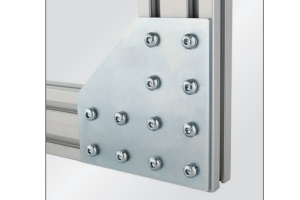 Joining Plate PG40-8080
Heavy joining plate for two 80 mm profiles at 90°, a structural corner joint…
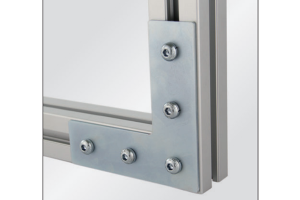 Joining Plate PG45-4545
Joining plate for two 45 × 45 mm profiles at 90°, sized to the…
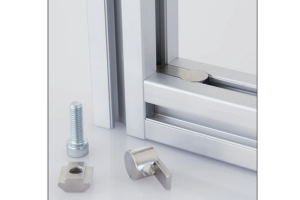 Butt Connector
Connector that joins two profiles end to end in a straight line, transmitting bending…
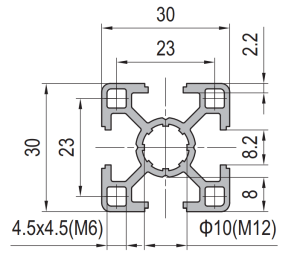 Strut Aluminium Profile 30×30 mm 4-Slot Light T-Slot Extrusion
30 x 30 mm light-wall four-slot T-slot strut aluminium profile in 6063-T5 with M5…
 Strut Aluminium Profile 30×120 mm 3-Slot Wide Beam T-Slot Extrusion
30 x 120 mm three-slot wide-beam T-slot strut aluminium profile in 6063-T5 with three…
