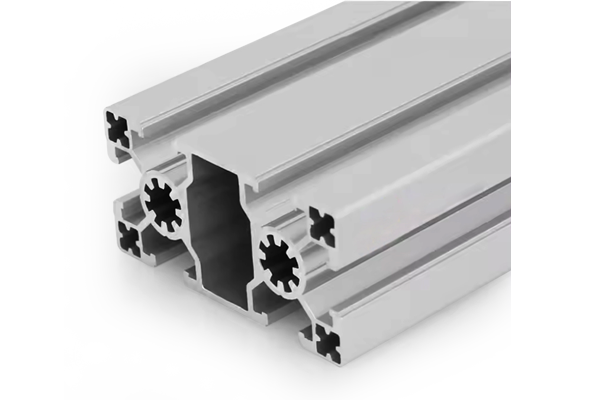
Aluminium Profile Truck Body Frame 50 x 100 mm for Dry Freight Boxes
50 x 100 mm six slot aluminium profile at about 5.40 kg/m for dry freight box body framing, with M8 and M10 slots, cut to a body cut list and available anodised for wet and salt exposure.
| Material | Aluminium |
|---|---|
| Alloy Grade | 6063-T5 |
| Temper | T5 |
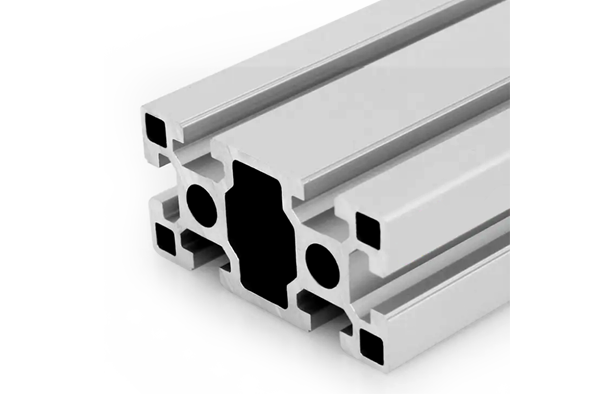
| Section Size | 50 x 100 mm, six slots |
| Slot | 6 x 10.2 mm groove, 8 mm mouth, 50 mm pitch, M8 and M10 hardware |
| Length | Cut to the body cut list to +/-0.5 mm |
| Tolerance | Cut length +/-0.5 mm, hole position +/-0.2 mm, section to EN 755-9 |
| Surface | Mill finish / clear anodised / black anodised; anodising recommended where the frame meets steel |
| MOQ | 200 m, or one body set, whichever is greater |
| Lead Time | 2 to 3 weeks for mill finish, plus about a week for anodising |
| Loading Port | Shanghai / Ningbo |
| Supply Ability | Extrusion and cut-to-list supply for body builders, with bay kits packed for assembly |
| Payment Terms | T/T 30% deposit + 70% before shipment | L/C at sight |
| Trade Terms | FOB | CIF | EXW |
| Certifications | Material certificate to EN 10204 3.1 on request, dimensional report, RoHS and REACH declarations |
01Why is a vehicle frame a different problem from a factory frame?
Because it moves, it gets wet, and it is bolted to steel. A 50 x 100 mm aluminium profile used for dry freight box body framing at about 5.40 kg/m replaces roughly 15.7 kg/m of steel for the same envelope, and that weight saving is the whole reason the material is used. The price of it is three failure modes that do not exist on a machine frame standing on a factory floor: vibration loosening, galvanic corrosion, and thermal movement over a 6 m length.
| Failure mode | Where it starts | What it looks like after two years |
|---|---|---|
| Vibration loosening | Slot nuts and bolted joints | Fasteners at less than torque, panels drumming, joints fretting |
| Galvanic corrosion | Any aluminium-to-steel contact, especially wet | White or grey powder at the joint, pitting on the aluminium side |
| Thermal movement | Long members fixed at both ends | Bowed panels, cracked sealant, elongated holes at the fixings |
| Fretting | Two aluminium faces clamped and vibrating | Black oxide smudge, then a loose joint that will not re-tighten |
Notice that none of the four is a section problem. All four are interface problems, and they are solved by detailing rather than by choosing a heavier profile.
02How much does 6 m of aluminium actually move?
About 5.5 mm across a 40 K temperature swing. The arithmetic is short enough to do on the back of an envelope: aluminium expands at roughly 23.1 micrometre per metre per kelvin, so 6 m times 23.1e-6 times 40 K gives 5.5 mm.
- Expansion coefficient
- 23.1 micrometre / m / K
- Member length
- 6 m
- Temperature swing
- 40 K, a realistic day-to-night range in some climates
- Movement
- 6 x 23.1e-6 x 40 = 5.5 mm
- Steel comparison
- about 2.8 mm, roughly half
- Consequence
- one end of a long member must be free to slide
The number itself is not the problem; the problem is what happens if both ends are fixed. A 6 m member restrained at both ends develops a compressive stress as it warms, and the first visible symptom is not a buckled beam — it is panels bowing and sealant cracking, because the panel is the least stiff thing in the assembly and it takes the movement.
- Fix one end, slot the other. Use a slotted hole or a slot-mounted bracket that can slide, and tighten it enough to locate but not enough to clamp.
- Keep panel fixings in slotted or oversized holes so the panel can move with the frame rather than against it.
- Do not bond a long panel rigidly to a frame that is fixed at both ends. The bond line becomes the restraint, and it will fail in peel at the ends.
- Expect the movement to be seasonal. A body built in winter and first used in summer will show the effect immediately, which is why a winter build is a good test.
03Where does galvanic corrosion actually happen?
At every point where aluminium touches a more noble metal and there is an electrolyte. On a truck that means rain, road salt and wash water, and the electrolyte is present most of the time. Aluminium becomes the anode and corrodes, and the corrosion product is a white powder that grows and forces joints apart.
| Interface | Risk | Why | Mitigation |
|---|---|---|---|
| Aluminium to mild steel chassis | High | Large area of steel against a small aluminium area, and it is always wet | Isolate with a rubber or nylon pad, and seal the edge |
| Aluminium to galvanised steel | Moderate | Zinc is closer to aluminium than steel is, but it is consumed first | Isolate, and inspect the zinc layer at each service |
| Stainless steel fasteners | Low to moderate | Small area, but the crevice under the head holds water | Sealant under the head, or bonded washers |
| Zinc plated fasteners | Low | The zinc coating sacrifices itself | Accept it and replace at service, or move to stainless with isolation |
| Aluminium rivet with steel mandrel | High | The mandrel stays in the hole and is the corrosion site | Use a sealed or monobolt type rivet, not a plain blind rivet |
| Aluminium to timber deck | Moderate | Timber holds moisture against the metal | Drainage gap, and treat the timber |
The single most useful rule is do not let bare aluminium touch bare steel in a wet place. A nylon washer and a bead of sealant cost almost nothing and they remove the majority of the risk. Where a large area contact is unavoidable, the aluminium should be the coated side, and the coating should be intact — which is an argument for anodising the frame rather than leaving it mill finish.
There is a design decision hiding in that table. If the body is bolted to a steel chassis, the fasteners are the only electrical path between the two, and they will corrode. Either isolate deliberately and accept that there is no electrical bond, or bond deliberately with a proper earth strap and accept that the fasteners are not the bond. Doing neither is the common failure.
04Rivet, bolt or bond?
All three are used on aluminium bodies and they are good at different things. The choice usually comes down to whether the joint has to come apart.
Riveted
- Fast, and needs access from one side only
- The standard method for panel-to-frame on a box body
- Not removable — a riveted joint is a permanent joint
- Blind rivets with steel mandrels leave a corrosion site in every hole
- Use a sealed or structural rivet, not a plain blind rivet
Bolted with slot nuts
- Removable, and adjustable along the slot
- Needs a T-nut and a torque, so it is slower than riveting
- Loosens under vibration unless it is locked
- Re-usable, which matters for a repair or a re-body
- The right answer for the structural frame, and for anything that may be modified
Bonding sits between them: a structural adhesive gives a continuous joint, excellent fatigue behaviour and no holes to corrode, and it needs a properly prepared surface, a controlled bond line and a cure that is not rushed. It is the best joint for a panel and the worst joint for anything that has to be taken apart.
A practical combination used on many bodies: frame bolted with slot nuts, panels riveted or bonded to the frame. The frame stays adjustable and repairable, the panels get a continuous joint with no fasteners working loose.
05Why do slot nuts come loose on a vehicle?
Because a T-slot nut is located by friction on the slot flange, and vibration reduces friction. It is not a bad fastener, it is a fastener being used in a condition it was not designed for. On a machine frame the load is static and the nut is fine; on a vehicle the load reverses thousands of times an hour.
- Preload is the control. A bolt that is properly preloaded does not lose clamp load under vibration. A bolt that is snug does.
- Use a thread-locking compound on every structural joint, and specify the grade. This is the cheapest single measure available.
- Use serrated flange nuts or bonded washers where the joint can take them — the serrations bite into the slot flange and resist movement.
- Do not rely on a spring washer. They are widely used and they do not prevent loosening on a joint that is losing preload.
- Re-torque after the first journey. A new body settles, and the first re-torque is the one that catches most of it.
- Check the slot itself. A nut that has been sliding in a slot full of abrasive dust will not hold its position even when it is tight.
06What is repairable, and what is not?
This is where a bolted profile frame earns its cost, and it is worth raising at design stage because it decides the joint type.
- A bolted bay can be replaced. Undo the joints at the two ends of the damaged bay, lift it out, bolt in a new one. That is a repair that a workshop can do.
- A riveted bay cannot. It has to be drilled out, which means removing panels and often damaging the adjacent frame.
- A bonded bay cannot either, and the bond line has to be cut, which is slow and leaves adhesive on the frame that has to be removed before re-bonding.
- Design the frame in bays so that a repair is a bay, not a body. The joint pattern is a design decision that costs nothing at drawing stage.
07What to check before ordering
Box body framing checklist
- Body dimensions, and the span between cross members
- Payload, and whether the frame carries it or the deck does
- Chassis interface: how the body is fixed, and whether it is isolated
- Fasteners: type, grade, and whether they are isolated from the aluminium
- Rivet type, if panels are riveted — sealed or structural, not plain blind
- Bonding: adhesive type, surface preparation and bond line control
- Thermal movement: which end of each long member is free to slide
- Drainage: where water leaves the frame, and whether it sits in a slot
- Repairability: is the frame divided into replaceable bays
- Who approves the body structure, and to which regulation
08Questions from body builders
Related sections and categories
Browse 50 Series Aluminium Profiles, 45 Series Aluminium Profiles, Strut Profiles, or see the 50 x 100 mm six slot section for the full section data, and the 45 x 90 mm six slot heavy section for cross members.
Is aluminium profile strong enough for a truck body?
For a dry freight box body, yes, and it is about a third of the weight of the equivalent steel. The limiting factors are the chassis interface, the fastener detailing and vibration, not the section strength.
How much does a 50 x 100 aluminium profile weigh?
Approximately 5.40 kg/m, against roughly 15.7 kg/m for the same envelope in steel.
How much does an aluminium body frame move with temperature?
About 23.1 micrometre per metre per kelvin, so a 6 m member moves about 5.5 mm across a 40 K swing. One end of every long member has to be free to slide.
How do I stop galvanic corrosion between aluminium and the steel chassis?
Isolate the contact with a nylon or rubber pad and seal the edge. Also use sealed or bonded washers under stainless fasteners, and avoid plain blind rivets with steel mandrels.
Why do the slot nuts work loose?
Because they are located by friction on the slot flange, and vibration reduces friction. Proper preload plus a thread-locking compound is the control, not a spring washer.
Should the frame be riveted or bolted?
Bolt the frame so a damaged bay can be replaced, and rivet or bond the panels to the frame. A fully riveted frame cannot be repaired without drilling it apart.
What to send for a body framing quote
- Body drawing, or the overall dimensions and the cross member spacing
- Payload, and whether the frame or the deck carries it
- Chassis interface detail, and whether isolation is required
- Fastener specification, or the environment so we can recommend one
- Rivet or bond specification for the panels
- Cut list with lengths and quantities
- Finish: mill, anodised or coated, and whether cut ends need caps
- Whether the frame is divided into replaceable bays
- Quantity of bodies, and whether it is a one-off or a repeat build
Send the chassis interface detail with the enquiry. It is the part that decides whether the body corrodes at the mounting points in two years or in ten.
Send the body drawing
Overall dimensions, cross member spacing and the chassis interface detail are enough to quote a cut list. Tell us the finish and whether the frame is divided into replaceable bays.
Request a quotationRelated Products
 Solar Mounting Aluminium Rail 45 x 45 mm for PV Array Frames
45 x 45 mm four slot aluminium profile at about 2.55 kg/m, used as…
 45 x 180 mm Aluminium Extrusion for Typhoon-Zone Frames
45 × 180 mm aluminium extrusion in 6063-T5 for outdoor frames in the Philippine…
 Aluminium Profile for Sale: 45 x 60 mm Cut to Length, No Minimum Run
45 x 60 mm aluminium profile in 6063-T5, sold by the length or by…
 20 x 80 mm Narrow Aluminium Profile for Textile and Diamond Machinery
20 x 80 mm ten slot narrow aluminium profile in 6063-T5 for machinery where…
 45 x 180 mm Aluminium Extrusion: Arrival Inspection for Importers
45 × 180 mm aluminium extrusion in 6063-T5 for importers clearing at Nhava Sheva.…
 45 x 90 mm Aluminium Profile for Pharma Cleanroom Framing
45 x 90 mm aluminium extrusion in 6063-T5 for GMP cleanroom framing. Six 10.2…
 45 x 60 mm Aluminium Profile for Textile Machine Frames
45 x 60 mm four-slot aluminium extrusion in 6063-T5 for loom, winder and conveyor…
 Aluminium Company Profile: How a 90 x 90 mm Section Is Made and Inspected
90 x 90 mm eight-slot aluminium extrusion in 6063-T5 for machine bases, robot pedestals…
