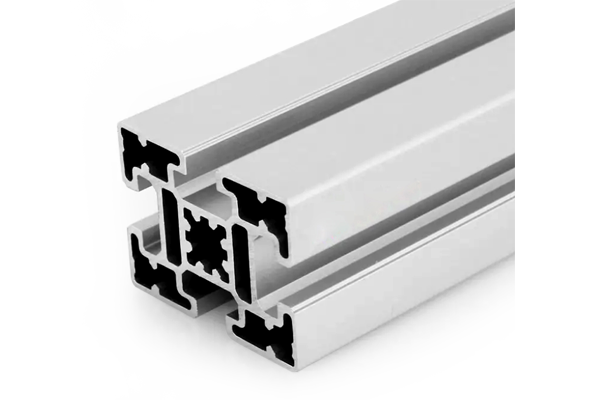
Aluminium Profile for Sale: 45 x 60 mm Cut to Length, No Minimum Run
45 x 60 mm aluminium profile in 6063-T5, sold by the length or by the metre with no production minimum. Available in a 10.2 mm slot with M8 or an 8 mm slot with M10, cut to your list and deburred.
| Material | Aluminium |
|---|---|
| Alloy Grade | 6063-T5 |
| Temper | T5 |
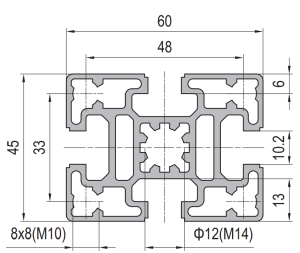
| Section Size | 45 x 60 mm, four slots, one per face |
| Slot | 10 x 10.2 mm groove with 10 mm mouth and M8, or 8 x 8 mm groove with M10 on a 33 mm pitch |
| Length | 6 m stock; cut to list to +/-0.5 mm; short cuts under 2.5 m for parcel shipping |
| Tolerance | EN 755-9, wall +/-0.15 mm; cut length +/-0.5 mm |
| Surface | Mill finish from stock; clear or black anodised on a rack-load basis |
| MOQ | One stock length. Anodised work is priced per rack load and may wait for a bath |
| Lead Time | Stock lengths ship in a few days; cut-to-list typically 5 to 10 working days; anodised 2 to 3 weeks |
| Loading Port | Shanghai / Ningbo |
| Supply Ability | Stock lengths held for small orders alongside 600 t per month extrusion |
| Payment Terms | T/T in advance for small orders | 30% deposit + 70% before shipment for production runs |
| Trade Terms | EXW | FOB | CIF |
| Certifications | Mill certificate per heat, RoHS and REACH declarations, coating report per lot when anodised |
01What actually sets a minimum order quantity?
Buyers assume MOQ comes from the extruder being difficult. It does not. There are three separate minimums behind a quoted MOQ, and they have nothing to do with each other. Knowing which one is binding tells you whether a small order is genuinely impossible or just inconvenient.
| Minimum | Where it comes from | Typical size | Can it be avoided? |
|---|---|---|---|
| Die amortisation | a new die has to be paid for by the first run | 300 to 1,000 kg on a new die | yes, if the section already exists |
| Press minimum run | below a certain weight the press cannot run economically | 200 to 500 kg per billet set | yes, by buying from stock |
| Anodising rack load | the bath is loaded by rack, not by your order | 150 to 400 m per colour per load | yes, by taking mill finish |
| Cutting and packing | setup time per cut list | effectively one bundle | no, but it is small |
A 45 x 60 mm section is a standard die that already exists, so the first minimum disappears entirely. That is the whole reason a single length is possible: you are not paying for a die, you are buying metal that was already extruded. The moment you ask for a colour you have not ordered before, the third minimum comes back — the anodising rack has to be filled with something, and if it is not your order it is somebody else’s.
02Are stock offcuts reliable enough to design around?
Stock offcuts are real, and they are also random. They exist because a previous order was cut from a 6 m length and 1.2 m was left over. That means the length you get depends on what somebody else ordered last month, and it changes week to week.
Treat offcuts as a way to get samples and prototypes, not as a supply plan. If your design needs 1,450 mm pieces, an offcut rack full of 900 to 1,300 mm pieces is useless to you, and no amount of asking will change that. The honest way to use them is: buy a couple of lengths to build the first article, confirm the slot and the connector fit, and then place a proper order for the production quantity.
If a supplier promises you a fixed length from stock every month, ask which length and for how many months. A stock commitment that is not written into a supply agreement is a hope, not a plan.
03Should the price be per length or per metre?
Both are quoted, and they are not equivalent. Per metre is the honest unit for comparison because it is independent of how the supplier happens to cut. Per length is what you actually receive, and it carries the cutting and handling cost.
The trap is comparing a per-metre price from one supplier against a per-length price from another. Convert both to price per metre of delivered, cut, deburred material before comparing. On small orders the cutting and packing can be 15 to 25 percent of the invoice, and it is the part that gets hidden when a quote is presented per metre with cutting listed separately at the bottom.
- Ask for the price per metre including cutting to your list, not per metre plus cutting.
- Ask whether deburring is included. Sawn ends have a burr that will cut you and will not sit flat against a connector.
- Ask what happens to the remnant — on a 6 m length cut into 1,450 mm pieces you get four pieces and a 200 mm offcut, and somebody has to decide who owns it.
04What are the three mistakes small buyers make most often?
- Mixing two slot systems in one frame. A 45 x 60 profile is sold with either a 10.2 mm slot taking M8 or an 8 mm slot taking M10, depending on which variant the supplier stocks. The T-nuts are not interchangeable, and the difference is not visible in a photo. Order connectors and profile from the same source, or measure the slot mouth with a caliper before you order anything else.
- Ordering anodised in small quantity and expecting a colour match later. Anodising colour depends on the alloy heat, the bath and the dwell time. Two small lots run weeks apart will differ slightly, and on a visible frame that difference is obvious. If the frame must match, order all of it at once and keep a retained sample.
- Under-ordering by one piece. Cutting always loses material at the saw and at the ends. On a cut list of 20 pieces at 1,450 mm from 6 m lengths you will get four per length, so five lengths give you exactly 20 with no margin for a bad cut. Order the sixth length. It costs less than a second setup.
Before you place a small order
- Measure the slot mouth on a sample with a caliper: 10.2 mm or 8 mm.
- Confirm the T-nut thread that goes with it: M8 for 10.2, M10 for 8 mm.
- Decide mill finish or anodised, and if anodised, whether the whole frame comes from one lot.
- Count pieces per 6 m length and add one spare length.
- Ask for the price per metre including cutting and deburring.
05Why are there two different 45 x 60 sections with the same part number?
This is worth stating plainly because it causes real ordering errors. Our own catalogue carries two 45 x 60 four-slot variants: one with a 10.2 mm slot and M8 T-nuts at about 2.8 kg/m, and one with an 8 mm slot and M10 T-nuts at about 3.3 kg/m. Both have been sold under the same part number prefix, which is a catalogue problem rather than a manufacturing one, and it is being cleaned up.
10.2 mm slot variant
- Slot mouth 10 mm, groove 10.2 mm
- Takes M8 T-nuts and M8 hammer nuts
- approx. 2.8 kg/m
- Matches the 45 series accessory range
- Better for mixed frames with 45 x 90
8 mm slot variant
- Slot mouth 8 mm, groove 8 x 8 mm
- Takes M10 slot nuts on a 33 mm pitch
- approx. 3.3 kg/m
- Heavier wall, higher bending capacity
- Better where the frame carries load, not just panels
Practical advice: order the profile and the connectors together and say which variant you need in writing. If you already have connectors in the stores, measure the slot they fit and order to that. Getting this wrong is a two-week delay, not a refund, because cut lengths cannot be returned.
06Where is the line between a parcel and a pallet?
Small orders fail on freight more often than on price. A 6 m length cannot go by normal courier, so anything over about 2.5 m moves to a freight forwarder and the cost jumps. The practical break points we see:
| Order size | How it usually ships | What to watch |
|---|---|---|
| 1 to 3 lengths, under 2.5 m | courier or LTL parcel | length surcharge; ask before ordering |
| Up to about 300 kg | LTL pallet | pallet must be over-length rated for 3 m |
| 300 kg to a container | 20 ft container, or LCL | LCL handling is where distortion happens |
| Over 10 t | 20 ft or 40 ft FCL | cradle the bundle, do not stack flat |
If you only need a few metres for a prototype, cut to under 2.5 m at our works rather than shipping a 6 m length. The cut costs almost nothing; the over-length freight surcharge does not.
Tell us the cut list and the slot you need
- 45 x 60 mm, 6063-T5, 10.2 mm slot with M8 or 8 mm slot with M10.
- Mill finish or anodised, clear or black.
- Single lengths, cut to list, deburred, packed for parcel or pallet.
Send a cut list with lengths and quantities. We will tell you how many 6 m lengths that consumes and what the remnant looks like.
Related sections and categories
Both slot variants sit under 45 Series Aluminium Profiles and Strut Profiles; the nuts that fit them are in Fastening Elements. Full section data is on 45 x 60 mm four slot strut profile.
Can I buy just one length?
Yes. The die already exists, so there is no tooling cost to amortise and a single stock length is a normal order.
Is there a minimum for anodised 45 x 60?
Yes, effectively. Anodising is priced per rack load, so a small coloured order waits for a bath to fill. Mill finish has no such minimum.
What is the difference between the two 45 x 60 variants?
Slot size and thread: 10.2 mm slot with M8 at about 2.8 kg/m, or 8 mm slot with M10 at about 3.3 kg/m. The T-nuts are not interchangeable.
Can you cut to under 2.5 m so it ships as a parcel?
Yes, and for prototypes we recommend it. Cutting is cheap, over-length freight is not.
How many pieces do I get from one 6 m length?
Depends on your cut and the saw kerf. Tell us the length and we will give the exact count per length including the remnant.
Do cut lengths come deburred?
On request, yes. Sawn ends have a burr that stops the profile sitting flat against a connector, so it is worth asking for.
Send a cut list, get a length count
Give us the lengths and quantities and we will tell you how many 6 m lengths it takes, what the remnant is, and the price per metre including cutting.
Request a quotationRelated Products
 45 x 180 mm Aluminium Extrusion: Arrival Inspection for Importers
45 × 180 mm aluminium extrusion in 6063-T5 for importers clearing at Nhava Sheva.…
 45 x 90 mm Aluminium Profile for Pharma Cleanroom Framing
45 x 90 mm aluminium extrusion in 6063-T5 for GMP cleanroom framing. Six 10.2…
 45 x 60 mm Aluminium Profile for Textile Machine Frames
45 x 60 mm four-slot aluminium extrusion in 6063-T5 for loom, winder and conveyor…
 Aluminium Company Profile: How a 90 x 90 mm Section Is Made and Inspected
90 x 90 mm eight-slot aluminium extrusion in 6063-T5 for machine bases, robot pedestals…
 45 x 90 mm Aluminium Profile: Stock Planning for Distributors
45 x 90 mm six-slot aluminium extrusion in 6063-T5 for distributor stock. 4.10 kg/m,…
 45 x 180 mm Aluminium Profile for Maghreb / EU-Bound Projects
45 × 180 mm aluminium extrusion in 6063-T5 for Maghreb fabricators feeding EU-bound projects.…
 45 x 180 mm Aluminium Profile for ESD-Safe Electronics Frames
45 × 180 mm aluminium extrusion in 6063-T5 for ESD-safe electronics frames sought by…
 45 x 180 mm Aluminium Extrusion vs Casting: Which One to Specify
45 × 180 mm aluminium extrusion in 6063-T5 as the worked example for extrusion…
