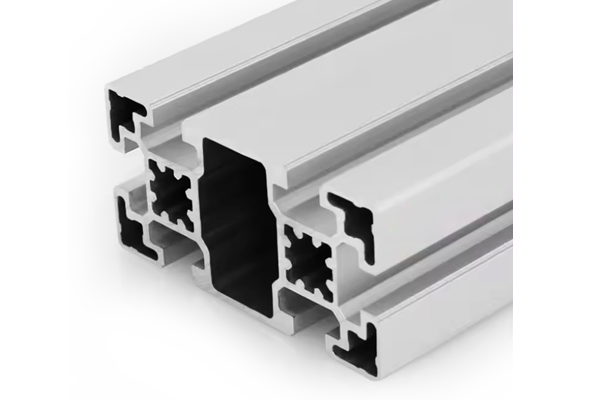
45 x 90 mm Aluminium Profile: Stock Planning for Distributors
45 x 90 mm six-slot aluminium extrusion in 6063-T5 for distributor stock. 4.10 kg/m, 6 m and 3 m lengths, M10 slot nuts, anodised in single rack loads so colour stays consistent between bundles.
| Material | Aluminium |
|---|---|
| Alloy Grade | 6063-T5 |
| Temper | T5 |
| Section Size | 45 x 90 mm, six slots |
| Slot | 6 x 10.2 mm groove, 10 mm mouth, 45 mm pitch, two per 90 mm face and one per 45 mm face, M10 |
| Length | 6 m and 3 m stock; 1.5 m and 2 m cut from 3 m to +/-0.5 mm |
| Tolerance | EN 755-9, wall +/-0.15 mm; straightness 1.5 mm per metre; twist 2 degrees |
| Surface | Mill finish, or anodised AA15 to EN ISO 7599; clear or black; single rack load per colour |
| MOQ | 500 m for a mixed container, 150 m for a single line |
| Lead Time | 20 to 28 days after deposit, plus 16 to 22 days ocean to Mundra or Nhava Sheva |
| Loading Port | Shanghai / Ningbo |
| Supply Ability | 600 t per month extrusion with in-house anodising |
| Payment Terms | T/T 30% deposit + 70% before shipment | L/C at sight |
| Trade Terms | FOB | CIF | DDP |
| Certifications | Mill certificate per heat, coating thickness and seal report per anodising lot, colour Delta E report against the retained sample |
01Which lengths should a distributor actually hold?
Three, and the split is decided by what a customer can cut down versus what they cannot join up. Hold 6 m as the master length, 3 m as the fast-moving length, and cut 1.5 m and 2 m from 3 m on demand rather than stocking them. A customer who needs 1.5 m will accept a 3 m length if the price is per metre; a customer who needs 6 m cannot use two 3 m lengths without a joint, and the joint is usually unacceptable.
The ratio that works in practice is roughly 55 percent 6 m and 45 percent 3 m by length, weighted further towards 3 m if your customers are fabricators with small vehicles and towards 6 m if they are project buyers. Review it every quarter against actual cut lengths, not against what customers said they wanted.
| Length | Role | Typical share | Cut from |
|---|---|---|---|
| 6 m | Master length for project and structural work | 50 to 60 percent | Supplied as is |
| 3 m | Fast moving, fits a small truck, cuts to 1.5 and 2 m | 35 to 45 percent | Supplied as is |
| 1.5 m | Sample and repair length | Under 5 percent | Cut from 3 m, not stocked |
| 2 m | Occasional | Under 5 percent | Cut from 3 m or 6 m, not stocked |
Every extra stocked length adds a SKU, a rack position and a shade-matching risk without adding coverage. Four lengths is the practical maximum for a distributor carrying more than one section; beyond that the working capital goes into variety rather than depth.
02Why does 45 x 90 cover more enquiries than any other single SKU?
Because it sits at the intersection of two slot systems. At 45 mm pitch with six 10.2 mm slots and M10 nuts, it takes the 45 series accessories directly, and its 90 mm face carries two slots at the same pitch, which lets it work as a beam in frames that were designed around a 90 mm module. Very few sections cross over like that.
It is also the smallest section in the range that carries a genuine two-slot face. A 45 x 60 gives you four slots total, one per face; the 45 x 90 gives six, with two on the wide face, which is what a panel or a rail needs.
- 4.10 kg/m, so a 6 m length is about 25 kg: one person can handle it, which matters for a distributor’s own labour.
- About 68 cm4 about the strong axis, enough for a 2.4 m span at normal panel loads.
- Takes M10 slot nuts, the same as the 45 x 180, so one accessory line covers both.
- Heavy wall version at 4.85 kg/m uses the same accessories, so a customer who upgrades does not have to change hardware.
03How do you fill a mixed container without wasting volume?
A 20 foot container holds about 28 cubic metres and around 20 to 24 tonnes of aluminium, whichever limit comes first. For extrusion bundles the volume limit almost always binds before the weight limit, because a bundle of hollow sections is mostly air. That is why the mix should be planned by bundle footprint, not by tonne.
The practical approach is to fix the number of bundles first, then allocate them across sections. A 6 m bundle of 45 x 90 in a timber cradle occupies roughly 0.5 m of container width, so a 20 foot box takes about four bundles across and four high, giving sixteen bundle positions. Allocate those sixteen before you think about tonnage.
| Line | Bundles | Approximate weight | Why |
|---|---|---|---|
| 45 x 90, 6 m | 6 | 6 to 7 t | The volume seller, takes the most positions |
| 45 x 90, 3 m | 4 | 4 to 5 t | Same section, shorter, fills the end space |
| 45 x 60, 6 m | 3 | 3 to 4 t | The step-down for customers who find 45 x 90 heavy |
| 40 x 40, 6 m | 2 | 2 to 3 t | Accessory-driven demand, high turnover |
| Accessories | 1 | 1 to 2 t | Nuts, bolts, brackets, in cartons on top of bundles |
Two practical constraints. Accessories go on top of the bundles, not in a separate pallet, or you lose a bundle position. And leave the last position partly empty rather than filling it with a slow-moving section: an under-filled position costs a little freight, an over-stocked slow mover costs working capital for a year.
04How do the payment term and the exchange rate set the price band?
A distributor’s margin is thin enough that the financing term moves it more than the unit price does. Two orders at the same FOB price, one on 30 days and one on 90 days, are not the same cost, and the difference is usually larger than the discount a supplier will give for a slightly bigger quantity.
Work the band from three inputs: the landed cost, the carrying cost of the payment term, and the currency exposure between order and arrival. For an order placed today and landing in seven weeks, a two percent move in the exchange rate is larger than most quantity discounts.
30 percent deposit, 70 before shipment
- Lower supplier risk, so a better unit price
- You carry the balance for the transit period
- Currency exposure from order to payment is short
- Best when you have confirmed orders in hand
Letter of credit at sight
- Higher unit price, plus bank charges
- Supplier risk sits with the banks
- Currency exposure can be fixed at opening
- Best when you are stocking speculatively
05How do you write a batch colour clause a supplier can actually meet?
Most colour disputes come from a clause that says “uniform colour” without saying against what, over what area, and under what light. A supplier cannot meet that, so they accept it and then argue about it later. A clause that can be met names four things: the reference, the measurement condition, the acceptance limit and the remedy.
- The reference. A retained physical sample, signed and dated by both sides, held by each. Not a colour code, because an anodised finish is not a paint colour and does not have a Pantone equivalent.
- The measurement condition. Daylight, north facing, or a defined light box at 6500 K. Never under sodium or mixed lighting, which is where most disputes are born.
- The acceptance limit. For clear anodising, a Delta E of about 1.5 between batches is a workable limit; for black, 1.0. State whether the comparison is batch to batch or batch to the retained sample.
- The remedy. Replacement of the affected bundles, or a credit, and the time limit for raising it. Without a remedy the clause is a statement of intent.
There is one cause of shade variation that no clause can fix: two different anodising racks. The film thickness varies with position on the rack, and a thicker film reads darker. The only control is to require the whole order to be anodised in one rack load, which caps the quantity per colour and has to be planned into the order, not negotiated after it.
06What five numbers should be on the enquiry?
A distributor’s enquiry is a stocking decision, so the numbers are about coverage and cash, not about one project.
- Length mix
- the 6 m and 3 m split, and whether you want 1.5 m cut or supplied
- Sections and ratio
- how the bundles split across 45 x 90, 45 x 60 and 40 x 40
- Finish
- mill finish for stock, AA15 anodised for the lines that sell anodised
- Payment term
- 30/70 or letter of credit, because it changes the landed cost
- Repeat schedule
- one container or four a year, which changes the die and press planning
- Colour clause
- the reference sample and the Delta E limit, stated at enquiry
Send the length mix and the bundle allocation
- 45 x 90 mm, 6063-T5, six 10.2 mm slots, 4.10 kg/m
- Six bundles at 6 m and four at 3 m
- Mill finish for stock, plus two bundles AA15 anodised clear
- One anodising rack load per colour, stated on the order
- Retained sample to be signed before production
Ask for the whole anodised quantity to be run in one rack load. It is the only control that actually prevents shade variation between bundles, and it is much easier to agree before the order than after the container arrives.
Related sections and categories
The 45 x 90 is listed with the rest of the range under 45 Series Aluminium Profiles. The 45 x 90 mm heavy wall version at 4.85 kg/m takes the same accessories, and the finish options are under anodised aluminium profiles.
What is the minimum order for a mixed container?
Around 500 m in total across two or three sections, which fills a 20 foot container to a sensible volume without leaving positions empty. A single line can be ordered from 150 m, but the freight per metre on a part container is poor, so most distributors combine lines rather than ordering one at a time.
Why is 45 x 90 the best single section to stock?
Because it covers the most enquiries per SKU. It has six 10.2 mm slots at 45 mm pitch with M10 nuts, so it takes the 45 series accessories directly, and its 90 mm face carries two slots, which lets it work as a beam where a 45 x 60 would be marginal. At 4.10 kg/m a 6 m length is about 25 kg, so one person can handle it in the yard.
How do I avoid shade differences between two shipments?
Three controls, in order of effectiveness. Run the whole quantity for one colour in a single anodising rack load, because film thickness varies with rack position and thicker film reads darker. Keep a signed retained sample with each party. And write an acceptance limit, about Delta E 1.5 for clear and 1.0 for black, with a stated remedy, rather than asking for uniform colour in general.
Is it cheaper to order one large container or several small ones?
One large order is cheaper per metre on the unit price, but the carrying cost of the stock and the shade risk between shipments often cancel the saving. For a distributor the usual answer is two or three containers a year on a repeat schedule, which keeps the die and press planning stable and lets each colour run in one rack load.
Can you hold stock for us and ship against a schedule?
We can hold produced material for a limited period against a deposit, and ship in agreed lots. What we cannot do is hold it indefinitely, because anodised stock sitting in a humid warehouse is a corrosion question, not just a space question. Tell us the schedule at enquiry and we will quote the storage terms with the material.
Send the length mix and the bundle allocation
Give us the sections, the 6 m and 3 m split and the number of containers per year. We will come back with a bundle plan that fills the box and an anodising schedule that keeps each colour to one rack load.
Request a quotationRelated Products
 45 x 180 mm Aluminium Profile for Maghreb / EU-Bound Projects
45 × 180 mm aluminium extrusion in 6063-T5 for Maghreb fabricators feeding EU-bound projects.…
 45 x 180 mm Aluminium Profile for ESD-Safe Electronics Frames
45 × 180 mm aluminium extrusion in 6063-T5 for ESD-safe electronics frames sought by…
 45 x 180 mm Aluminium Extrusion vs Casting: Which One to Specify
45 × 180 mm aluminium extrusion in 6063-T5 as the worked example for extrusion…
 30 x 120 mm Aluminium Profile for Heavy Equipment Frames
30 x 120 mm ten-slot aluminium extrusion in 6063-T5 for construction equipment guards, platform…
 90 x 90 mm Aluminium Profile Supply: Stock Planning and Lead Time
90 x 90 mm eight-slot aluminium extrusion in 6063-T5 for multi-site supply across Maharashtra.…
 50 x 50 mm Aluminium Profile for Precision and Aerospace Fixtures
50 x 50 mm four-slot aluminium extrusion in 6063-T5 for inspection and assembly fixtures.…
 45 x 60 mm Aluminium Profile Solutions for Windows and Facades
45 x 60 mm four-slot aluminium extrusion in 6063-T5 for shopfront, screen and facade…
 40 x 40 mm Light Aluminium Profile for Mining Equipment
40 x 40 mm four-slot aluminium extrusion in 6063-T5 from 1.30 kg/m, for guards…
