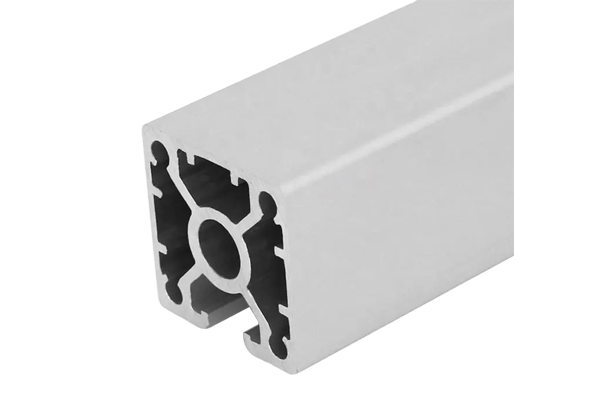
40 x 40 mm Light Aluminium Profile for Mining Equipment
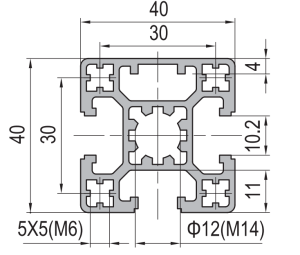
40 x 40 mm four-slot aluminium extrusion in 6063-T5 from 1.30 kg/m, for guards and light frames on mining equipment. AA20 anodised, with slot covers and isolating fixings for dust and washdown.
| Material | Aluminium |
|---|---|
| Alloy Grade | 6063-T5 |
| Temper | T5 |
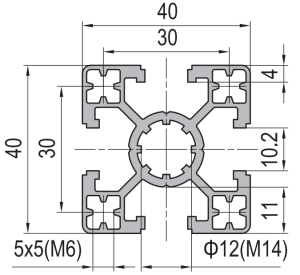
| Section Size | 40 x 40 mm, four slots |
| Slot | M6 slot, 6.2 mm mouth, four faces, 30 mm pitch |
| Length | 6 m stock; cut to frame list to +/-0.5 mm |
| Tolerance | EN 755-9, wall +/-0.15 mm; straightness 1.5 mm per metre; twist 2 degrees |
| Surface | Anodised AA20 to EN ISO 7599, sealed; clear or black |
| MOQ | 150 m |
| Lead Time | 20 to 30 days after deposit, plus 22 to 30 days ocean to Durban |
| Loading Port | Shanghai / Ningbo |
| Supply Ability | 600 t per month extrusion with in-house anodising |
| Payment Terms | T/T 30% deposit + 70% before shipment | L/C at sight |
| Trade Terms | FOB | CIF | DAP Durban |
| Certifications | Mill certificate per heat, coating thickness and seal report per lot, salt spray to EN ISO 9227 on request, RoHS and REACH declarations |
01What does an underground environment do that a workshop does not?
Three things, and only one of them is about load. The first is abrasive dust, which gets into every open profile in the first shift and does not come out. The second is impact, not from a designed load but from a rock, a bucket or a boot. The third is humidity, which in a deep mine is often close to saturation and stays there.
The structural consequence is that a frame designed for a calculated load is being asked the wrong question. It will not fail from the load. It will fail from a dent, a blocked slot, or a fixing that has corroded because water sat in it.
| Condition | Effect on the frame | Design response |
|---|---|---|
| Abrasive dust | Fills slots, jams nuts, abrades the anodic film | Slot covers, or orient slots downward |
| Saturated humidity | Water sits in slots and at fixings, pitting follows | Drain path, sealed fixings, AA20 minimum |
| Impact | Local deformation, bent members, cracked joints | Design for replacement, not resistance |
| Vibration | Preload loss at bolted joints | Hardened washers, re-torque schedule |
| Washdown | Detergent and water at pressure | Sealed film, stainless or isolated fixings |
02Where does the 1.30 kg/m mass saving actually pay?
Not on a fixed guard. On a fixed frame the difference between 1.30 and 2.35 kg/m is about 6 kg over 6 m, and nobody notices 6 kg. The saving pays when the frame is on a moving part, because mass there is multiplied twice: once by the acceleration to move it, and again by the structure upstream that has to carry it.
A guard on a boom is the clear case. Every kilogram on the boom is a kilogram the boom hydraulics accelerate, and often a kilogram the boom section has to be sized for. Cutting the guard from 2.35 to 1.30 kg/m can take 6 kg off the end of an arm, which is worth more than 6 kg at the pivot.
- On a fixed frame, choose the section for stiffness and ignore the mass.
- On a moving part, choose the thinnest wall that meets the stiffness and impact requirement, then check the impact case separately.
- Remember that a thinner wall deforms earlier under impact. On a moving guard that is often acceptable because the guard is a consumable.
- Do not go to the thin wall for a member that carries another member. The saving is small and the stiffness loss is not.
03What happens to dust in an open slot?
It fills, it compacts, and then it holds water. A 10.2 mm groove with an 8 mm mouth will take a remarkable amount of fine dust in a single shift, and once compacted it does not drain. The result is a slot that no longer accepts a nut, and a pocket of moisture against the anodic film for the life of the frame.
Three practical responses, in order of cost. Orient the slots downward or sideways so dust falls out rather than in. Fit slot covers, which are cheap and removable. Or use the slot only where a fixing is needed and leave the rest covered, rather than treating the whole length as available.
Dust and water checklist for a mining frame
- Slots oriented downward or horizontally, never upward.
- Slot covers on any exposed upward run longer than a few hundred millimetres.
- A drain path at the lowest point of every closed member, so water cannot be trapped.
- Sealed or isolated fixings at every stainless-to-aluminium contact.
- AA20 anodising minimum, and a washdown routine that does not use hypochlorite.
04Why design the frame to deform rather than to resist?
Because the alternative is repairing it in place, and underground repair is the most expensive maintenance there is. A guard that dents and can be unbolted and replaced in twenty minutes costs far less over a mine’s life than a guard that resists the impact and transfers the load into the machine structure.
This is the argument for bolted extrusion over welded steel in this application, and it is a maintenance argument rather than a strength one. The bolted frame is a set of replaceable members; the welded frame is one object that has to be cut and re-welded.
Bolted extrusion guard
- Members replaceable individually
- Deforms locally, then is unbolted
- No hot work underground
- Reconfigurable when the machine changes
Welded steel guard
- One object, repair means cutting and re-welding
- Transfers impact into the parent structure
- Hot work permit required underground
- Cheaper per kilogram at first purchase
05Is aluminium actually a problem underground?
The common claim is that aluminium sparks when struck, and that is mostly a myth in the form people repeat it: the sparking in the well-known demonstrations comes from a thermite reaction with rust particles, not from aluminium against steel alone. But the myth has produced real rules, and in coal mining some operations restrict aluminium components in defined zones for impact and friction ignition reasons.
So the honest position is not “aluminium is safe” or “aluminium is banned”. It is: check the mine’s own standard before specifying. For hard rock gold and platinum operations the concern is usually abrasion and corrosion rather than ignition, and aluminium guards are common. For coal, ask first.
This is a specification question, not a materials argument. A supplier who tells you aluminium is universally accepted underground has not read the mine’s standard, and a supplier who tells you it is universally banned has not read it either.
06What five numbers should be on the enquiry?
For a mining application the environment is part of the specification, so the numbers include where the frame goes.
- Mine type and zone
- coal or hard rock, and whether the zone restricts aluminium
- Fixed or moving
- which decides whether the thin wall is worth having
- Impact exposure
- what hits it and how often, because it sets the replacement strategy
- Washdown and chemistry
- what the frame is cleaned with, because hypochlorite changes the finish
- Span and load
- the structural check, which still has to be done
- Section
- 40 x 40 mm at 1.30 to 2.35 kg/m, or 40 x 80 at 3.60 kg/m for loaded guards
Send the mine standard and the impact exposure
- 40 x 40 mm, 6063-T5, four 6.2 mm slots, 1.30 kg/m
- 180 m cut to the frame list, slot covers supplied separately
- AA20 anodised, clear
- Isolating washers and sleeves with the fixings
- Mine standard reference attached for the aluminium restriction check
Send the mine’s standard with the enquiry. Whether aluminium is acceptable in the zone you are working in is decided by that document, not by the material data sheet, and it is much cheaper to settle before the order than at the gate.
Related sections and categories
The 40 x 40 is listed under 40 Series Aluminium Profiles, and the heavier 40 x 80 mm section at 3.60 kg/m is the step up for a loaded guard. The full range is compared on the 40 mm profile range page.
Is aluminium allowed underground in South African mines?
It depends on the mine and the zone. Hard rock gold and platinum operations commonly use aluminium guards and frames, and the concerns there are abrasion and corrosion. Some coal operations restrict aluminium components in defined zones for impact and friction ignition reasons. Check the mine’s own standard before specifying; it is a specification question rather than a materials one.
Does the 1.30 kg/m version save enough weight to matter?
On a fixed frame, no: 6 kg over 6 m is not worth the stiffness loss. On a moving part it does, because mass there is multiplied by the acceleration and by the structure upstream that carries it. A guard on a boom is the case where the thin wall pays for itself.
How do I stop dust filling the slots?
Orient slots downward or horizontally so dust falls out rather than in, fit slot covers on exposed upward runs, and use the slot only where a fixing is actually needed. A compacted slot holds water against the film, which is where the pitting starts.
Should the guard be welded or bolted?
Bolted, for maintenance reasons rather than strength. A bolted extrusion guard is a set of replaceable members that can be swapped in twenty minutes; a welded guard has to be cut and re-welded, which needs a hot work permit underground and takes the machine out of service.
What coating for a washdown environment?
AA20 minimum, and check what the frame is washed with. Hypochlorite attacks the anodic film, so if the mine uses it for disinfection, either restrict it away from the frame or accept a shorter service life. Ask for the seal test as well as the thickness.
Send the mine standard and the impact exposure
Tell us the mine type, whether the frame is fixed or moving, and what hits it. We will come back with the wall thickness, the slot cover arrangement and the fixing isolation for the washdown chemistry.
Request a quotationRelated Products
 Custom 45 x 90 mm Aluminium Extrusion: Dies, Tooling and Lead Time
45 x 90 mm six-slot aluminium extrusion in 6063-T5 from a China plant. 4.10…
 T-Slot Reducing Profile
Reducing insert that narrows a wide T-slot to accept standard nuts and accessories from…
 Joining Plate PG40-4040
Joining plate sized for two 40 × 40 mm profiles meeting at 90°, the…
 Strut Aluminium Profile 40×40 mm 4-Slot T-Slot Extrusion Machine Frame
40 x 40 mm four-slot T-slot strut aluminium profile in 6063-T5 with M6 slots…
 Strut Aluminium Profile 20×40 mm 2-Slot T-Slot Extrusion for Light Frames
20 x 40 mm two-slot T-slot strut aluminium profile in 6063-T5 with two M6…
 Strut Aluminium Profile 30×30 mm 4-Slot Light T-Slot Extrusion
30 x 30 mm light-wall four-slot T-slot strut aluminium profile in 6063-T5 with M5…
 Strut Aluminium Profile 30×120 mm 3-Slot Wide Beam T-Slot Extrusion
30 x 120 mm three-slot wide-beam T-slot strut aluminium profile in 6063-T5 with three…
 Strut Aluminium Profile 40×40 mm 3-Slot T-Slot Extrusion Closed Face
40 x 40 mm three-slot T-slot strut aluminium profile in 6063-T5 with one solid…
