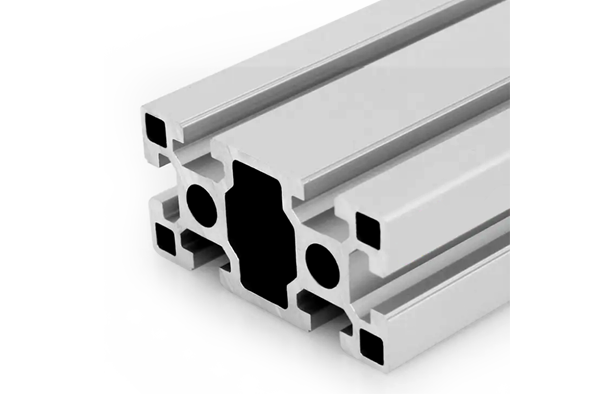
Custom 45 x 90 mm Aluminium Extrusion: Dies, Tooling and Lead Time
45 x 90 mm six-slot aluminium extrusion in 6063-T5 from a China plant. 4.10 kg/m, extrusion ratio about 12 on a 6 inch billet, supplied on a customer-owned die with a trial report and ISPM 15 packing.
| Material | Aluminium |
|---|---|
| Alloy Grade | 6063-T5 |
| Temper | T5 |
| Section Size | 45 x 90 mm, six slots |
| Slot | 6 x 10.2 mm groove, 10 mm mouth, 45 mm pitch, two per 90 mm face and one per 45 mm face, M10 |
| Length | 6 m stock; cut to list to +/-0.5 mm |
| Tolerance | EN 755-9, wall +/-0.15 mm; straightness 1.5 mm per metre; twist 2 degrees |
| Surface | Mill finish, or anodised AA15 / AA20 to EN ISO 7599; clear or black |
| MOQ | 150 m off an existing die, 500 m with a new die |
| Lead Time | 30 to 40 days to load with a new die and anodising, 12 to 20 days on an existing die and mill finish, plus 18 to 26 days ocean |
| Loading Port | Shanghai / Ningbo |
| Supply Ability | 600 t per month extrusion with in-house anodising |
| Payment Terms | T/T 30% deposit + 70% before shipment | L/C at sight |
| Trade Terms | FOB | CIF | DAP | DDP |
| Certifications | Mill certificate per heat, trial report with measured dimensions, coating report per lot, ISPM 15 mark on timber, RoHS and REACH |
01How does the timeline from enquiry to arrival actually break down?
Five stages, and only one of them is the sailing. Quoting a single number hides which stage is the constraint, which is why delivery arguments usually start at the end of the chain when the real delay was at the beginning.
| Stage | Duration | What sets the floor |
|---|---|---|
| Drawing review and die design | 2 to 5 days | How complete the drawing is, and whether the section is feasible |
| Die making | 7 to 12 days | Die shop queue and the number of trial corrections |
| Trial and approval | 2 to 5 days | Whether the first trial needs a correction |
| Production run | 5 to 8 days | Press schedule; small lots wait for a slot |
| Anodising, if required | 5 to 8 days | Rack load size and colour change schedule |
| Packing and inland | 2 to 4 days | Cradle build and container booking |
| Ocean freight | 18 to 26 days | Sailing frequency, not distance |
So a mill finish order on an existing die is roughly 12 to 20 days to load, and an anodised order on a new die is roughly 30 to 40. The difference between those two numbers is almost entirely the die, which is why the die question comes before the price question.
02What does the die cost, who owns it, and is it refundable?
For a section in this size range, a solid die is 1,500 to 4,000 USD depending on the number of cavities, the complexity and whether a special bolster is needed. A hollow die for a multi-cavity section sits at the top of that range. The number itself is not the interesting part; the ownership and the refund terms are.
Three arrangements are common. The die is charged and owned by the customer, which is the cleanest for the buyer. The die is charged and owned by the supplier, which usually means a lower price per metre and no die refund if you move. Or the die is free against a committed volume, which means it is amortised into the price and you pay for it either way.
Customer-owned die
- You pay the 1,500 to 4,000 USD up front
- The die can be moved to another extruder
- Die maintenance history is yours to request
- Best if the section is a long-term product
Supplier-owned die
- Lower up front cost, sometimes no die charge
- The die stays with the supplier
- Moving supplier means paying again
- Best for a trial or a short run
Two things to put in writing. Who holds the die, and whether it can be collected if the relationship ends. And whether the die is refundable against volume, because a refund clause that requires 50 tonnes is not a refund for most buyers.
03What extrusion ratio and press does a 45 x 90 need?
The profile area is about 1,520 square millimetres at 4.10 kg/m and a density of 2.70. The extrusion ratio is the billet area divided by the profile area, and for 6063 a ratio of 10 to 40 is normal, with lower ratios easier to run and higher ratios producing better mechanical properties but harder surfaces.
| Billet size | Billet area | Extrusion ratio | Comment |
|---|---|---|---|
| 5 inch, 127 mm | 12,670 mm2 | About 8.3 | Easy to run, lower properties |
| 6 inch, 152 mm | 18,150 mm2 | About 11.9 | The usual choice for this section |
| 7 inch, 178 mm | 24,880 mm2 | About 16.4 | Higher properties, needs more press |
The practical consequence is that a 45 x 90 is not a demanding section. It runs comfortably on a 5 or 6 inch press at around 800 to 1,100 tonnes, which means most established plants can make it and the competition is on consistency rather than capability. That is worth knowing when a supplier quotes a premium for complexity.
A low extrusion ratio is not automatically better. At a ratio of 8 the material is worked less, the mechanical properties are lower and the surface can be rougher after etching. If the section is structural rather than decorative, a ratio nearer 12 is the better target.
04What happens to the trial material?
A new die typically needs two to four trials, each consuming one to three billets. That is several hundred kilograms of material that is dimensionally wrong in some way, and where it goes is a commercial question that is rarely discussed until the invoice.
The usual positions are: the supplier absorbs it, the buyer pays for it at scrap value, or the buyer pays full price. The middle option is normal and fair. What is not acceptable is trial material being shipped as production, which happens when the trial correction was cosmetic rather than dimensional. Ask for the trial report, which should state the measured dimensions against the drawing.
- Ask how many trials the die quote includes, and what happens after that.
- Ask for the trial report with measured dimensions, not a photograph.
- Ask whether trial material is charged, and at what rate.
- Ask for a sample length from the approved trial before the production run starts.
05What does export packing involve, and where does risk pass?
Timber packaging for export must meet ISPM 15, which means heat treated or fumigated timber carrying the IPPC mark. Plywood cases are exempt because the manufacturing process removes the pest risk, which is why a plywood case is often simpler than a timber cradle for cut lengths.
For 6 m lengths a timber cradle is normal, and it needs the IPPC mark on every piece of solid timber. A cradle that fails the mark gets refused at the destination, and the cost of that is a returned container rather than a delay.
| Term | Risk passes | Who arranges freight | What it means for you |
|---|---|---|---|
| EXW | At the factory | Buyer | You carry everything from the loading bay |
| FOB | When loaded on the vessel | Buyer | You carry the ocean risk, and you insure it |
| CIF | When loaded on the vessel | Seller | Seller arranges freight, but risk is still yours |
| DAP | At the named destination | Seller | Seller carries transit risk to your site |
| DDP | At the destination, duty paid | Seller | Seller carries everything including duty |
The point most buyers miss is CIF. It reads like the seller is responsible for the freight, and they are, but the risk still passes at the load port. So a container damaged on the water under CIF is the buyer’s insurance claim, not the seller’s problem.
06What should a factory audit look at?
Four documents, and none of them is about the size of the building.
Four documents worth more than a factory tour
- The die number and its maintenance record, showing metres run and the last rework.
- Furnace charts for the ageing ovens over the last three months, with actual ramp and hold.
- Anodising seal test results per lot, not a generic certificate of conformity.
- A rejected lot report with the defect, the cause and the corrective action.
07What five numbers should be on the enquiry?
For a first order the die is the biggest single line, so the enquiry should make the die decision easy.
- Section and alloy
- 45 x 90 mm six slot, 6063-T5, 4.10 kg/m, or a drawing for a new die
- Total length and cut list
- how the metres split, because the saw and the cradle follow it
- Finish
- mill, AA15 or AA20, and which face is visible
- Die arrangement
- customer owned or supplier owned, and the refund terms
- Delivery term and port
- FOB, CIF or DAP, and the destination port
- Trial material
- whether it is charged, and at what rate
Send the drawing and the die preference
- 45 x 90 mm, 6063-T5, six 10.2 mm slots, 4.10 kg/m
- 600 m cut into 3 m and 6 m lengths
- AA15 anodised, clear, visible face the 90 mm face
- Customer-owned die, refundable against 5 tonnes
- Trial report with measured dimensions before the production run
Settle the die ownership before the price. It is the one line on the quotation that decides whether you can move supplier later, and it is much easier to negotiate before the die exists than after.
Related sections and categories
The 45 x 90 is listed under 45 Series Aluminium Profiles, with the heavy wall version at 4.85 kg/m. For a new die, the extrusion against casting page covers when a die is worth cutting at all.
How much does a die for a 45 x 90 section cost?
Between 1,500 and 4,000 USD for a solid die, depending on the number of cavities and the complexity. A hollow die for a multi-cavity version sits at the top of that range. The more important question is ownership: a customer-owned die can be moved to another extruder, a supplier-owned one cannot, and the difference only matters when you want to leave.
How long does a first order take?
Thirty to forty days to load for an anodised order with a new die, made up of 2 to 5 days drawing review, 7 to 12 days die making, 2 to 5 days trial, 5 to 8 days production and 5 to 8 days anodising. Add 18 to 26 days of ocean freight. On an existing die and mill finish, the same order is 12 to 20 days to load.
Is a 45 x 90 a difficult section to extrude?
No. The profile area is about 1,520 square millimetres, so the extrusion ratio is around 8 on a 5 inch billet and around 12 on a 6 inch. That is well within the comfortable range for 6063, which means most established plants can make it and the competition is on consistency rather than capability.
What is ISPM 15 and does it apply to my packing?
It is the international standard for phytosanitary measures on wood packaging, and it requires solid timber to be heat treated or fumigated and marked with the IPPC stamp. Plywood cases are exempt because the manufacturing process removes the pest risk. A cradle without the mark can be refused at the destination.
Under CIF, who pays if the container is damaged at sea?
You do. Under CIF the seller arranges and pays the freight, but the risk passes to the buyer when the goods are loaded on the vessel. A container damaged on the water is the buyer’s insurance claim. If you want the seller to carry transit risk, the term is DAP or DDP, and the price reflects it.
Send the drawing and the die preference
Tell us whether the die is customer owned or supplier owned, the volume you can commit, and the delivery term. We will come back with the die cost, the trial plan and a lead time broken into stages rather than a single number.
Request a quotationRelated Products
 T-Slot Reducing Profile
Reducing insert that narrows a wide T-slot to accept standard nuts and accessories from…
 Joining Plate PG45-4545
Joining plate for two 45 × 45 mm profiles at 90°, sized to the…
 Strut Aluminium Profile 40×40 mm 4-Slot T-Slot Extrusion Machine Frame
40 x 40 mm four-slot T-slot strut aluminium profile in 6063-T5 with M6 slots…
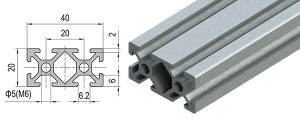 Strut Aluminium Profile 20×40 mm 2-Slot T-Slot Extrusion for Light Frames
20 x 40 mm two-slot T-slot strut aluminium profile in 6063-T5 with two M6…
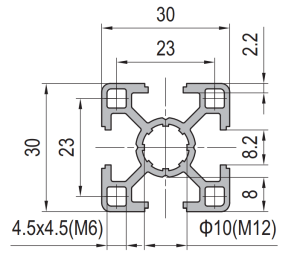 Strut Aluminium Profile 30×30 mm 4-Slot Light T-Slot Extrusion
30 x 30 mm light-wall four-slot T-slot strut aluminium profile in 6063-T5 with M5…
 Strut Aluminium Profile 30×120 mm 3-Slot Wide Beam T-Slot Extrusion
30 x 120 mm three-slot wide-beam T-slot strut aluminium profile in 6063-T5 with three…
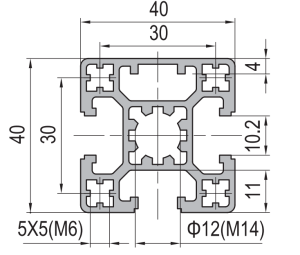 Strut Aluminium Profile 40×40 mm 3-Slot T-Slot Extrusion Closed Face
40 x 40 mm three-slot T-slot strut aluminium profile in 6063-T5 with one solid…
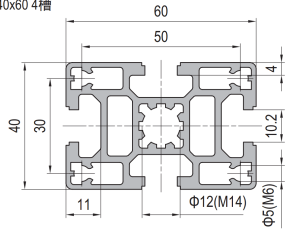 Strut Aluminium Profile 40×60 mm 4-Slot Rectangular T-Slot Extrusion
40 x 60 mm four-slot rectangular T-slot strut aluminium profile in 6063-T5 with M6…
