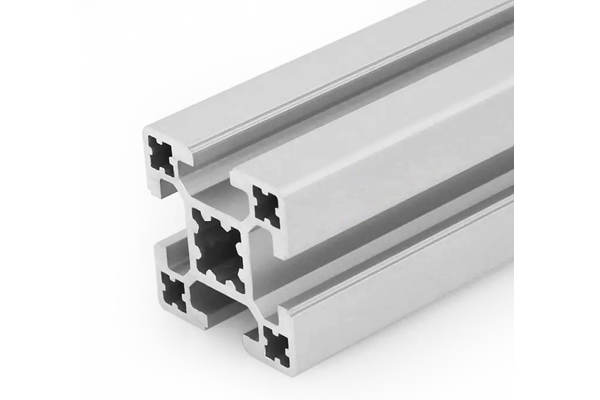
Aluminium 40 Series Extrusion 40 x 40 mm for PV Module Lines
40 x 40 mm aluminium 40 series extrusion for photovoltaic module lines. Four slots, M6, 1.30 to 2.35 kg/m, anodised for UV and wet exposure.
| Material | Aluminium |
|---|---|
| Alloy Grade | 6063-T5 |
| Temper | T5 |
| Section Size | 40 x 40 mm |
| Slot | M6 slot, 8 mm mouth, 4 faces, 30 mm pitch |
| Length | 6 m stock, cut to list to +/-0.5 mm |
| Tolerance | EN 755-9 / GB/T 6892, wall +/-0.15 mm |
| Surface | Mill finish / clear anodised / black anodised |
| MOQ | 500 m for mill finish; anodised orders priced per batch |
| Lead Time | 15 to 25 days after deposit for mill finish, longer for anodising |
| Loading Port | Shenzhen, Guangzhou, Ningbo |
| Supply Ability | Extrusion and machining of 40 series sections with anodising in house |
| Payment Terms | T/T 30 per cent deposit, balance against copy of bill of lading |
| Trade Terms | FOB, CIF, CFR, EXW |
| Certifications | Mill certificate to EN 10204 3.1 on request, RoHS and REACH declarations |
01What changes when the frame lives in a PV module line?
Four things, and none of them are about strength. A 40 x 40 mm aluminium 40 series extrusion at 1.30 to 2.35 kg/m is more than adequate structurally for a module line frame. What changes is that the frame now sits in a wet, chemically active, electrically sensitive, thermally cycling environment for a decade, and each of those four adjectives creates its own failure mode.
- Wet — condensation inside hollow profiles, and standing water in upward facing slots.
- Chemically active — deionised water, mild detergents and occasionally alkaline cleaners on an anodised surface.
- Electrically sensitive — an anodised layer is an insulator, so an anodised frame is not automatically bonded.
- Thermally cycling — daily expansion and contraction working every bolted joint loose over years, not weeks.
The rest of this page deals with those four in order. If you are building a dry, indoor, non-electrical frame out of the same section, most of it does not apply — and the standard frame guidance on the 40 x 40 four slot product page is the better starting point.
02Does UV degrade an anodised aluminium frame?
The oxide layer itself, no. Anodising is an inorganic oxide and it does not chalk, yellow or embrittle under UV the way a polymer coating does. That is the main reason anodised aluminium is preferred over powder coat on a line that sees daylight or strong UV from process lamps.
| Finish | Under long term UV | Under wet and chemical exposure | Verdict for a PV line |
|---|---|---|---|
| Clear anodised | Stable; no colour to fade | Stable to neutral and mild alkaline cleaning; attacked by strong alkali | The default |
| Black anodised | The oxide is stable but the dye fades to a bronze or grey | Same corrosion behaviour as clear | Only where colour is needed and fading is acceptable |
| Powder coated | Chalks and loses gloss; colour shift over years | Coating can lift at a scratch and then corrosion runs under it | Avoid on wet stations |
| Mill finish | Oxide bloom appears and grows | Stains quickly; looks neglected within months | Not suitable |
The one thing UV does affect on an anodised frame is anything attached to it: cable ties, plastic slot covers, adhesive labels and gaskets all degrade faster than the aluminium. Specify UV stabilised covers and ties, or plan to replace them on a schedule.
03What do PV line cleaning agents do to the frame?
Module lines use a narrow set of cleaning agents, and the frame is exposed to all of them as overspray and run-off. The list below covers what is normally found; the specific product should be checked against its working pH rather than its marketing description.
| Agent | Where it comes from | Effect on anodised aluminium | Practical guidance |
|---|---|---|---|
| Deionised water | Final rinse, glass cleaning | No chemical attack, but very aggressive on any bare aluminium because it has no buffering capacity | Keep cut faces and threads anodised or sealed; DI water finds every bare spot |
| Neutral detergent | General washing | None at working dilution | Suitable |
| Mild alkaline cleaner | Glass and frame washing | Slow attack at elevated temperature | Rinse and do not let it dry on the frame |
| Isopropyl alcohol | Wipe down, print heads | None | Suitable |
| Ammonia based glass cleaner | Glass | Attacks the oxide layer slowly | Avoid on the frame; use on glass only |
| Strong alkali | Floor and drain cleaning nearby | Rapid dissolution of the oxide layer | Keep away from the frame |
The deionised water row is the one people miss. DI water is chemically clean but it is hungry — it will dissolve aluminium from any unprotected surface it sits on, and it does it fastest at a cut face or a thread where there is no oxide layer. On a line that uses DI water as a final rinse, every cut face needs to be anodised, sealed, or kept out of the wet zone.
04Why is an anodised frame not automatically bonded?
Because the anodised layer is a dielectric. It is aluminium oxide, typically 10 to 15 micrometres thick, and it does not conduct. A multimeter probe touched onto an anodised surface will read open circuit, or a resistance that varies with probe pressure. So a frame assembled entirely from anodised profile with anodised brackets is a set of insulated parts that happen to be bolted together.
That matters on a PV line for two reasons: operator protection if a heater, drive or lamp fails and puts a conductor in contact with the frame, and static control around glass and polymer handling, where a floating frame becomes a charge store.
- Test criterion
- A commonly used acceptance figure is 0.1 ohm between the protective bonding terminal and any exposed conductive part — confirm against the standard your customer works to
- Problem
- Anodised interfaces read open circuit and fail the test
- Fix 1
- Serrated or toothed washers that bite through the anodised layer at each joint
- Fix 2
- A dedicated bonding stud with the anodising masked on assembly
- Fix 3
- Bare aluminium busbar or a separate conductor linking the frame sections
| Bonding mistake | What happens | Why it is easy to make |
|---|---|---|
| Relying on the bolt | Continuity passes when new, fails after a season | The bolt threads are also anodised; contact is through a few asperities that corrode |
| Bonding one point per frame section | The next section is floating | Every joint is an insulated interface, so each section needs its own path or a continuous conductor |
| Using a star washer on an anodised face without checking | Reads good on a meter, corrodes open in months | The bite is a small area and it is exactly where the cleaning agents collect |
| Testing with a low voltage meter | Passes, but the joint is not sound | A high resistance joint can still read low at low test current |
05How much deflection is acceptable when the line handles glass?
Much less than for a general machine frame. Glass is brittle, it does not yield, and it fails from a stress concentration rather than from a load. A rail that sags 3 mm under a module is not a problem for the rail — it is a problem for the module, which now sits on a curved support and carries a bending stress it was never designed for.
The practical rule is to set the deflection limit from the glass, not from the structure. A limit of span divided by 500 is a common starting point for a support rail under glass; for thin or large format modules, tighter. Then check the section against that limit rather than checking the stress.
| Span | Limit at span / 500 | Limit at span / 1000 | Comment |
|---|---|---|---|
| 1.0 m | 2.0 mm | 1.0 mm | Easily met by a 40 x 40 heavy |
| 1.5 m | 3.0 mm | 1.5 mm | Check the wall variant before choosing |
| 2.0 m | 4.0 mm | 2.0 mm | Usually needs a deeper section or a mid support |
| 2.5 m | 5.0 mm | 2.5 mm | A 40 x 40 is normally too flexible here |
Add a mid support before stepping up the section. Deflection falls with the cube of span, so halving the span is an eightfold improvement for the price of one bracket, while going up a section size is only a few times better for a lot more material.
06Where does condensation collect?
Inside the hollow profile, and in any slot that faces up. A hollow aluminium extrusion on a line that cycles between warm and cool is a chimney: moist air enters at one open end, condenses on the cool inner wall, and the water has nowhere to go. Over years it sits there and works on the inside surface, which is the one surface nobody inspects.
- Cap every open profile end. Plastic end caps are cheap and they close the chimney.
- Turn upward facing slots into covered slots, using a slot cover strip. An open slot is a gutter.
- Drill a weep hole at the low end of any run that cannot be capped, and deburr it.
- Do not seal a profile that already has water in it. Cap it dry, or the water stays in permanently.
- On a wet station, slope horizontal runs slightly so any water that does get in leaves by the weep hole rather than sitting.
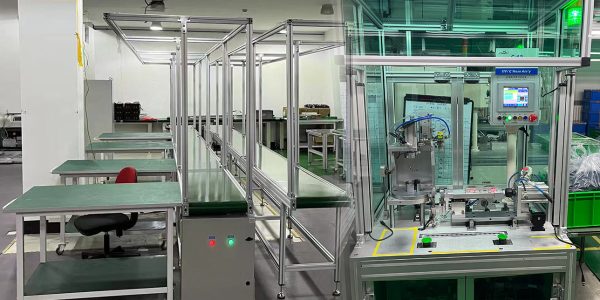
07What needs checking on a maintenance schedule?
Four items, and they are all things that degrade slowly and then fail suddenly.
PV line frame maintenance checklist
- Bonding continuity at each frame section, measured, not assumed
- Slot cover strips and end caps present and UV intact
- Fastener torque on joints that see thermal cycling
- Anodised surface at cut faces and threads, looking for pitting
- Weep holes clear and not blocked by swarf or sealant
- Any adhesive label or cable tie that has gone brittle
- Glass support rails checked for deflection under load, not just visually
The bonding check is the one that gets skipped, because it needs a meter and a record rather than a look. It is also the one that matters most, because a frame that was bonded when installed can become unbonded through corrosion at a single joint and nothing on the outside of the machine will show it.
08Questions from PV line and automation engineers
Related sections and categories
Browse 40 Series Aluminium Profiles, Strut Profiles, the 40 x 40 mm four slot section, or see the 40 x 40 mm three slot closed face section for the full section data.
Is anodised aluminium UV stable?
The oxide layer is, yes — it does not chalk or embrittle under UV. Black anodising is the exception in appearance only: the dye fades to bronze or grey, while the corrosion behaviour is unchanged.
How do you bond an anodised aluminium frame?
Through bare metal, not through the coating. Use serrated washers that bite through the anodised layer at each joint, or a dedicated bonding stud with the anodising masked, or a separate conductor linking the sections. An anodised interface reads open circuit on a meter.
Does deionised water damage aluminium?
Yes. DI water has no buffering capacity, so it dissolves aluminium from any unprotected surface, fastest at a cut face or a thread. Keep those anodised or sealed on a line that uses DI water as a final rinse.
What deflection limit should a glass support rail be designed to?
Set the limit from the glass, not the structure. Span divided by 500 is a common starting point, tighter for thin or large format modules. Add a mid support before stepping up the section, because deflection falls with the cube of span.
What weight is 40 x 40 four slot extrusion?
Between 1.30 and 2.35 kg/m depending on the wall, with an 8 mm slot mouth, M6 slot nuts and a 30 mm slot pitch on four faces.
What to send for a PV line frame quote
- Line layout with rail spans and the load on each rail
- Glass or module size and weight, and the deflection limit if there is one
- Cleaning agents used on the line, including the final rinse
- Whether the frame has to pass a bonding continuity test, and the criterion
- Wet or dry zone, so the drainage and capping detail can be specified
- Finish and whether cut faces need sealing
- Quantity in metres and number of complete frame sections
If the line has an existing frame with a problem, send a photo of the failed area. On a PV line the failure is almost always at an end, a joint or a bonding point — never in the middle of a span.
Send the line layout and the bonding requirement
Tell us the rail spans, the glass weight, the cleaning agents and whether the frame has to pass a continuity test. We will specify the wall variant, the drainage detail and the bonding points.
Request a quotationRelated Products
 Anodised Aluminium Profile 40 x 40 mm AA15 Clear Finish for Visible Frames
40 x 40 mm anodised aluminium profile in 6063-T5 with an AA15 clear anodised…
 CNC Machined Aluminium Profile 40 x 40 mm Drilled and Tapped Cut List
40 x 40 mm aluminium profile supplied CNC machined to a cut list: saw…
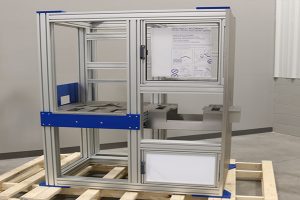 Aluminium Profile Hinge 40 Series 180 Degree for 8 mm Slot Guard Doors
180 degree hinge for 40 series aluminium profile guard doors. Two leaves clamp into…
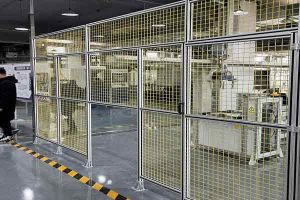 Aluminium Profile Sliding Door 40 Series 8 mm Slot for Machine Enclosures
Sliding door leaves framed in 40 series aluminium profile for machine enclosures. Top hung…
 Aluminium Lean Pipe Joint System 28 mm for Kaizen Cart Frames
28 mm lean pipe joint system in aluminium tube with a 1.0 mm wall,…
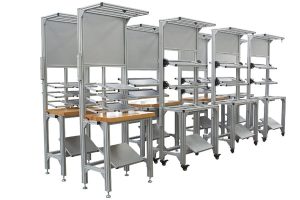 ESD Aluminium Profile Workbench 40 x 40 mm Anti-Static Assembly Frame
ESD workbench built on a 40 x 40 mm aluminium profile frame, supplied mill…
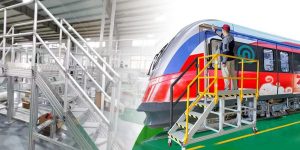 Aluminium Profile Stair Stringer 45 x 90 mm for Access Platforms
45 x 90 mm six slot heavy aluminium profile at about 4.85 kg/m, cut…
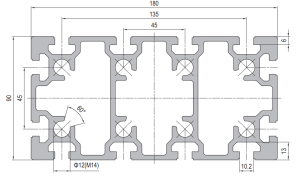 Aluminium Profile CNC Router Gantry 90 x 180 mm Twelve Slot Beam
90 x 180 mm twelve slot aluminium profile at about 9.50 kg/m for a…
