PG30 60×30 mm Six Slot Aluminium Strut Profile Rectangular T-Slot Extrusion for Cabinet Uprights
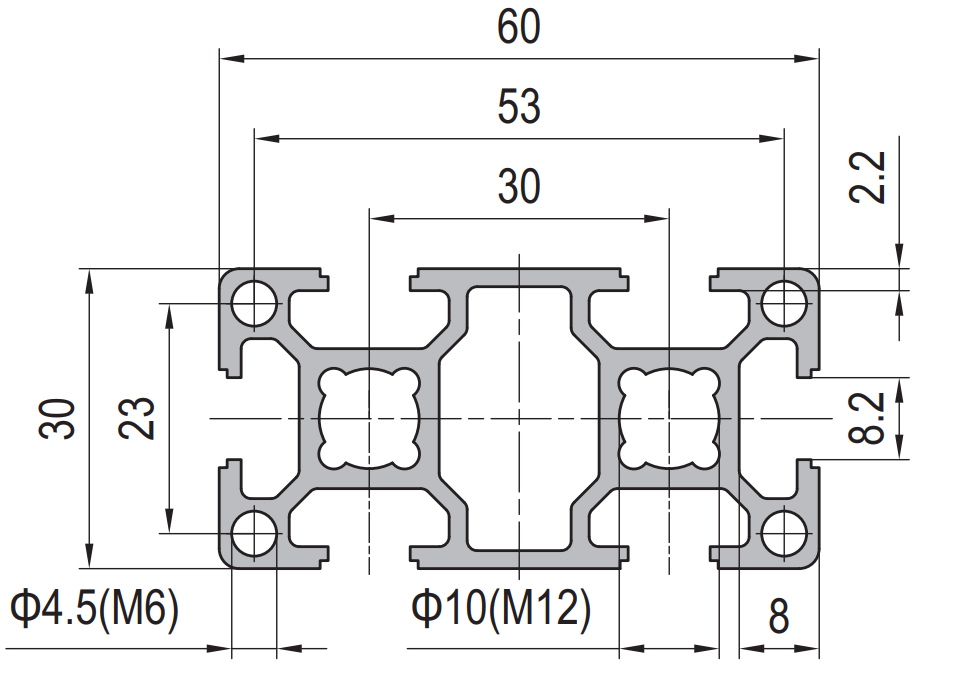
60 x 30 mm six slot PG30 rectangular aluminium strut profile in 6063-T5 with two 8.2 mm grooves per wide face on a 53 mm pitch. For cabinet uprights, wide rails and door frames.
| Material | Aluminium |
|---|---|
| Alloy Grade | 6063-T5 |
| Temper | T5 |
| Section Size | 60 x 30 mm |
| Slot | 6 x 8.2 mm groove, 6 mm mouth, 53 / 30 mm pitch, M8 |
| Length | 6 m stock, cut to drawing to +/-0.5 mm |
| Tolerance | EN 755-9 / GB/T 6892, wall +/-0.15 mm |
| Surface | Mill finish / clear anodised / black anodised |
| MOQ | 500 |
| Lead Time | 15-25 days after deposit for mill finish |
| Loading Port | Shanghai / Ningbo |
| Supply Ability | 600 t per month |
| Payment Terms | T/T 30% deposit + 70% before shipment | L/C at sight |
| Trade Terms | FOB | CIF | EXW |
| Certifications | ISO 9001:2015 | EN 755-9 | RoHS | REACH |
Structural framing · PG30 rectangular
A 60 x 30 mm six-slot strut profile is a rectangular aluminium extrusion, 60 mm wide and 30 mm deep, with six T-slots. There are two slots on each of the 60 mm faces on a 53 mm pitch, one slot on each 30 mm end face, and the two centre positions sit 30 mm apart. The groove is 8.2 mm with a 6 mm mouth, so it takes 30-series M8 hardware. The centre bore is Ø10 mm tapped M12, the corner holes are Ø4.5 mm tapped M6, and the wall is 2.2 mm at the flange and 8 mm through the web. We extrude it in 6063-T5 and supply it cut, drilled, tapped or machined.
The important thing about a 2:1 rectangle is that it is not a bigger version of a 30 x 30. It is a directional member: standing with the 60 mm dimension vertical it is roughly four times stiffer than the same section lying with the 30 mm dimension vertical. That makes it efficient where the load direction is known and wasteful where it is not — and it makes orientation a decision that has to be made on the drawing, exactly as it is on a flat beam.
A 2:1 rectangle is a beam that knows which way it bends
Put 60 mm of depth in the load direction and the material is spread far from the neutral axis, so the section is stiff. Turn it 90 degrees and the same material sits half as far out, so the section is roughly four times softer. The section does not care which way it is installed; the load does. So the first thing to settle on any drawing that uses a 60 x 30 is which face is vertical, and that decision then fixes where every fixing goes.
This is also why a 60 x 30 is often a better answer than a 30 x 30 where the available space is rectangular. A cabinet upright, a conveyor side rail, a machine guard post and a wide panel edge all have a tall, narrow space to fill, and a rectangle uses that space more efficiently than a square that has to be oversized to reach the same stiffness.
| Section | Stiffness on edge | Stiffness flat | Weight |
|---|---|---|---|
| 30 x 30, three slot | approx. 3.6 cm4 | approx. 3.6 cm4 | approx. 0.95 kg/m |
| 60 x 30, six slot | approx. 38 cm4 | approx. 9.5 cm4 | approx. 1.40 kg/m |
| 90 x 30, eight slot | approx. 120 cm4 | approx. 12 cm4 | approx. 1.90 kg/m |
The pattern in that table is the whole argument for rectangular sections: going from 30 x 30 to 60 x 30 roughly multiplies the on-edge stiffness by ten while the weight rises by less than half. Going on to 90 x 30 multiplies it again while the weight rises by about a third. Where the depth direction is free, a rectangle is almost always the lighter way to buy stiffness.
Why cabinet uprights want a wide face
An electrical cabinet or a control box is a frame with a door on one side and equipment on the others, and the uprights have to do three jobs at once: hold the cabinet square, carry the door, and provide mounting for everything inside. A 60 x 30 upright on edge does all three because it has a wide, flat, slotted face facing into the cabinet. That face is what makes the difference — it carries two rows of devices side by side without them competing for the same slot.
Cutting and machining the 60 x 30
A rectangular section behaves differently on the saw and on the mill from a square one, and two details are worth building into the drawing before the order goes out.
- Fix the orientation on the drawing and on the cut list Because the section is directional, a member cut to length is not interchangeable with the same member turned 90 degrees. Mark the orientation so the holes are put in the correct face.
- Watch the web when drilling the wide face The 2.2 mm flange is thin, so any hole in a wide face should be positioned in the slot or through the 8 mm web rather than through the flange between slots.
- Use the end-face slot for door and hinge fixings The 30 mm end faces each carry a slot, which is the natural place for hinge plates, corner brackets and connectors. It is also the face most often forgotten when the drawing is laid out.
- Allow for twist over long lengths A 60 x 30 upright over 2 m will twist slightly more than a square section of the same weight, because the rectangle is less resistant to torsion. Where the cabinet is tall, brace the frame at mid-height or specify a heavier wall.
Selection rule: if the load direction is known, use a rectangle on edge. If the load direction can change, or the member is also acting as a post in compression, a square section is the safer choice because it behaves the same way in both directions.
Frequently asked questions
Is 60 x 30 stiffer than 30 x 30?
On edge, roughly ten times stiffer in bending for about half again the weight. Laid flat it is only about two and a half times stiffer. That is the point of a rectangle: it buys stiffness in one direction only, and only if the orientation is right.
Can I use it as an upright post?
Yes, provided the compression load is applied along the member and the section is oriented with the 60 mm dimension facing the load. Where a post has to carry compression and may be loaded from any direction, a square section is safer.
How many slots does it have and where?
Six. Two on each 60 mm face on a 53 mm pitch, and one on each 30 mm end face. The two centre positions on the wide faces are 30 mm apart, which is what allows two rows of devices on one face.
What is the maximum span?
On edge and lightly loaded, up to about 2 m with an acceptable deflection. Where the member carries a door or equipment, keep the support centres under about 1.2 m and send us the load case for a check.
Do you supply it cut and drilled for a cabinet layout?
Yes. We cut to +/-0.5 mm, drill and tap to the cabinet layout, and can supply the uprights bagged by cabinet so the assembler is not sorting members on site.
Send the cabinet layout, get an upright schedule
Tell us the cabinet height, the door weight and what goes inside. We will confirm the orientation and the section, then quote cut lengths, drilling and FOB pricing.
Request a QuoteRelated Products
 PG30 90×30 mm Eight Slot Aluminium Strut Profile Wide Beam T-Slot Extrusion for Door Frames
90 x 30 mm eight slot PG30 wide beam aluminium strut profile in 6063-T5…
 PG30 90 x 15 mm Seven Slot Aluminium Strut Profile Narrow Multi Slot Rail
90 x 15 mm seven-slot aluminium strut profile with 8.2 mm grooves on a…
 PG30 60×60 mm Eight Slot Aluminium Strut Profile Heavy Duty T-Slot Extrusion for Robot Pedestals
60 x 60 mm eight slot PG30 heavy duty aluminium strut profile in 6063-T5…
 PG30 120 x 60 mm Twelve Slot Aluminium Strut Profile Heavy Frame Beam
A 120 x 60 mm twelve slot PG30 aluminium strut profile at about 5.20…
 PG40 40 x 40 mm Single Slot Aluminium Strut Profile Guide Rail Base
40 x 40 mm single-slot aluminium strut profile with one 10.2 mm groove on…
 PG40 40 x 40 mm Two Slot Type A Aluminium Strut Profile Guide Rail
40 x 40 mm Type A two slot asymmetric PG40 aluminium strut profile in…
 PG40 40 x 40 mm Two Slot Type B Aluminium Strut Profile Opposite Rail
40 x 40 mm Type B two-slot aluminium strut profile with two 10.2 mm…
 PG40 40 x 40 mm Four Slot Heavy Aluminium Strut Profile Standard Frame
40 x 40 mm heavy-wall four-slot aluminium strut profile with 10.2 mm grooves, 8…
