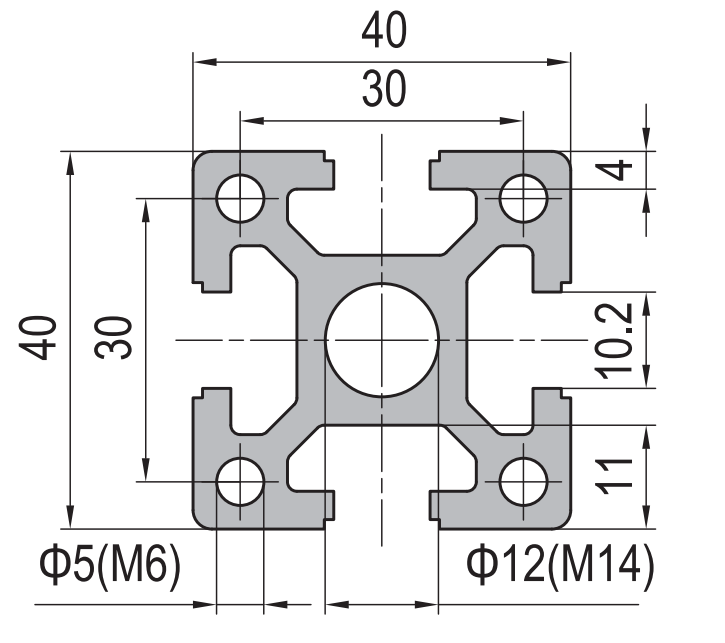
PG40 40 x 40 mm Four Slot Heavy Aluminium Strut Profile Standard Frame
40 x 40 mm heavy-wall four-slot aluminium strut profile with 10.2 mm grooves, 8 mm mouth, Phi12 mm bore and M8 accessories. The structural variant of the standard 40 x 40 four-slot, with I of about 8.6 cm4.
| Material | Aluminium |
|---|---|
| Alloy Grade | 6063-T5 |
| Temper | T5 |
| Section Size | 40 x 40 mm square, heavy-wall, four slots |
| Slot | 4 x 10.2 mm groove, 8 mm mouth, 30 mm pitch, one per face, M8 |
| Length | 6 m stock, cut to drawing to +/-0.5 mm |
| Tolerance | EN 755-9 / GB/T 6892, wall +/-0.15 mm |
| Surface | Mill finish / clear anodised / black anodised |
| MOQ | Made to order; small trial lengths available from stock offcuts |
| Lead Time | Typically 2 to 3 weeks for mill finish, about a week longer for anodising |
| Loading Port | Shanghai, Ningbo, Qingdao |
| Supply Ability | Extrusion capacity for standard and custom dies, with in-house cutting, machining and anodising |
| Payment Terms | T/T 30 per cent deposit, balance against copy of bill of lading; L/C at sight for larger orders |
| Trade Terms | FOB, CIF, CFR, EXW |
| Certifications | Mill certificate to EN 10204 3.1 on request, RoHS and REACH declarations |
01What is the 40 x 40 mm heavy-wall four-slot?
How is the heavy-wall different from the standard 40 x 40?
The standard 40 x 40 four-slot has a wall of about 3.0 mm and weighs about 1.49 kg/m. The heavy-wall variant increases the wall to about 3.5 mm and the weight to about 2.35 kg/m. That extra material goes into the outer faces and the slot lips, which raises the second moment of area from about 5.8 cm4 to about 8.6 cm4 — an increase of roughly 48 per cent in bending stiffness, for a 58 per cent increase in weight.
Why would you choose the heavy-wall over the standard?
When the frame carries real structural load — a machine base, a gantry, or a workbench that holds several hundred kilograms. The standard 40 x 40 is adequate for enclosures and light frames, but the heavy-wall is the one you want when the beam between two supports has to hold weight without sagging. The 48 per cent stiffness increase translates to about 30 per cent less deflection at the same span and load.
Is it compatible with the standard 40 series accessories?
Yes. The groove is the same 10.2 mm width, the mouth is the same 8 mm, and the slot pitch is the same 30 mm. The Phi12 mm centre bore is also the same. All M8 slot nuts, T-bolts, cover strips and hinges from the 40 series range fit without modification. The only difference is the wall thickness, which affects the weight and the pull-out force, not the accessory fit.
02Section data
| Item | Value | Note |
|---|---|---|
| Envelope | 40 x 40 mm square | same as standard 40 x 40 |
| Slots | 4 | 10.2 mm groove, 8 mm mouth, one per face |
| Slot pitch | 30 mm between centres | same as standard |
| Centre bore | Phi12 mm | tapped M14 |
| Wall | approx. 3.5 mm | heavy-wall variant, vs 3.0 mm standard |
| Weight | approx. 2.35 kg/m | vs 1.49 kg/m for the standard wall |
| I (second moment of area) | approx. 8.6 cm4 | vs 5.8 cm4 for standard |
| Alloy | 6063-T5 | EN AW-6063 |
| Standard | EN 755-9 / GB/T 6892 | wall tolerance +/-0.15 mm |
| Length | 6 m stock | cut to drawing to +/-0.5 mm |
The weight and second moment of area figures are for the heavy-wall variant. The standard-wall 40 x 40 four-slot is also available if the load does not justify the extra material. See the 40 series profiles page for the full range.
03Bending performance and allowable span
The heavy-wall 40 x 40 has a second moment of area of about 8.6 cm4, compared to 5.8 cm4 for the standard wall. That is a 48 per cent increase in stiffness, which translates to about 30 per cent less deflection at the same span and load.
| Span (mm) | Standard wall deflection at 100 N | Heavy wall deflection at 100 N | Improvement |
|---|---|---|---|
| 500 | 0.09 mm | 0.06 mm | -33 per cent |
| 750 | 0.31 mm | 0.21 mm | -32 per cent |
| 1000 | 0.37 mm | 0.25 mm | -32 per cent |
| 1500 | 1.25 mm | 0.85 mm | -32 per cent |
| 2000 | 3.0 mm | 2.0 mm | -33 per cent |
For a machine frame, the practical limit is a deflection of 0.5 mm over the span. The heavy-wall reaches that at about 1200 mm under a 100 N load, versus about 1000 mm for the standard wall. That extra 200 mm of span is the reason to choose the heavy-wall for structural frames.
04The M8 accessory ecosystem
The heavy-wall uses the same M8 accessory range as the standard 40 series: M8 slot nuts, M8 hammer head bolts, M8 T-bolts, cover strips, hinges and end caps. The groove is the same 10.2 mm width and the mouth is the same 8 mm. The only difference is that the slot pull-out force is higher on the heavy-wall, because the 3.5 mm wall gives the slot nut more engagement than the 3.0 mm standard wall.
| Fastener | Standard wall pull-out | Heavy wall pull-out | Improvement |
|---|---|---|---|
| M8 slot nut | approx. 1.5 kN | approx. 1.8 kN | +20 per cent |
| M8 T-bolt | approx. 1.5 kN | approx. 1.8 kN | +20 per cent |
| Through-bolt (M14) | full bolt rating | full bolt rating | same |
The pull-out improvement comes from the thicker wall at the slot lip. The heavy-wall gives the slot nut about 8.5 mm of effective engagement instead of 7 mm, which raises the pull-out force by about 20 per cent.
05When to move up from 40 heavy-wall to 45 series
The 40 series heavy-wall is close to the 45 series standard wall in stiffness (8.6 cm4 vs 7.7 cm4 — actually higher), and the weights are similar (2.35 kg/m vs 2.35 kg/m). So why would you ever move to 45? The answer is the fastener size.
| Criterion | 40 heavy-wall | 45 standard | Winner |
|---|---|---|---|
| I (cm4) | approx. 8.6 | approx. 7.7 | 40 HW |
| Weight (kg/m) | 2.35 | 2.35 | tie |
| Slot nut | M6/M8 | M8 only | 40 HW (more options) |
| Mouth | 8 mm | 10 mm | 45 (bigger) |
| Pull-out per M8 nut | approx. 1.8 kN | approx. 2.5 kN | 45 |
| Corner hole | M6 | M10 | 45 |
The 45 series wins on slot pull-out (the 10 mm mouth and thicker lip give the M8 nut more engagement) and on corner hole capacity (M10 vs M6 for levelling feet and anchors). If those are what your frame needs, move to 45. If it is just stiffness you need, the 40 heavy-wall is actually slightly better and costs less.
06Choosing between the heavy-wall and the standard-wall
Choose the heavy-wall
- The frame is a machine base or structural frame
- Members span more than 800 mm between supports
- The frame carries heavy panels, equipment or static load
- You need higher slot pull-out without going to 45 series
- The frame is fixed or semi-permanent and weight is not critical
Choose the standard-wall
- The frame is an enclosure or guard panel
- Members span under 800 mm with light load
- Weight matters: the standard is 1.49 kg/m vs 2.35 kg/m
- M6 fasteners are adequate for the joint loads
- Cost per metre is the primary driver
07Failure modes to design out
| What goes wrong | Why it happens | Design it out by |
|---|---|---|
| Frame is heavier than expected | the heavy-wall weighs 2.35 kg/m, 58 per cent more than standard | check the weight budget; use standard-wall for non-structural members |
| Deflection still too high at long span | even 8.6 cm4 has limits; 2 m is not 1 m | add an intermediate support or move to 45 or 60 series for spans over 1.2 m |
| Standard and heavy-wall sections mixed in one frame | they look identical but have different weights and stiffness | specify one wall variant per frame on the BOM; do not let the assembler mix |
| Corner joint fails under racking load | M8 slot nuts alone do not prevent racking | use corner brackets or gusset plates at every structural joint |
| M6 nut used in an M8 groove | the 8 mm mouth is wider than an M6 nut body | use M8 slot nuts; if M6 is needed, use an adapter sleeve |
08What to check before you order
Procurement checklist for the heavy-wall four-slot
- Confirm the wall variant: heavy-wall or standard-wall. The drawing must say which, because they look identical from outside.
- Confirm the span: if any member exceeds 1.2 m between supports, check deflection against the 8.6 cm4 second moment of area.
- Confirm the accessory range: M8 slot nuts, M8 bolts, M6 corner holes. Do not mix with 45 series accessories.
- Confirm the finish: mill for clad frames, clear or black anodised for exposed service.
- Confirm the weight budget: 2.35 kg/m. For a frame with 20 m of profile, that is 47 kg before brackets or panels.
- Confirm the quantity in metres and add offcut allowance.
09Terms used on this page
- Heavy-wall
- A variant of a standard section with a thicker wall and more material. The 40 x 40 heavy-wall has a 3.5 mm wall vs 3.0 mm for the standard.
- Second moment of area
- A geometric property of the section, in cm4, that determines bending stiffness. The heavy-wall has 8.6 cm4 vs 5.8 cm4 for the standard.
- Slot pull-out
- The force required to pull a slot nut out of the groove, in kN. The heavy-wall gives about 1.8 kN per M8 nut vs 1.5 kN for the standard.
- Corner hole
- The tapped hole in the corner of the section, sized for M6 on the 40 series. Used for levelling feet and structural anchors.
- Through-bolt
- A long bolt through the Phi12 mm centre bore, tying two members in tension. Same on both wall variants.
10Questions buyers ask
What is the difference between the heavy-wall and the standard 40 x 40?
The wall thickness: 3.5 mm on the heavy-wall vs 3.0 mm on the standard. That raises the weight from 1.49 to 2.35 kg/m and the second moment of area from 5.8 to 8.6 cm4. The groove, mouth, bore and accessory range are the same.
Is it compatible with standard 40 series accessories?
Yes. All M8 slot nuts, T-bolts, cover strips and hinges fit. The groove and mouth dimensions are identical to the standard wall. The only difference is the wall thickness.
When should I use the heavy-wall instead of the standard?
When the frame carries structural load, when members span more than 800 mm, or when you need higher slot pull-out without going to the 45 series. For enclosures and light frames, the standard wall is sufficient.
Is it available in 6061-T6?
Yes. 6063-T5 is standard. 6061-T6 is available for structural applications with higher yield strength requirements.
What is the weight per metre?
Approximately 2.35 kg/m, from the published product specification.
Can it be anodised?
Yes. Clear, black, champagne and bronze at 10 to 15 micron. Mill finish for clad frames.
What we need to quote this section
- The section drawing or the profile reference GP-SP-4040-4S-HW.
- The cut length for each member and the number of members.
- The wall variant: heavy-wall. Confirm on the drawing.
- The finish: mill, clear anodised, black anodised, or a colour.
- The annual or per-order quantity, in metres or pieces.
- Any certification requirement: mill certificate to EN 10204 3.1.
Send those six items and the quotation comes back with the extrusion price, the cutting and machining charge, the finish surcharge and the lead time broken out separately. Browse the full aluminium profile catalogue and the 40 series aluminium profiles range for related sections.
Need this heavy-wall section quoted for your machine frame?
Send the section, the cut list and the finish. We quote extrusion, cutting, machining and anodising as separate lines.
Request a quotationRelated Products
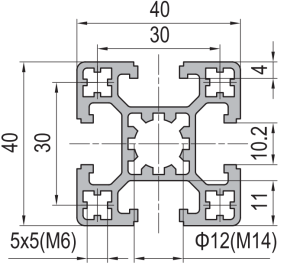 PG40 40×40 mm Four Slot Light Wall Aluminium Strut Profile Cost Optimised T-Slot Extrusion
40 x 40 mm four slot light wall PG40 aluminium strut profile in 6063-T5…
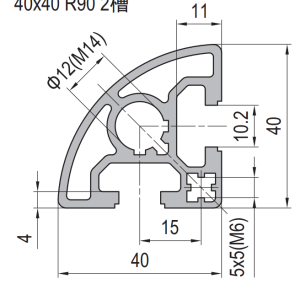 PG40 40×40 mm R90 Quarter Round Aluminium Strut Profile Radius Corner Guard Frame Extrusion
40 x 40 mm R90 quarter round PG40 aluminium strut profile in 6063-T5 with…
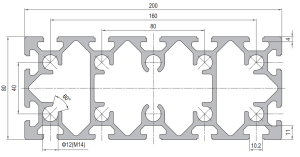 PG40 200 x 80 mm Fourteen Slot Aluminium Strut Profile Large Section Beam
A 200 x 80 mm fourteen slot PG40 aluminium strut profile at about 7.80…
 PG45 180 x 90 mm Twelve Slot Aluminium Strut Profile Heavy Duty Column
A 180 x 90 mm twelve slot PG45 aluminium strut profile at about 9.50…
 Aluminium Conduit Profile 120×60 mm Cable Duct Extrusion 2 mm Wall for Machine Wiring
120 x 60 mm aluminium conduit profile duct in 6063-T5 with a 2 mm…
 Aluminium Conduit Profile 160×80 mm Cable Duct Extrusion with Two Sided Mounting for Machine Frames
160 x 80 mm aluminium conduit profile duct in 6063-T5 with a 2 mm…
 Aluminium Conduit Profile 200×80 mm Cable Duct Extrusion 2.5 mm Wall for Long Production Line Runs
200 x 80 mm aluminium conduit profile duct in 6063-T5 with a 2.5 mm…
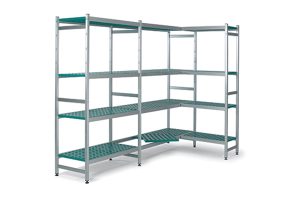 Agricultural Framework Aluminium Profile System 45×45 mm T-Slot for Shelving and Storage Racks
A bolted 45 x 45 mm T-slot aluminium profile framing system for agricultural shelving,…
