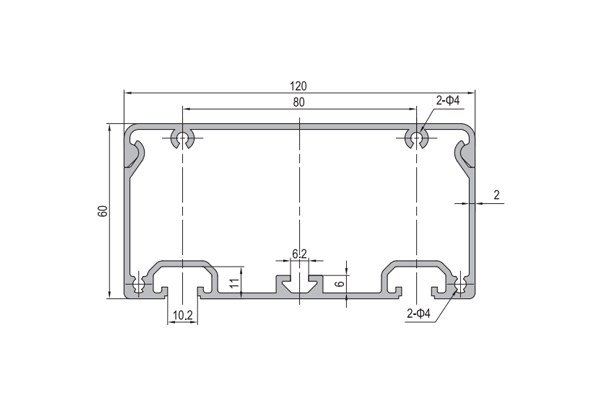
Aluminium Conduit Profile 120×60 mm Cable Duct Extrusion 2 mm Wall for Machine Wiring
120 x 60 mm aluminium conduit profile duct in 6063-T5 with a 2 mm wall and about 65 cm2 of internal area. For machine wiring where the fill ratio and the bend radius decide the section.
| Material | Aluminium |
|---|---|
| Alloy Grade | 6063-T5 |
| Temper | T5 |
| Section Size | 120 x 60 mm |
| Slot | Base slot 10.2 mm groove, 8 mm mouth, 40 series |
| Length | 6 m stock, cut to drawing to +/-0.5 mm |
| Tolerance | EN 755-9 / GB/T 6892, wall +/-0.15 mm |
| Surface | Mill finish / clear anodised / black anodised |
| MOQ | 300 |
| Lead Time | 18-28 days after deposit for mill finish |
| Loading Port | Shanghai / Ningbo |
| Supply Ability | 400 t per month |
| Payment Terms | T/T 30% deposit + 70% before shipment | L/C at sight |
| Trade Terms | FOB | CIF | EXW |
| Certifications | ISO 9001:2015 | EN 755-9 | RoHS | REACH |
Cable management · Aluminium duct
A 120 x 60 mm aluminium conduit profile is a rectangular duct with a 2 mm wall and two Ø4 mm holes through one wide face. It is extruded in 6063-T5, weighs about 1.75 kg/m and is supplied cut to length, drilled or machined. The internal cross-section is roughly 116 by 56 mm, which gives about 65 cm2 of free area.
Capacity is the question this section is usually bought to answer, and it is worth being clear about how it is worked out. A duct is almost always specified by its outside dimensions, and the outside dimensions tell you almost nothing, because they say nothing about how much of the inside is usable. What decides whether a bundle fits is the internal area, the fill ratio you are prepared to work to, and whether the cables have to be pulled through the duct or simply laid into it.
Capacity is a fill ratio, not an outside size
The fill ratio is the proportion of the internal area that the cables are allowed to occupy. A duct filled completely will not accept its own cables, because a bundle of round cables does not pack into a rectangle without gaps, and because a duct that is full cannot be added to or worked on afterwards.
Two figures cover most installations. A fill ratio of 40 per cent is the usual limit for a duct that is loaded once, closed and not revisited. A fill ratio of 25 per cent is the figure to work to where cables have to be pulled through and where more circuits will be added later, because the pull gets much harder as the duct fills.
| Fill ratio | Usable area in this duct | 8 mm OD cables | When to work to it |
|---|---|---|---|
| 25 per cent | About 16 cm2 | About 32 | Cables pulled in, or future additions |
| 30 per cent | About 20 cm2 | About 39 | Mixed pull and lay-in |
| 40 per cent | About 26 cm2 | About 52 | Loaded once and closed |
| 50 per cent | About 33 cm2 | About 65 | Only where cables are laid in, never pulled |
| Above 50 per cent | Over 33 cm2 | Over 65 | Not recommended at any time |
Working out the cable count
- List the cables and their outside diameters Take the outside diameter from the cable data sheet, not from the conductor size. A 4 mm2 conductor is nowhere near 4 mm across once the insulation and the screen are counted.
- Convert each diameter to an area The area of a round cable of diameter d is 0.785 times d squared. An 8 mm cable is about 50 mm2, which is 0.5 cm2. Add the areas rather than counting cables, because a few large cables occupy far more than the same number of small ones.
- Add a factor for the gaps between round cables Round cables in a rectangular duct leave gaps, so the bundle occupies more than the sum of the cable areas. A factor of 1.2 on the total is a reasonable allowance for a mixed bundle of round cables.
- Apply the fill ratio and compare with the internal area Take the internal area of 65 cm2, multiply by the fill ratio you have chosen, and compare. If the bundle is larger, go up a section rather than adding a second run of the same size.
| Bundle | Sum of cable areas | With the 1.2 gap factor | Fill ratio in this duct |
|---|---|---|---|
| 20 cables at 8 mm | 10 cm2 | 12 cm2 | 18 per cent |
| 40 cables at 8 mm | 20 cm2 | 24 cm2 | 37 per cent |
| 52 cables at 8 mm | 26 cm2 | 31 cm2 | 48 per cent |
| 12 cables at 12 mm | 13.6 cm2 | 16.3 cm2 | 25 per cent |
| 12 cables at 12 mm plus 20 at 8 mm | 23.6 cm2 | 28.3 cm2 | 44 per cent |
The 60 mm depth and the bend radius it allows
Depth is the dimension that catches people out, because it is not a capacity limit at all. The internal depth here is about 56 mm, and that caps the radius of any bend a cable can make inside the duct at about 28 mm. A cable cannot bend more tightly than its own minimum bend radius without being damaged, and the minimum is usually stated as a multiple of the cable diameter.
For a flexible control cable the fixed-installation minimum is typically six times the diameter. A 28 mm radius therefore suits a cable up to about 4.7 mm across and no larger. A cable that has to keep moving, such as one on a machine axis, is usually rated at ten to fifteen times the diameter, which brings the limit down to a cable of less than 3 mm.
| Cable type | Typical minimum bend radius | Largest cable for a 28 mm radius |
|---|---|---|
| Fixed flexible control cable | 6 x diameter | About 4.7 mm |
| Fixed armoured or screened cable | 8 x diameter | About 3.5 mm |
| Continuous flex cable | 10 x diameter | About 2.8 mm |
| High flex cable for a moving axis | 15 x diameter | About 1.9 mm |
The practical consequence: a 180 degree turn inside this duct is only possible for small signal cables. Larger power and control cables have to enter and leave at the ends of the run, or the duct has to be a size that gives a deeper internal section. Plan the cable entries around this before choosing the section, not after.
Separating power from signal in a duct with no divider
This section has no central partition, so power and signal cables sharing it will couple. The usual guidance is to keep them apart, and the practical options are to run two separate ducts, to fit a partition strip that divides the internal section, or to accept the coupling and use screened signal cable throughout.
Where the two have to share a duct, keep the runs to the two sides and cross them as rarely as possible and at right angles where you do. A screened signal cable with the screen earthed at one end is the usual answer where a second duct is not available, and it is cheaper than a bigger section with a divider.
Frequently asked questions
How many cables will this duct take?
The internal area is about 65 cm2. At a 40 per cent fill that is about 26 cm2 of usable area, which is roughly 52 cables of 8 mm outside diameter once the gaps between round cables are allowed for. At a 25 per cent fill for easy pulling, about 32.
What fill ratio should I work to?
40 per cent where the duct is loaded once and closed, and 25 per cent where cables are pulled through or where more circuits will be added later. Above 50 per cent is not recommended at any time.
Can I turn a cable through 180 degrees inside the duct?
Only for small cables. The internal depth is about 56 mm, which caps the radius at about 28 mm, and a flexible control cable needs six times its diameter as a minimum radius. That limits a full turn to a cable of under about 4.7 mm.
How do I keep power and signal apart?
This section has no central divider, so use two separate ducts, fit a partition strip inside the section, or run screened signal cable earthed at one end. Two ducts is the cleanest and makes later additions independent.
Do you supply it with the cable entries cut?
Yes. We cut to length, drill the Ø4 mm holes to pattern, machine the cable entry slots and openings to drawing, and supply the lid with the duct so it arrives ready to fit.
Send the cable schedule and the bend radii
Tell us the cables, their outside diameters and whether they have to bend inside the duct. We will work out the fill ratio, confirm the section and quote the duct, the cable entries, the lids and FOB pricing.
Request a QuoteRelated Products
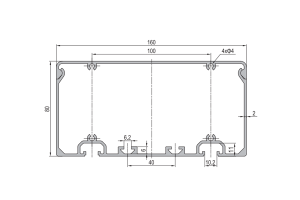 Aluminium Conduit Profile 160×80 mm Cable Duct Extrusion with Two Sided Mounting for Machine Frames
160 x 80 mm aluminium conduit profile duct in 6063-T5 with a 2 mm…
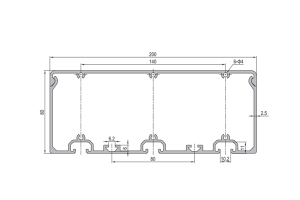 Aluminium Conduit Profile 200×80 mm Cable Duct Extrusion 2.5 mm Wall for Long Production Line Runs
200 x 80 mm aluminium conduit profile duct in 6063-T5 with a 2.5 mm…
 Agricultural Framework Aluminium Profile System 45×45 mm T-Slot for Shelving and Storage Racks
A bolted 45 x 45 mm T-slot aluminium profile framing system for agricultural shelving,…
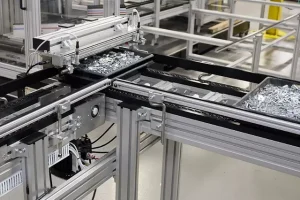 Conveyor System Aluminium Profile Extrusion Frame 45×60 mm for Belt and Roller Lines
A bolted conveyor frame in 45 x 60 mm T-slot aluminium profile with 45…
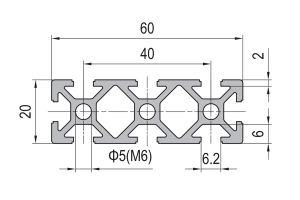 PG20 60 x 20 mm Eight Slot Aluminium Strut Profile Wide Miniature Rail
60 x 20 mm eight-slot aluminium strut profile with 6.2 mm grooves on a…
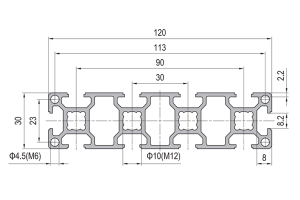 PG30 120 x 30 mm Ten Slot Aluminium Strut Profile Wide Multi Slot Rail
A 120 x 30 mm ten slot PG30 aluminium strut profile wide beam with…
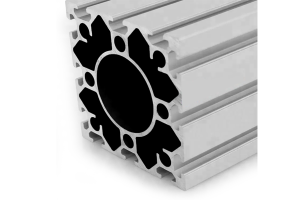 PG40 120×120 mm Twelve Slot Aluminium Strut Profile with 62 mm Centre Bore
A 120 x 120 mm twelve slot PG40 aluminium strut profile with a 62…
 PG40 160×80 mm Twelve Slot Aluminium Strut Profile Heavy Beam for Gantry Frames
A 160 x 80 mm twelve slot PG40 aluminium strut profile heavy beam with…
