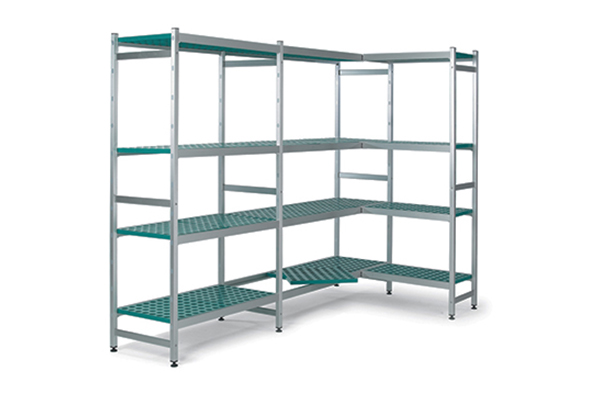
Agricultural Framework Aluminium Profile System 45×45 mm T-Slot for Shelving and Storage Racks
A bolted 45 x 45 mm T-slot aluminium profile framing system for agricultural shelving, feed stores and wash-down storage racks. Cut to a bay cutting list with all T-slot hardware supplied.
| Material | Aluminium |
|---|---|
| Alloy Grade | 6063-T5 |
| Temper | T5 |
| Section Size | 45 x 45 mm post, 45 x 60 and 50 x 50 mm beams |
| Slot | 10 mm groove, M8 and M10 slot nuts, 45 mm pitch, 4 faces |
| Length | 6 m stock, cut to a bay cutting list to +/-0.5 mm |
| Tolerance | EN 755-9 / GB/T 6892, wall +/-0.15 mm |
| Surface | Mill finish / clear anodised / black anodised |
| MOQ | 100 |
| Lead Time | 18-28 days after deposit for mill finish |
| Loading Port | Shanghai / Ningbo |
| Supply Ability | 300 t per month |
| Payment Terms | T/T 30% deposit + 70% before shipment | L/C at sight |
| Trade Terms | FOB | CIF | EXW |
| Certifications | ISO 9001:2015 | EN 755-9 | RoHS | REACH |
Framing systems · Agricultural storage structures
An agricultural framework aluminium profile system is a bolted frame built from 45 x 45 mm four slot T-slot extrusion, used for shelving racks, feed stores, chemical stores and wash-down storage in livestock and crop buildings. The post is a standard 45 x 45 mm section weighing about 2.55 kg/m with a second moment of area of about 15.5 cm4; the shelf beams are cut from the same family in 45 x 45, 45 x 60 or 50 x 50 mm. Everything is bolted with T-slot hardware, so the rack can be re-configured on site with a hex key and no welding.
A farm rack is not a shelf, it is a structure, and it fails in a different way from the way people expect. The post almost never crushes — a 45 x 45 mm aluminium post has more than an order of magnitude of crushing strength in reserve. What governs is the deflection of the shelf beam under load and, on a tall free-standing rack, the buckling of the post. Both are calculated below, and both are governed by the span rather than by the material.
The post is not the weak point — but check it anyway
The buckling load of a post follows the Euler formula, with the second moment of area of the 45 x 45 mm four slot section at about 15.5 cm4 and Young’s modulus for aluminium at 70,000 N/mm2. The factor that matters is how the post is held at the ends. A post that is braced in both directions by shelf beams behaves as pinned at both ends and the effective length equals the actual height. A free-standing post with a fixed base and nothing holding the top behaves as fixed-free, and its effective length is double — which quarters the buckling load.
| Post height | Pinned-pinned (K = 1) | Fixed-free (K = 2) | Allowable at safety factor 3, K = 1 |
|---|---|---|---|
| 1.5 m | approx. 47.6 kN | approx. 11.9 kN | approx. 15.9 kN |
| 2.0 m | approx. 26.8 kN | approx. 6.7 kN | approx. 8.9 kN |
| 2.5 m | approx. 17.1 kN | approx. 4.3 kN | approx. 5.7 kN |
| 3.0 m | approx. 11.9 kN | approx. 3.0 kN | approx. 4.0 kN |
Read that table twice, because the message is counter-intuitive. Even the worst case — a 3 m post with no top restraint at all — carries 3 kN before it buckles, which is 300 kg on one post. A four post rack with levels every 600 mm will therefore never buckle its posts in a normal store. The post check exists to catch the two cases where it does matter: a very tall rack over 3 m with no diagonal bracing, and a rack that gets side-loaded by a tractor or a telehandler.
Diagonal bracing is the cheap insurance. One pair of diagonals in the back plane of a tall rack turns a fixed-free post into a pinned one and multiplies the buckling load by four. On any rack over 2.5 m high, brace the back plane.
The shelf beam is what actually decides the design
The beam carries the shelf load and it deflects. For storage the usual working limit is span divided by 200 — a 1.2 m beam may sag 6 mm at full load. Working backwards from that limit gives the second moment of area the beam needs, and that number is the whole design. The table below is computed for a uniformly distributed load on a simply supported beam, which is the right model for a shelf full of sacks or crates.
| Shelf beam span | 150 kg per level | 300 kg per level | 500 kg per level |
|---|---|---|---|
| 0.9 m | 4.4 cm4 | 8.9 cm4 | 14.8 cm4 |
| 1.2 m | 7.9 cm4 | 15.8 cm4 | 26.3 cm4 |
| 1.5 m | 12.3 cm4 | 24.6 cm4 | 41.1 cm4 |
Now compare those numbers with what the catalogue actually offers, and the choice becomes a lookup rather than a guess. Note that the second moment of area has to be taken about the axis that is doing the bending: a 45 x 60 mm beam laid on edge uses its 31 cm4 figure, laid flat it uses only 21 cm4, and that difference alone decides whether a 1.5 m shelf passes or fails.
| Required second moment of area | Beam to use | Why |
|---|---|---|
| Up to 12 cm4 | 45 x 45 mm four slot (15.5 cm4) | The standard post section doubles as the lightest shelf beam. |
| 12 to 20 cm4 | 45 x 45 mm heavy (19.5 cm4) | Same 45 mm face, thicker wall, no change to the node hardware. |
| 20 to 26 cm4 | 50 x 50 mm four slot (25 cm4) or 60 x 60 mm four slot (26 cm4) | Both pass; 50 x 50 at 3.1 kg/m is the lighter of the two. |
| 26 to 40 cm4 | 45 x 60 mm on edge (31 cm4) or 60 x 60 mm heavy (38 cm4) | Lay the rectangular beam on edge — flat it only gives 21 cm4. |
| Over 40 cm4 | 100 x 50 mm two slot heavy on edge (150 cm4) | Use a deeper beam rather than a heavier one; depth is what buys stiffness. |
What a livestock building does to the frame
The structural calculation is the easy part in a farm building. What actually shortens the life of an aluminium rack is the environment, and it attacks three things: the oxide film, the fasteners and the joints.
Ammonia is the first problem. Aluminium is naturally protected by a thin oxide layer, but that layer is amphoteric — it is attacked both by strong alkalis and by strong acids, and ammonia solutions are alkaline. A bare mill finish will show surface staining and pitting within a season in a poultry or pig building. Anodising builds that natural film up to a controlled thickness and is the correct answer here.
| Environment | Frame requirement | Fastener requirement |
|---|---|---|
| Dry grain or feed store | Mill finish is adequate | Zinc plated steel is acceptable indoors |
| General livestock housing | Clear anodised, 15 micron minimum | A2 stainless (304) or isolated steel |
| Poultry or pig house with ammonia | Clear anodised, 20 micron minimum | A2 stainless, no bare steel in the joint |
| Wash-down with alkaline detergent | Anodised 20 to 25 micron, sealed | A4 stainless (316) for the wet zones |
| Outdoor, coastal or silage clamp | Anodised 20 to 25 micron | A4 stainless throughout |
The second problem is galvanic corrosion. Aluminium sits well below steel in the galvanic series, and in a wet building a bare steel bolt in an aluminium slot becomes a small battery. The steel is protected and the aluminium around it is consumed. The fix is either to use stainless fasteners or, where steel is unavoidable, to break the electrical path with a nylon washer or an isolating sleeve. It is a cheap detail that decides whether a rack lasts three years or fifteen.
The third is thermal movement, and it is the one people forget on long runs. Aluminium expands at about 23 parts per million per kelvin. A 30 m long rack in a building that swings 40 K between a winter night and a summer afternoon will grow and shrink by roughly 28 mm. A rack bolted solidly end to end with no allowance will either distort or tear its fixings. Leave a slotted joint or a deliberate gap every 6 m of run.
Building the rack
- Fix the levels before you cut anything Shelf pitch is set by what goes on the shelf, not by a round number. Measure the tallest crate or sack and add the clearance you need to lift it in and out with a forklift or by hand.
- Cut the posts as a set Cut all four posts of a bay to the same length in one pass and mark them so they stay together. A rack whose posts differ by 2 mm will not sit flat and the error shows up as a rocking shelf.
- Assemble the two end frames flat on the floor first Build each end frame — two posts plus the shelf beams — as a flat rectangle on the ground, then stand them up and join them with the front and back beams. Assembling a rack in the air is how bolts end up not reaching their slots.
- Fit the diagonals before loading anything Put the back-plane diagonals in while the frame is still empty and square. Once shelves are loaded it is very hard to pull a rack back into square.
- Level the feet on the finished floor, not on the slab Adjustable feet are set after the rack is standing, using a spirit level on the top beams. This is the last operation, not the first.
Frequently asked questions
Why aluminium rather than galvanised steel for a farm rack?
Weight and re-configurability. An aluminium rack can be moved, extended and re-levelled by two people with a hex key, and it never needs repainting. Galvanised steel is cheaper per kilogram and stiffer, so for a large fixed rack in a dry store steel can still win on price.
How thick should the anodising be?
15 micron is the practical minimum indoors, 20 micron for a livestock building where ammonia is present, and 20 to 25 micron for anything that gets washed down with detergent. Thicker than 25 micron is rarely worth the cost on a structural frame.
Can I use stainless bolts in an aluminium slot?
Yes, and you should in any wet or ammonia environment. Stainless is close enough to aluminium in the galvanic series that the couple is mild. Avoid bare carbon steel or zinc plated bolts in wet areas, and never mix steel and stainless in the same joint.
What shelf load can one bay carry?
That is a beam question, not a post question. Take the shelf span and the load per level from the table above to find the beam you need, then check the total against the post table. For most farm stores the beam governs by a wide margin.
Do you supply the rack as a kit or as lengths?
Either. We cut the posts and beams to your cutting list with a tolerance of plus or minus 0.5 mm and supply the T-slot hardware, feet and end caps bagged per bay. Send the bay layout and we will quote the kit.
Send the bay layout and the shelf load
Tell us the rack height, the shelf span, the load per level and what the building environment is. We will size the posts and beams, specify the anodising and quote the kit as a cutting list.
Request a QuoteRelated Products
 Assembly Line Workstation Aluminium Profile Frame 40×40 mm T-Slot Workbench Structure
A re-configurable assembly workstation frame in 40 x 40 mm T-slot aluminium profile with…
 Conveyor System Aluminium Profile Extrusion Frame 45×60 mm for Belt and Roller Lines
A bolted conveyor frame in 45 x 60 mm T-slot aluminium profile with 45…
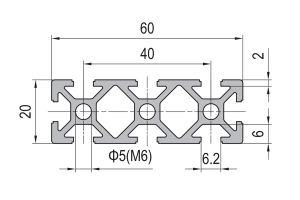 PG20 60 x 20 mm Eight Slot Aluminium Strut Profile Wide Miniature Rail
60 x 20 mm eight-slot aluminium strut profile with 6.2 mm grooves on a…
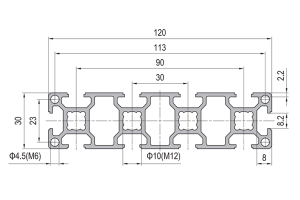 PG30 120 x 30 mm Ten Slot Aluminium Strut Profile Wide Multi Slot Rail
A 120 x 30 mm ten slot PG30 aluminium strut profile wide beam with…
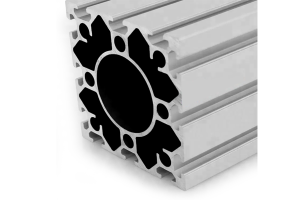 PG40 120×120 mm Twelve Slot Aluminium Strut Profile with 62 mm Centre Bore
A 120 x 120 mm twelve slot PG40 aluminium strut profile with a 62…
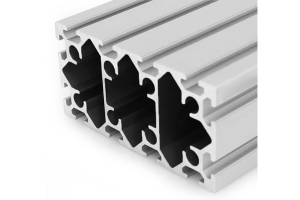 PG40 160×80 mm Twelve Slot Aluminium Strut Profile Heavy Beam for Gantry Frames
A 160 x 80 mm twelve slot PG40 aluminium strut profile heavy beam with…
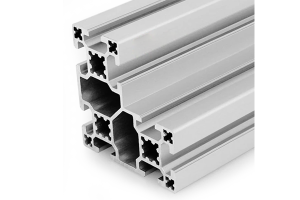 PG40 80×80 mm L-Shape Eight Slot Aluminium Strut Profile Corner Section
An 80 x 80 mm L-shape eight slot PG40 aluminium strut profile corner section…
 PG40 80×80 mm Eight Slot Heavy Aluminium Strut Profile High Load Column
An 80 x 80 mm eight slot heavy PG40 aluminium strut profile with diamond…
