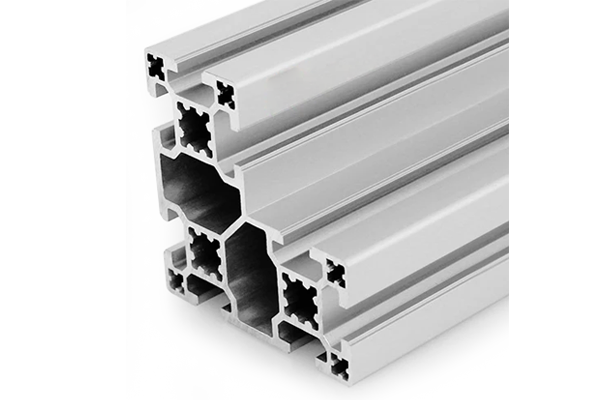
PG40 80×80 mm L-Shape Eight Slot Aluminium Strut Profile Corner Section
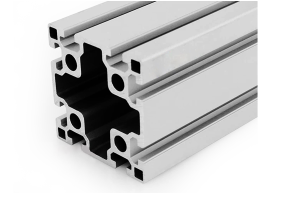
An 80 x 80 mm L-shape eight slot PG40 aluminium strut profile corner section that forms two faces of a column at once, removing the corner node entirely.
| Material | Aluminium |
|---|---|
| Alloy Grade | 6063-T5 |
| Temper | T5 |
| Section Size | 80 x 80 mm L cross section |
| Slot | 8 x 10.2 mm groove, 8 mm mouth, 40 mm pitch, outer pair 40 mm apart, M8 |
| Length | 6 m stock, cut to drawing to +/-0.5 mm |
| Tolerance | EN 755-9 / GB/T 6892, wall +/-0.15 mm |
| Surface | Mill finish / clear anodised / black anodised |
| MOQ | 200 |
| Lead Time | 20-30 days after deposit for mill finish |
| Loading Port | Shanghai / Ningbo |
| Supply Ability | 250 t per month |
| Payment Terms | T/T 30% deposit + 70% before shipment | L/C at sight |
| Trade Terms | FOB | CIF | EXW |
| Certifications | ISO 9001:2015 | EN 755-9 | RoHS | REACH |
Structural framing · PG40 corner section
A PG40 80 x 80 mm L-shape eight slot aluminium strut profile is a corner section that forms two faces of a square column at right angles. It has eight 10.2 mm slots on a 40 mm pitch with an 8 mm mouth taking 40 series M8 hardware, 5 x 5 mm corner holes tapped M6 and a Ø12 mm bore tapped M14. The flange is 4 mm, the web 11 mm, the outer slots are 40 mm apart and the section weighs about 3.4 kg/m.
What makes the L section useful is that it removes a node. A conventional corner needs two square columns meeting at right angles, a bracket or a joining plate to hold them, and the labour to assemble it. The L section is one member that already is the corner, so the joint disappears. What it brings instead is eccentricity: the centre of the section is not the centre of the 80 x 80 envelope, and that offset has to be dealt with.
One member instead of two, and no node
Compare the two ways of building a corner of a cabinet, a guard or a machine enclosure. The conventional way uses two square 40 x 40 mm columns, cut to length, plus a bracket or a joining plate at the corner, plus the bolts. The L section does it with one member cut to length and bolted to the members above and below it.
| Two square columns plus a node | One L section | |
|---|---|---|
| Members at the corner | 2 | 1 |
| Corner connection hardware | Bracket or joining plate plus bolts | None |
| Assembly operations | Two members aligned and clamped, then jointed | One member positioned |
| Outer surface | Two members with a seam at the corner | Continuous, no seam on either outer face |
| Weakness | The joint is the weak point | No joint to be weak |
The seam is the part that matters visually. On two square members meeting at a corner there is a visible line where they meet, and unless both are cut and aligned perfectly it is also a visible step. An L section has a continuous outer surface on both faces, which is why it turns up on door frames, display frames and enclosures where the corner is on show.
The price: the section is eccentric
The centroid of an L is not where you would expect. Take an 80 x 80 mm L with 4 mm legs: the area is about 624 mm2 and the centroid sits roughly 20 mm in from each of the two outer faces. The geometric centre of the 80 x 80 envelope is 40 mm from each face, so the centroid is offset by about 28 mm along the 45 degree diagonal — toward the corner.
That offset matters because loads rarely act through the centroid. A load applied at the geometric centre of the envelope, which is where a designer naturally puts it, is 28 mm eccentric. The eccentricity turns the load into a load plus a moment, and the moment has to be carried by the section and by the connection at the ends.
An L is stiff, but not about the axis you think. The principal axes of an L are rotated 45 degrees to the legs. Its stiffness about the two leg directions is not the same as its stiffness about the diagonals, so a simple square-section calculation will be wrong. Send us the load case and we will confirm the section.
Three ways to handle the eccentricity
The one approach to avoid is ignoring it. An L section carrying a load at its geometric centre is a member in combined bending and compression, and a frame designed as though the load were concentric will show the error as a lean rather than as a failure — the frame will stand, but it will not be straight.
Using an L section well
- Decide which two faces are the outer ones The L has two legs and therefore two outer faces. Work out which two sides of the finished structure they are before you order, because the slots are arranged around the legs.
- Put the structural connection in the M14 bore The Ø12 mm bore tapped M14 is the strongest fixing in the section. Use it for the load-bearing end connection and keep the slots for panels and trim.
- Keep the load near the corner The centroid is close to the corner, so a load applied near the inside corner is much closer to concentric than one applied near the open ends of the legs.
- Close the open side if it is visible The L leaves one side of the column open. On a visible frame, close it with a cover profile or a flat panel, or accept the open slot as a design feature.
- Check the frame for lean, not just for strength Because the section is eccentric, the symptom of an error is a frame that leans rather than one that fails. Check verticality after assembly, not just that everything is tight.
Frequently asked questions
Where would I use an L section rather than two square columns?
Anywhere a corner is visible, and anywhere the node count matters. Door and window frames, machine enclosure corners, display frames and cabinet corners are the usual applications.
How much weaker is it than two 40 x 40 mm columns?
It is not weaker, it is differently shaped. The L has more material in the corner, where a corner joint needs it, and no joint to fail. Its limit is the eccentricity, not the section.
Can I bolt panels into the open side?
Yes. The slots on the inside of the legs are accessible and take standard 40 series hardware, so a panel can be fixed from the inside face.
Does the L come in other sizes?
The 45 series range includes a 90 x 90 mm L section. Tell us the envelope you need and we will confirm what is available or quote a custom die.
Can you supply it mitred?
Yes. We cut and mitre to your cutting list, and we can supply the corner already formed if you send the frame drawing.
Send the corner detail and the load position
Tell us which two faces of the structure the L has to form and where the load acts. We will confirm the section, suggest how to deal with the eccentricity and quote cut or mitred lengths.
Request a QuoteRelated Products
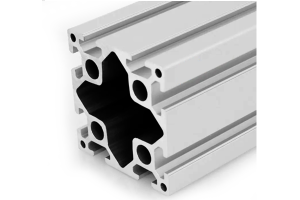 PG40 80×80 mm Eight Slot Heavy Aluminium Strut Profile High Load Column
An 80 x 80 mm eight slot heavy PG40 aluminium strut profile with diamond…
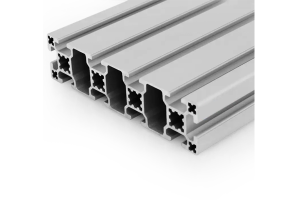 PG40 160×40 mm Ten Slot Aluminium Strut Profile Wide Beam for Overhead Rails
A 160 x 40 mm ten slot PG40 aluminium strut profile wide beam with…
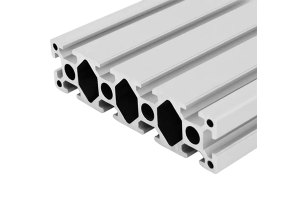 PG40 160×40 mm Ten Slot Heavy Aluminium Strut Profile for Cantilever Arms
A 160 x 40 mm ten slot heavy PG40 aluminium strut profile with round…
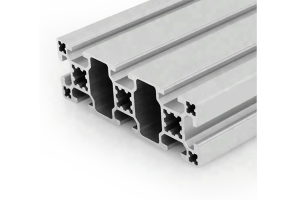 PG40 120×40 mm Eight Slot Aluminium Strut Profile Standard Beam for Table Frames
A 120 x 40 mm eight slot PG40 aluminium strut profile standard beam with…
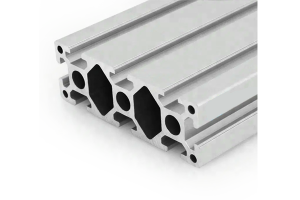 PG40 120×40 mm Eight Slot Heavy Aluminium Strut Profile for Machine Bases
A 120 x 40 mm eight slot heavy PG40 aluminium strut profile with round…
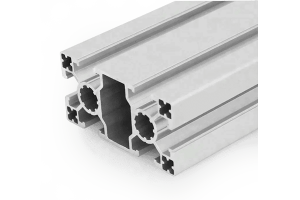 PG40 80×40 mm Six Slot Super Light Aluminium Strut Profile for Enclosures
An 80 x 40 mm six slot super light PG40 aluminium strut profile with…
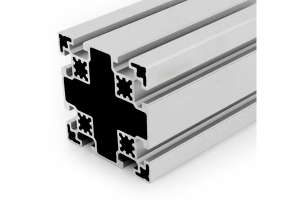 PG45 90×90 mm Eight Slot Aluminium Strut Profile M10 Column Section
A 90 x 90 mm eight slot PG45 aluminium strut profile with 8 x…
 PG45 90×90 mm Eight Slot Heavy Aluminium Strut Profile for Heavy Machinery Frames
A 90 x 90 mm eight slot heavy PG45 aluminium strut profile with thicker…
